By Staff Reporter
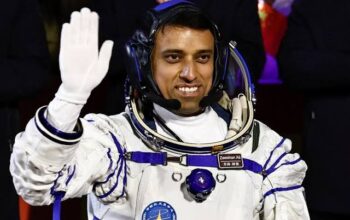
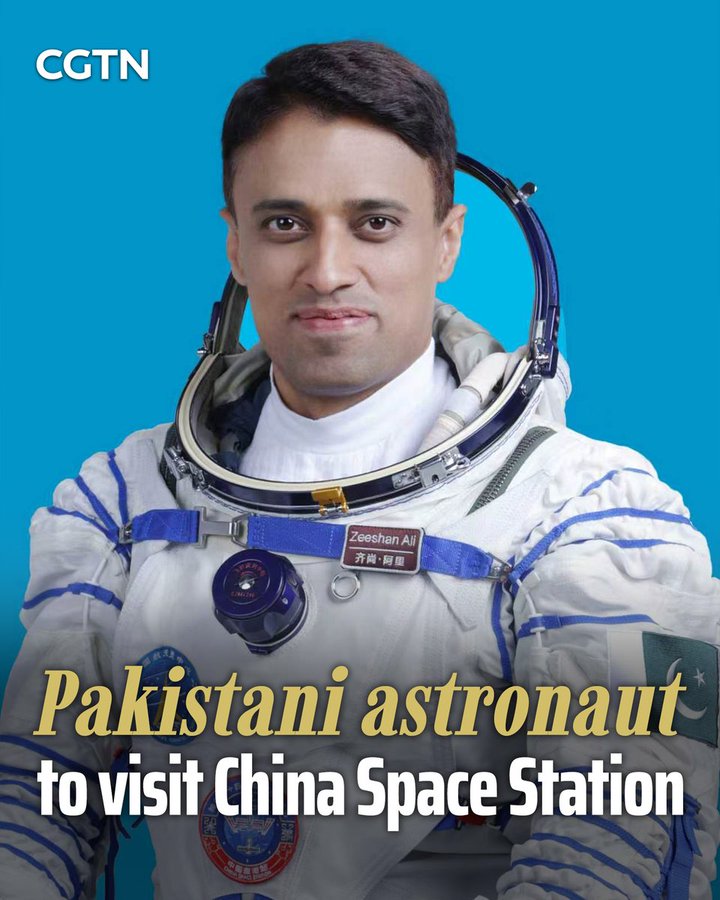
ISLAMABAD: Pakistan will send its first astronaut into orbit on Wednesday, when Muhammad Zeeshan Ali becomes the first foreign national to fly to China’s Tiangong space station.
The 8.18am Beijing time (5.18am Pakistan time) launch of the Shenzhou-24 spacecraft, aboard a Long March-2F rocket from the Jiuquan Satellite Launch Centre in north-western China, will be the first joint mission of Chinese and foreign astronauts in the country’s history.
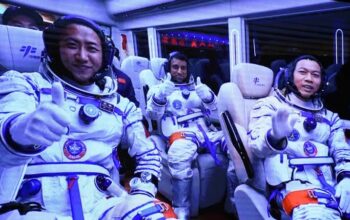
The China Manned Space Agency (CMSA) named the three-member crew at a press conference at the launch centre on Tuesday. Ali, a pilot, will fly as payload specialist under the command of Tang Hongbo, 51, a veteran of China’s space programme. The third crew member is Wu Yi, who is in his late thirties and making his first spaceflight.
“Pakistani astronaut Mohammad Zeeshan Ali is the first foreign national to visit Tiangong,” said CMSA spokesperson Zhang Jingbo. The Chinese foreign ministry described him as the first international crew member to join China’s manned space programme.
Zhang said the rocket would soon be filled with propellant. “The crew is in good condition and the space station is functioning normally, meeting all requirements for the mission.”
Ali is expected to spend about a week in orbit. The crew will carry out around 90 experiments, as well as routine maintenance of the station and the handover to the Shenzhou-23 crew, who docked with Tiangong in May.
Ali will return to Earth with two of that crew, Lai Ka-ying, Hong Kong’s first astronaut and the only woman currently aboard, and Zhang Zhiyuan. Their commander, Zhu Yangzhu, will remain to complete China’s first full-year stay in space, a test of endurance considered critical to its lunar and deep-space ambitions.
Ali told a press briefing that he felt the weight of the occasion. “I am not flying for myself,” he said. “I carry the name of Pakistan on my shoulder, the hopes of 250 million Pakistanis.”
He said the mission would turn a dream into reality. “Now, this dream belongs to me and also belongs to Pakistan.”
Ali message to Pakistani children was simple. “Just look up at the sky and remember that I am up there with your dreams,” he said.
“This mission is not a finish line; it is a launch pad,” Ali said, adding that he hoped cooperation would grow “from one astronaut, one flight to multiple joint flights, to the Moon, Mars and beyond”.
To his family, he made a personal promise. “Whenever I look back at the Earth for the first time, I will always search for the light of our home before I look at anything else,” he said. “No matter how far I fly, we will still share the same Moon, and I will still be looking back at the same Earth.”
He said he would take handwritten letters from his children and his father on the journey.
Ali was chosen with a fellow candidate, Khurram Daud, under an agreement signed by Pakistan’s space agency, Suparco, and the CMSA in February 2025. Both men began training in China in April.
Planning Minister Ahsan Iqbal, who is in China for the launch, said the pair were selected “from among Pakistan’s finest pilots and scientists”. “They trained in centrifuges and simulators, in emergency drills and in a new language,” he said. “Both performed exceptionally well in training. Though Zeeshan Ali will fly tomorrow, both have already made Pakistan proud.”
Ali said the planned one-year training course had been compressed into seven months. The hardest part, he said, was not the physical or technical demands but language. “Learning the Chinese language is the key to the hearts of Chinese people,” he said, adding that he can now speak to his crewmates in Chinese.
He described that bond in the language of the two countries’ diplomacy. “We trained side by side, and our friendship embodies the friendship between China and Pakistan: higher than the mountains, deeper than the oceans, sweeter than honey and as vast as outer space.” He noted that 2026 marks 75 years of both diplomatic relations and space cooperation between the two countries. “Together with my Chinese crewmates, I will show that this friendship is real, not only on paper, but also in orbit.”
Ali will also carry Pakistan’s own scientific programme into orbit. It consists of four experiments developed by Pakistani researchers, covering materials science, fluid physics, life sciences and biotechnology, with possible applications in climate resilience, food security and industry.
One will test whether microalgae can be grown in small “green micro-factories” as a source of nutrients and oxygen on long-duration missions. The other three will be mounted outside the station and exposed to space for a year. They will examine whether quinoa seeds survive microgravity and cosmic radiation, whether microcapsule-based composites can repair themselves after damage, and how hybrid composite materials cope with vacuum, radiation and extreme temperatures.
The work is being carried out with the Centre for Space Utilisation, the Shanghai Institute of Technical Physics, Dalian Maritime University and Shanghai Jiao Tong University.
Tiangong orbits about 400km (248 miles) above Earth. China launched its Tianhe core module in April 2021 and added the Wentian and Mengtian laboratory modules in July and October 2022, completing the three-module station that November. Shenzhou-24 is the 41st mission of China’s crewed space programme and the eighth crewed flight in the station’s operational phase.
In Islamabad, Prime Minister Shehbaz Sharif said Pakistan stood on the “threshold of a historic first”. “Tomorrow, Pakistan will look to the skies with anticipation, pride and deep gratitude,” he wrote on X. “It is a moment that belongs to every Pakistani.”
He thanked Chinese President Xi Jinping, whose “visionary” leadership, he said, had taken the relationship to an “unprecedented height”. “Pakistan-China friendship is surpassing the heights of the Himalayas, in its journey to outer space,” he said.
The flight carries strategic weight as well as national pride. Beijing has invested heavily in its space programme in recent years, closing the gap with its main rival, the United States, and aims to land astronauts on the Moon by 2030. China has been excluded from the International Space Station since 2011, when the US barred Nasa from working with Chinese space agencies, and has since sought partners elsewhere. Pakistan, a close ally of decades’ standing, and China’s largest trading partner and a major foreign investor in the country, is a natural choice.
Copyright © 2021 Independent Pakistan | All rights reserved