By Staff Reporter
ISLAMABAD: Prime Minister Shehbaz Sharif has promised Khyber Pakhtunkhwa’s governor the full backing of the federal government in the fight against terrorism, six weeks after Islamabad placed the province under emergency and governor’s rule.
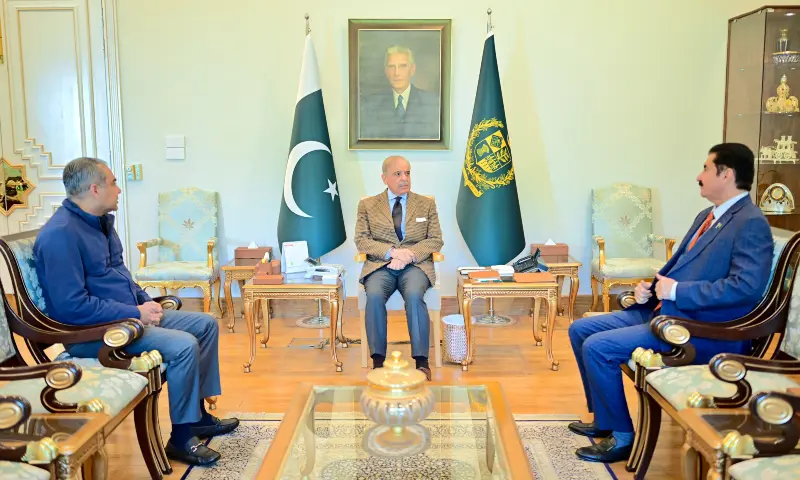
Sharif gave the assurance on Tuesday at a meeting at PM House in Islamabad with Governor Faisal Karim Kundi, also attended by Interior Minister Mohsin Naqvi, according to a statement the Prime Minister’s Office (PMO) issued on X.
The federal government would continue to “fully support the implementation of the decisions taken at the apex committee meeting to completely eliminate terrorism”, Sharif was quoted as saying. He told the governor the sacrifices of the security forces and the provincial police would not go in vain.
The PMO said the prime minister also pledged all possible resources to give people in the province healthcare, education and other basic facilities. He directed that special attention go to social development indicators, and said sports facilities should be promoted so young people had constructive activities.
Kundi briefed him on the efforts of his office and the KP Advisory Council to improve law and order. Separately, he met President Asif Ali Zardari and briefed him on the situation since October 11, with particular attention to security, the President’s Office said.
The meetings came days after the president’s office confirmed he had promulgated five ordinances covering the province. One of them strips the KP Provincial Assembly’s privileges law of 21 of its 40 sections, including the protection that shielded members from preventive detention. Two others create executive committees to oversee “special initiatives”, including development schemes, in 12 designated districts and across the rest of the province, with the power to recommend military formations as executing agencies. The prime minister nominates the members of the committee for the designated districts, and the governor those for the remainder.
Chief Minister Sohail Afridi, whose role has been rendered non-functional by governor’s rule, Speaker Babar Saleem Swati and other lawmakers have been in preventive detention since the emergency began, according to police. Kundi said last month that they had been placed under house arrest.
On November 3, the District and Sessions Court in Islamabad upheld non-bailable arrest warrants against the chief minister over his repeated absence from proceedings in a case involving allegations against state institutions. Opposition leaders in the National Assembly and Senate have since asked the Federal Constitutional Court to order the release of Afridi and other detained lawmakers. They also want the court to recall its November 5 order suspending proceedings that challenge the emergency and governor’s rule. Afridi has not been seen publicly since the federal government acted.
The Centre imposed emergency and governor’s rule on October 11 under Articles 232 and 234 of the Constitution, citing the provincial government’s “deliberate disengagement” from the fight against terrorism and a deteriorating law and order situation. Parliament endorsed the move amid protests by the opposition. On October 22, Sharif chaired a meeting of the federal apex committee in Peshawar, vowing to take tough decisions.
The security picture remains grim. A assessment presented to the federal cabinet found that terrorist incidents in the province rose by 195 per cent between March 1, 2024 and September 23, 2026. It said 73 percent of this year’s attacks targeted police and security personnel, and that militants were increasingly using drones and other advanced technology. The police and the Counter-Terrorism Department (CTD) still lack trained personnel, modern weapons and operational equipment.
On November 8, as Kundi called for greater political ownership of the fight against terrorism, the provincial government announced a plan to strengthen both forces. It proposed Rs59.8bn for the police and Rs10.3bn for the CTD, according to Adviser for Home and Tribal Affairs Kifayatullah Khan and Home Secretary Amjad Ali Khan.
On November 20, Field Marshal Asim Munir, Chief of Defence Forces and Chief of Army Staff, visited Miran Shah in North Waziristan. According to the military’s media wing, he reaffirmed the security forces’ resolve to “decisively eliminate terrorism” and preserve the “hard-earned peace and stability” of the province.
Copyright © 2021 Independent Pakistan | All rights reserved