By Staff Reporter
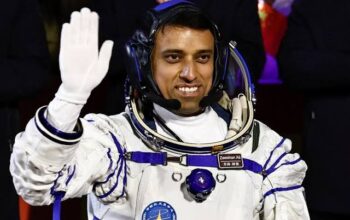
ISLAMABAD: Zeeshan Ali has become the first Pakistani in space and the first foreigner to reach China’s Tiangong space station, docking less than four hours after launch.
The Shenzhou-24 spacecraft linked up with the station three hours and 38 minutes after liftoff, the China Manned Space Agency (CMSA) confirmed on Wednesday. The South China Morning Post reported that the crew entered the station’s main module once safety procedures were complete.
The Long March 2-F rocket left the Jiuquan Satellite Launch Centre in north-west China at 8.18am Beijing time (5.18am in Pakistan), rising through flame and smoke under a pink sky, according to footage from state broadcaster CCTV. The capsule separated from the rocket about 10 minutes later and reached its planned orbit.
“The spacecraft is functioning well. I declare the Shenzhou-24 launch mission a complete success,” an official at the launch centre announced.
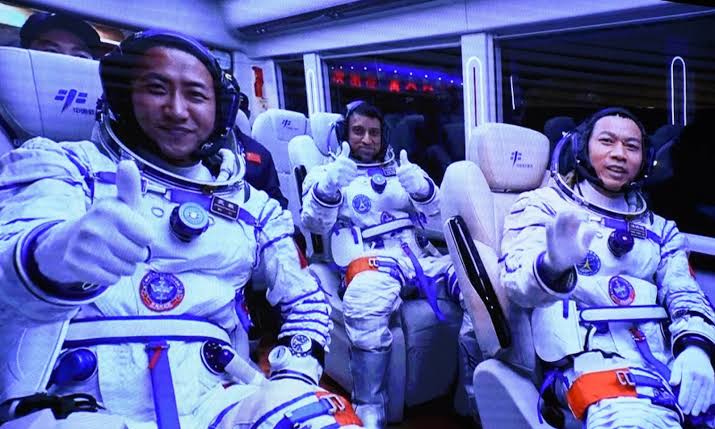
Ali, 40, is the payload specialist on a three-man crew commanded by Tang Hongbo, with Wu Yi as pilot. It is the first joint flight of Chinese and foreign astronauts in the history of China’s crewed space programme.
At a press briefing on Tuesday, Ali framed the flight as a beginning rather than an end.
“This mission is not a finish line; it is a launch pad,” he said. “And I hope the next chapter of China-Pakistan space cooperation will grow from one astronaut, one flight to multiple joint flights, to the Moon, Mars and beyond.”
He said he was carrying the “hopes of 250 million Pakistanis”. “I am not flying for myself. I carry the name of Pakistan on my shoulders,” Ali said. “To every child who is watching while I am in orbit, just look up at the sky and remember that I am up there with your dreams.”
His message to his family was more personal. He said he would travel farther from home than ever before, but promised that “whenever I look back at the Earth for the first time, I will always search for the light of our home before I look at anything else”.
“No matter how far I fly, we will still share the same Moon, and I will still be looking back at the same Earth.”
Ali spent seven months training in Beijing, including intensive Chinese-language classes. He learned Chinese songs, read Chinese poetry, practised calligraphy and played table tennis. He and a fellow Pakistani, Khurram Daud, began training in China in April under a cooperation agreement between Pakistan’s space agency, Suparco, and the CMSA, signed in February 2025. Daud was the backup and did not fly.
Prime Minister Shehbaz Sharif said “today Pakistan has begun its journey beyond the stars”. He told young Pakistanis: “If a Pakistani can reach a space station today, tomorrow a Pakistani will reach the moon too.”
Planning Minister Ahsan Iqbal, who watched the launch at Jiuquan with a Pakistani delegation, said he had first proposed the idea to Chinese counterparts in 2017-18. He wanted cooperation under the China-Pakistan Economic Corridor to extend into space once the road and infrastructure projects were finished.
“From highways to information superhighways, and now to skyways, Pakistan-China friendship and CPEC are rising even higher than the skies,” Iqbal said. He added that the flight showed “how developing countries can cooperate to have capability in areas which are very critical for future economic development”.
President Asif Ali Zardari and Chinese president Xi Jinping exchanged letters on the flight.
Xi wrote that astronauts from both countries “joining hands in the quest for the universe represents a living testament to their deep-rooted friendship”. He called the Chinese station “an ark of peace, friendship and cooperation”.
Zardari thanked China for choosing Pakistan as its first foreign partner in the crewed programme. He said the achievement would “inspire generations of young Pakistanis to pursue excellence in scientific research, innovation and technological advancement”.
Ali’s stay will be short by Chinese standards, where six-month rotations are the norm. Reports vary on the length, from about five days to 10. He will return to Earth aboard the Shenzhou-23 capsule with two of its crew, Zhang Zhiyuan and Lai Ka-ying, the latter the first astronaut from Hong Kong.
Shenzhou-23 commander Zhu Yangzhu will stay on at Tiangong to complete a year-long mission. He will hold the record for the longest single stay in orbit by a Chinese astronaut by the time he leaves. The study is meant to show how the human body copes with extended spaceflight, a necessary step towards China’s planned crewed Moon landing and a possible journey to Mars. Tang and Wu will remain in orbit for about six months.
The CMSA says the crew will carry out more than 90 experiments, covering space life sciences, materials, microgravity fluid physics, combustion, fundamental physics and space medicine. Four of them are joint China-Pakistan projects in biotechnology and materials.
Ali will work on photosynthetic cyanobacteria and, according to Suparco, microalgae as a possible source of food and oxygen for future missions. He will also test how spaceflight affects quinoa seeds. Another experiment will examine whether self-healing carbon fibre composites can repair small cracks in spacecraft.
The flight carries diplomatic weight beyond the science. China has promoted Tiangong, fully operational since late 2022, as a hub for international cooperation, while the Nasa-led International Space Station faces possible retirement by 2030. Beijing has poured billions into its space programme and aims to land astronauts on the Moon before 2030. The US is racing it with its Artemis programme, targeting 2028.
Space cooperation between China and Pakistan dates back to the early 1990s. China has launched Pakistani satellites, and a Pakistani-built rover is due to fly on a Chinese lunar mission around 2028.
Copyright © 2021 Independent Pakistan | All rights reserved