By Staff Reporter
ISLAMABAD: Pakistan has asked China to open its market to Pakistani goods without tariffs, a request Planning Minister Ahsan Iqbal said could lift annual exports to $20 billion to $25 billion from about $3 billion, Radio Pakistan reported.
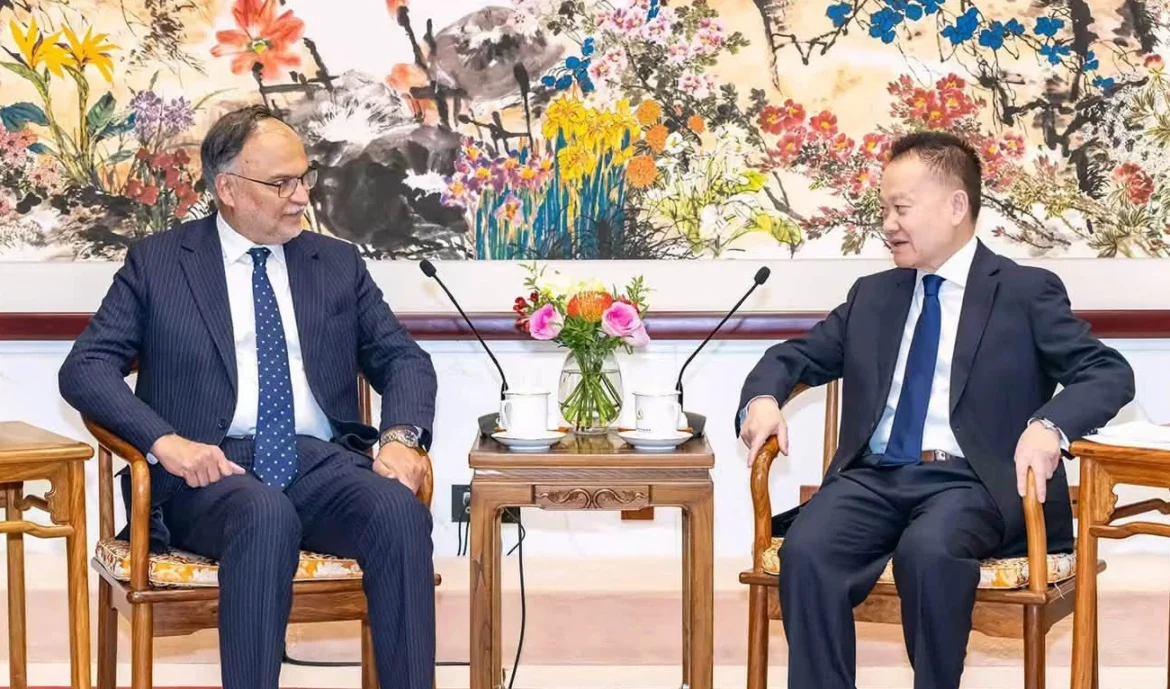
Iqbal made the pitch Friday in Beijing in a meeting with Liu Haixing, head of the International Department of the Communist Party of China’s Central Committee. He pointed to the tariff concessions China has given African countries as a possible model for improving the competitiveness of Pakistani exports. In a post on X, Iqbal said the two sides discussed preferential zero-tariff access and proposals to expand bilateral trade.
Pakistan’s planning ministry described the proposal as a non-reciprocal arrangement that would sit apart from the existing bilateral free trade agreement. Iqbal suggested technical talks to settle product coverage, rules of origin and an implementation timetable.
The request targets one of the most lopsided trade relationships in South Asia. Pakistan’s imports from China reached $22.34 billion in the fiscal year through June, against exports of $2.71 billion, a gap of about $19.6 billion. The $20 billion to $25 billion target Iqbal cited would amount to a roughly sevenfold to eightfold increase from the roughly $3 billion level he used.
Islamabad has long argued that it is losing ground to rivals in the Chinese market. Pakistani officials say gains under earlier phases of the free trade agreement have been diluted by China’s later deals with ASEAN countries and other partners. In September 2025, Iqbal urged Beijing to give Pakistan the same market access that Southeast Asian nations enjoy. The African precedent is more recent: China granted unilateral zero-tariff access to 53 African countries effective May 1, 2026.
The two countries are already negotiating a third phase of their free trade agreement. In May, local media reported that Pakistan planned to formally request unilateral concessions on about 700 product lines. The current second phase took effect in January 2020. Pakistan shipped $2.375 billion of goods to China in the fiscal year through June 2025, of which $2.16 billion moved under the existing agreement. Islamabad had also been pressing for more concessions through other channels, with Commerce Minister Jam Kamal Khan raising the issue in October as Pakistan sought better preferential access to major trading partners.
The push comes as the two governments try to give the second phase of the China-Pakistan Economic Corridor, known as CPEC 2.0, more substance. In January, they agreed to align development priorities around industrialization, agriculture, mining, connectivity and technology. In May, Pakistani and Chinese companies announced agreements and memorandums of understanding worth more than $7 billion at a business conference in Hangzhou. Pakistan’s ambassador to China said in July that memorandums worth more than $20 billion had been signed.
Iqbal described the first phase of CPEC as having attracted about $25 billion in investment. He said it added more than 8,000 megawatts of generation capacity, built 888 kilometers (552 miles) of highways and motorways, and created an estimated 236,000 direct and indirect jobs. For the next phase, he named industrial and agricultural cooperation, business partnerships, technology transfer, mineral development and green growth as priorities. He linked it to Pakistan’s URAAN development program and China’s 15th five-year plan, stressing the need for policy continuity, and reaffirmed Pakistan’s commitment to the security of Chinese personnel and projects.
The minister also sought Chinese backing for a proposed Pakistan-China Knowledge Corridor, which would let about 10,000 Pakistani scholars pursue doctoral studies and specialized research over a decade. Radio Pakistan said the plan envisages scholarships, partnerships with leading Chinese universities and co-financing. Priority fields include artificial intelligence, engineering, advanced manufacturing, modern agriculture, biotechnology and mineral sciences.
Iqbal also met Zhou Haibing, vice chairman of the National Development and Reform Commission, the country’s top economic planning agency. The planning ministry’s statement placed that meeting on Thursday. He pressed for early completion of a financing agreement for the 102-kilometer Thor Nullah-Raikot section of the Karakoram Highway, part of a wider realignment project costing 576 billion rupees. He also discussed Chinese participation in upgrading the ML-1 railway line beyond the Karachi-Rohri section, for which Pakistan is exploring financing from the Asian Development Bank.
For Gwadar, the Arabian Sea port at the center of CPEC, Iqbal asked China to help restore regular shipping services. He proposed a joint feasibility study for strategic petroleum storage facilities there. Discussions also covered the Gwadar Free Zone, the second phase of the Eastbay Expressway and a proposed corridor linking mining areas in Chagai to Gwadar for mineral processing and exports.
On power, the minister called for progress on the Kohala and Azad Pattan hydropower projects. He proposed joint assessments of converting selected plants from imported coal to locally mined Thar coal, a switch that would ease pressure on Pakistan’s import bill. Pakistan also asked that three private-sector projects be added to the CPEC industrial agenda: an aluminum complex at Port Qasim, a fertilizer plant in Thar, and a refinery and fuel storage complex at Dhabeji.
Copyright © 2021 Independent Pakistan | All rights reserved