By Staff Reporter
ISLAMABAD: Pakistan and Turkey have pledged to step up support for Saudi Arabia against Houthi attacks, a day after a projectile struck the kingdom’s Jazan refinery and killed a worker, but announced no new military measures.
The pledge was made after about two and a half hours of talks in Islamabad on Friday under a three-way pact in which an assault on one member is an assault on all. The alliance has not said what its members will do when one of them is under sustained fire.
“The three sides reiterated their strong condemnation of the persistent and heinous attacks by the Houthi militia targeting civilians and civilian infrastructure in the Kingdom of Saudi Arabia,” said Ishaq Dar, Pakistan’s deputy prime minister and foreign minister.
They had, he added, “reaffirmed their collective resolve to continue and intensify efforts to support the Kingdom in safeguarding its security, sovereignty and territorial integrity in accordance with the collective defence provisions of the Makkah Agreement for Joint Defence”.
Dar announced no specific military measures, and, leaving the central question facing the young alliance largely unanswered: what its members will actually do when one of them is under sustained fire.
Friday’s wording is more pointed than at the allies’ emergency meeting in Riyadh on 5 October, when they called for the rapid deployment of agreed forces and capabilities, subject to national laws. That statement did not name Yemen or the Houthis. Friday’s names them.
The pledge came a day after a projectile hit the Jazan refinery, near the Yemeni border in south-western Saudi Arabia. Saudi Arabia’s energy ministry said it killed a Nepalese worker, wounded several others and temporarily halted some operations. The Saudi-led coalition blamed the Houthis and said it later destroyed a ballistic missile launch platform in the Yemeni port of Hodeidah that was used in the attack. The plant is designed to process up to 400,000 barrels of crude a day.
The strike on Jazan followed a claim by the Iran-aligned Houthis on Wednesday that they had attacked Ras Tanura, Saudi Arabia’s largest oil refinery. The authorities have not confirmed a strike on the plant, only the interception of four drones in the area. On Tuesday, 11 people were reported injured when a tower in Riyadh’s financial centre was hit. By Friday, the Saudi-led coalition said it had destroyed another drone heading towards the capital region.
In all, Saudi authorities say suspected Houthi missile and drone attacks have killed at least 26 people in the kingdom since 23 September, 23 of them in strikes on airports.
On the Yemeni side, Houthi-affiliated media said Saudi air strikes killed 11 civilians in al-Turbah, in Taiz governorate, on Friday. The coalition did not immediately comment, and The Independent could not verify the claim. The World Health Organisation had recorded 2,260 deaths and 10,519 injuries in Yemen from the latest escalation by 16 November.
Houthi-affiliated media said Saudi air strikes killed 11 civilians in al-Turbah, in Yemen’s Taiz governorate, on Friday. The coalition did not immediately comment, and The Independent could not verify the claim. The World Health Organisation had recorded 2,260 deaths and 10,519 injuries from the latest escalation by 16 November.
Pakistan’s defence minister, Khawaja Asif, said before the talks that Islamabad read its obligations broadly. “Any threat to Saudi Arabia is a threat to Pakistan and Turkiye according to the pact, which is absolutely clear,” he told AFP.
The “continuous turmoil south of Saudi Arabia”, he said, would “obviously be one agenda point in the meeting”. He added: “It is very important.” Mr Asif has also said Pakistan will use “whatever means are available” to defend the kingdom.
Pakistan sent a military contingent, including fighter jets and support aircraft, to the kingdom in April under a bilateral defence agreement signed in September 2025. Saudi Arabia’s defence ministry said the force had arrived at King Abdulaziz airbase in the Eastern Province. A security source said deployments including JF-17 aircraft, drones and HQ-9 air defence systems would now fall within the trilateral framework. Pakistan’s foreign ministry said last month that its troops in Saudi Arabia would not cross into Yemen to attack the Houthis.
Turkey’s foreign minister, Hakan Fidan, said on 21 November that Ankara was providing defensive support. “No decision has been made on deploying troops inside Yemen,” he said. He has made clear that deployment is not automatic, and that joining an all-out war would require parliamentary approval. Friday’s joint statement describes the practical implementation of collective defence commitments as being “in line with their national legislation”.
President Recep Tayyip Erdogan’s approval of the agreement was published in Turkey’s official gazette on Friday, completing its ratification. Parliament had backed it on 5 November by 279 votes to 119. Pakistan said on 23 October that it and Saudi Arabia had completed their own processes.
The pact was signed in Mecca on 7 August, in a region already at war after US and Israeli strikes on Iran in February. Renewed fighting between Saudi Arabia and the Houthis has since deepened the threat to energy supplies and global trade, with shipping disrupted through the Strait of Hormuz and the Bab al-Mandab.
Dar said the three had “expressed satisfaction at the pace of progress towards the establishment and operationalisation of the alliance secretariat in Saudi Arabia”. The Riyadh-based secretariat is led by retired Pakistani Lieutenant General Nauman Mahmood, appointed to a three-year term as its first secretary general. A working committee of member-state officials is also functioning.
The alliance has not publicly defined its military doctrine, the composition of its forces, its command arrangements or the procedures that would govern a joint response. A Pakistani official had indicated that Friday’s talks were expected to address standard operating procedures, implementation and coordination between political, defence and military institutions.
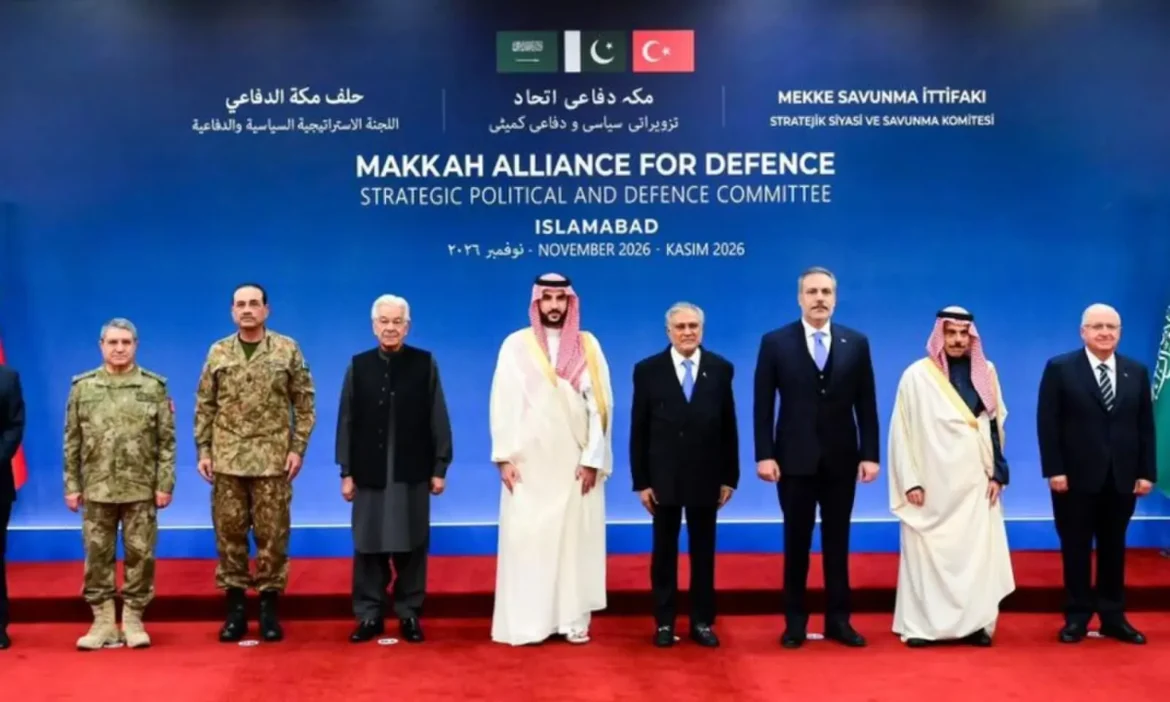
Friday’s session of the Strategic Political and Defence Committee, the alliance’s principal decision-making body, was its second regular session and third meeting in all. The members recommitted themselves to “collective defence, mutual solidarity, and respect for the sovereignty and territorial integrity of each country”. They also committed to closer cooperation in defence industries, joint technological development and training, “with a view to enhancing the collective capabilities and cohesion of their armed forces”.
“The SPDC agreed to continue consultations aimed at enhancing cooperation and coordination on matters of mutual interest, supporting efforts towards de-escalating regional tensions, and encouraging the peaceful resolution of disputes through dialogue and diplomacy,” Dar said.
The Turkish foreign ministry said before the meeting that Fidan was expected to raise Israel’s actions in Gaza, the occupied West Bank and East Jerusalem. He was also expected to press for continued diplomacy between the US, Israel and Iran, and for safe navigation through the Bab al-Mandab.
Pakistan has deepened its military ties with Riyadh while keeping its door to Tehran open. Dar spoke by telephone to the Iranian foreign minister, Abbas Araghchi, on Thursday, and Araghchi renewed Tehran’s invitation for Pakistan to attend a regional economic summit there on 3 and 4 December.
Islamabad brokered a June accord that briefly halted fighting between the US and Iran and set out a roadmap for reopening Hormuz and negotiating over Tehran’s nuclear programme. The truce collapsed amid mutual accusations of violations, prompting months of shuttle diplomacy led principally by Qatar and Pakistan. In October, Saudi Arabia’s defence minister, Prince Khalid bin Salman, Pakistan’s army chief and Turkey’s intelligence chief, Ibrahim Kalin, met Mohsen Rezaei, secretary of Iran’s Supreme National Security Council, in Tehran.
Analysts say greater involvement against the Houthis, whose principal backer is Iran, could weaken Pakistan’s role as a mediator. Umer Karim, of the King Faisal Centre for Research and Islamic Studies in Riyadh, told Al Jazeera that Riyadh wants Pakistan’s help against the Houthis while also keeping it as a channel to Tehran, and that pressure on Islamabad could grow if Saudi diplomacy with Iran stalls.
All three members say the alliance is defensive and aimed at no particular country. It builds on long-established military links. Pakistan has trained and advised Saudi forces for decades and worked closely with Turkey on defence, and Riyadh agreed in 2023 to buy Turkish drones in what Ankara called its largest defence export contract. Syria’s foreign minister has said Damascus is evaluating whether to join.
Dar led Pakistan’s delegation with Asif and Field Marshal Asim Munir, the Chief of Defence Forces and army chief. Saudi Arabia was represented by its defence minister, Prince Khalid, foreign minister, Prince Faisal bin Farhan, and Chief of General Staff, General Fayyadh bin Hamed Al-Ruwaili. Mr Fidan attended with Turkey’s defence minister, Yasar Guler, and military chief, General Selcuk Bayraktaroglu.
Authorities declared local holidays in Islamabad and neighbouring Rawalpindi and imposed traffic restrictions in the capital. Government offices in the high-security Red Zone were told to work remotely.
“Today’s meeting not only symbolises the bonds of long-standing friendship and solidarity among the three brotherly countries but also represents Pakistan’s continued efforts towards regional and international peace and security,” Dar said. He said it also showed “Pakistan’s growing and robust diplomatic footprint at the international level”.
Copyright © 2021 Independent Pakistan | All rights reserved