By News Desk
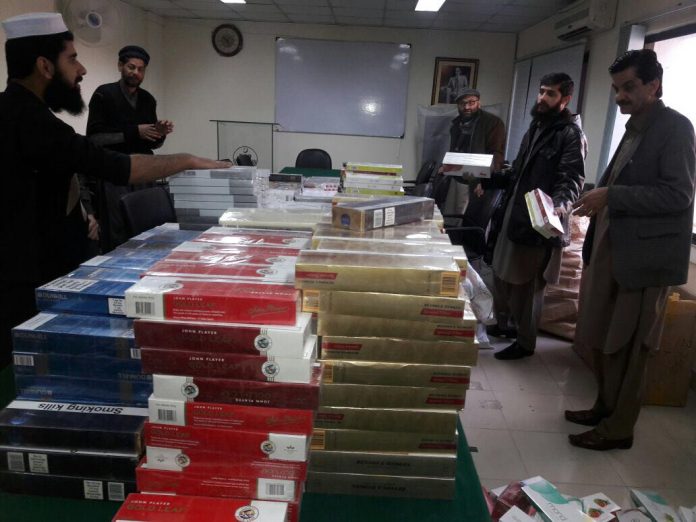
The flood of smuggled cigarettes that hit Pakistan after the stellar tax hike brought by a minibudget a few months ago continues to surge, allowing black market forces to prey upon legitimate businesses and depriving the national kitty of previous revenue.
In other words, there is a black market boom cultivated by the government. The government took the rather extreme measure of increasing the Federal Excise Duty (FED) on taxpaying cigarette brands by 154 percent in view of its dire revenue needs against the backdrop of negotiations with the International Monetary Fund (IMF) for a bailout package. But the move seems to have backfired in a spectacular way.
Their prices hiked outside the reach of most smokers because of the new taxation regime, taxpaying cigarette brands are losing market share to the ubiquitous tobacco black market. Sneaked in through the country’s purpose border with Afghanistan, smuggled cigarettes end up at the same retail outlets that sell legitimate taxpaying brands, and are no irresistibly cheaper than the taxpaying Pakistani brands.
The upshot is that more and more foreign brands are entering the local market through smuggling, which has now become more lucrative than ever because of the heftier profit margin enabled by the 154 percent FED.
Mr. Tariq (one name), who has been a habitual smoker for the last 30 years, said that he has switched to a (smuggled) foreign brand for the first time because of the massive price increase brought on by the mini budget. He said smuggled cigarettes are freely available everywhere.
Observers say Pakistan’s cigarette smuggling has surged by 200 percent in recent months, and many newer brands have appeared on the market. Data suggests that in the aftermath of increased FED by 154 percent on domestic brands. The number of smuggled packs of cigarette brands crossed the psychological mark of 100 brands which earlier stood at around 20 to 25 brand packs.
Industry experts say that at least 70 new smuggled brands were flooding into the Pakistani market because massive increases in domestic prices in the aftermath of the hike in FED provided incentives to smuggled brands for increasing their penetration in our domestic market.
For good or for bad, Pakistan’s legitimate tobacco market is dominated by two giants with international linkages: Pakistan Tobacco Company and Philip Morris Pakistan. The PTC contributes 82 percent of the government’s revenue from the sector, while Philip Morris contributes 16 percent. All other domestic players contribute only a 2 percent share in the shape of taxes to the national exchequer.
Observers say plummeting sales of Pakistani cigarettes are an indication of the losses the national exchequer is stacking up in terms of tax collection. There is also a need to fully analyze the prevailing dynamics with regard to the tobacco sector in Pakistan.
Multilateral financial institutions such as the IMF and the World Bank remain unable to comprehend the Pakistani market mainly because of possessing only experience of the developed or Western world.
In Pakistan, there are three major types of cigarettes causing losses to the national exchequer. The first and foremost one is Duty Not Paid (DNP) as these are locally manufactured cigarettes with certain characteristics such as hiding their actual production, evading paying duty and taxes, selling below the minimum price and minimum tax, and establishing their production units usually in areas which are outside from the normal taxation regime prevailed in Pakistan as for instance their production facilities are located in Azad Jammu & Kashmir (AJK).
The second type is counterfeit cigarettes as these are just copies of original brands, in similar packaging but of poor quality. These are usually sold at transitory places such as Railways Stations or Bus Stops and they also have fake tax stamps. The third one has smuggled cigarettes which has recently become a growing phenomenon in Pakistan mainly because they are now priced below tax-paid cigarette brands.
Cigarettes of these brands are sneaked into Pakistan mainly through the Afghan border. These smuggled cigarettes do not comply with statutory requirements, evade duty and taxes, display no health warnings at all, and show no tax stamps showing that this pack never bothered to pay any penny into national kitty.
All three categories are causing losses to the national exchequer. Prime Minister Shehbaz Sharif has recently decided to take stern action against the recent surge in smuggling. There is a need to remind the FBR that smuggled cigarettes became another sector that witnessed a 200 percent increase under the tight nose of customs authorities in recent weeks and months. So proper vigilance and enforcement are required at borders and entry and exit points to ensure a reduction in smuggled cigarettes.
At a time when all three categories of illicit in the shape of Duty Non-Paid, counterfeit, and smuggled cigarettes have witnessed an increase in sales, the ultimate victim will be the tax collection target of the FBR envisaged for the current fiscal year.
Copyright © 2021 Independent Pakistan | All rights reserved