By Staff Reporter
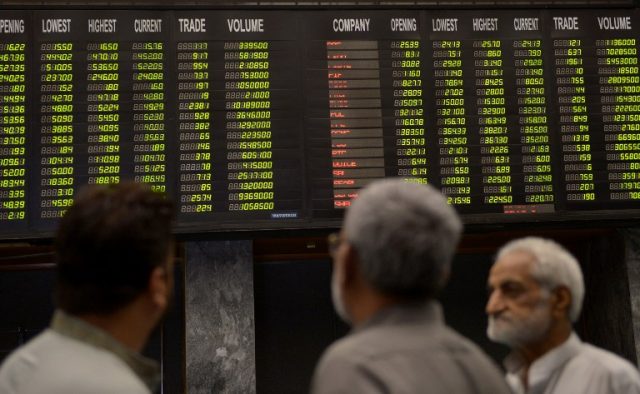
KARACHI: The Pakistan Stock Exchange, which had been on a remarkable rally for the past few months, suffered a major setback on Tuesday as investors rushed to sell their shares amid rising leverage costs and looming political risks.
The benchmark KSE-100 index, which tracks the performance of the 100 largest companies listed on the exchange, closed at 62,833.03, down 3.64 percent or 2,371.64 points from the previous day. It was the biggest single-day drop since March 2020, when the coronavirus pandemic triggered a global market meltdown. The index had lost 925.35 points on Monday, ending a nine-day winning streak that had pushed it to an all-time high of 66,130.02 on Dec. 15.
The sharp reversal came as investors faced mounting pressure from margin calls, which are triggered when the value of the securities held as collateral falls below a certain level, forcing borrowers to either deposit more cash or sell their holdings to repay their loans.
Margin calls are especially common when investors use leverage, or borrowed money, to amplify their returns. Leverage can magnify both gains and losses, making the market more volatile and prone to sudden swings.
According to data from the Pakistan Stock Exchange, the total amount of leverage in the market, measured by the sum of futures open interest, margin trading system (MTS), and margin financing system (MFS), reached a two-year high of Rs40 billion on Tuesday, up from Rs14.3 billion at the end of June.
The increase in leverage was driven by a surge in investor confidence and trading activity, fueled by a series of positive developments in the country’s economy and politics.
The country, which had been struggling with a balance of payments crisis and a fiscal deficit, secured a $3 billion loan from the International Monetary Fund (IMF) in July 2023, after agreeing to implement a series of reforms and austerity measures. The IMF program, which was successfully reviewed for the first time in November, helped stabilize the rupee, which had depreciated by more than 50 percent against the dollar since 2022. The IMF deal also paved the way for other sources of external financing, such as loans and grants from friendly countries like China, Saudi Arabia, and the United Arab Emirates.
Moreover, the announcement of general elections, scheduled for Feb. 8, 2024, raised hopes for a smooth and peaceful transition of power, which has been a rare occurrence in Pakistan’s history, marred by military coups and political instability.
These factors, along with the gradual recovery of the global economy from the pandemic, boosted the sentiment of domestic and foreign investors, who poured money into the PSX, betting on the prospects of higher corporate earnings and dividends. The KSE-100 index, which had hit a low of 38,342.01 on Jan. 17, 2023, rose by 64 percent to reach its peak on Dec. 15, outperforming most emerging and frontier markets. The average daily trading volume and value also increased significantly, reaching 1.3 billion shares and Rs31 billion in the last two weeks, compared to 0.3 billion shares and Rs6 billion in the first half of 2023.
However, the rapid rise in share prices also made the market more vulnerable to a correction, as some analysts and investors warned that the valuations had become too stretched and disconnected from the fundamentals.
Pakistan, which is still classified as a frontier market by the global index provider MSCI, trades at a steep discount to its peers in the emerging and frontier markets, reflecting the higher risks and lower liquidity associated with investing in the country.
The market capitalization to gross domestic product (GDP) ratio, a measure of how large the stock market is relative to the economy, stood at 18 percent as of Dec. 19, compared to 54 percent for the MSCI Emerging Markets Index and 32 percent for the MSCI Frontier Markets Index. Similarly, price to earnings (P/E) ratio, a measure of how expensive the stocks are relative to their earnings, stood at 3.6 times for the year 2024, compared to 14.9 times for the MSCI Emerging Markets Index and 9.9 times for the MSCI Frontier Markets Index.
The dividend yield of 10 percent is also significantly higher than the dividend yields of its peers in the emerging and frontier markets, which stand at 2.2 percent and 3.9 percent, respectively. Pakistan’s PBV ratio of 0.8 times is also significantly lower than the PBV ratios of its peers, which stand at 1.9 times and 1.2 times, respectively. The market capitalization to GDP ratio of 9 percent is also significantly lower than the market capitalization to GDP ratios of the emerging and frontier markets.
While these metrics suggest that the market is undervalued and has room for further growth, they also reflect the challenges and uncertainties the country faces internally and externally.
The economy, which contracted by 0.17 percent in the fiscal year 2023, is expected to grow by 2.5 percent in the fiscal year 2024. However, even this meager projection is contingent on the successful implementation of the IMF program, which requires the government to undertake difficult and unpopular measures, such as raising taxes, cutting subsidies, increasing electricity tariffs, and reforming state-owned enterprises.
These measures, while necessary to improve the fiscal and external balances, could also hurt the disposable income and purchasing power of the consumers, as well as the profitability and competitiveness of the businesses, thereby affecting the demand and supply of goods and services in the economy. Moreover, the IMF program could also face political resistance and opposition from various segments of society, especially as the country approaches the election season, which is likely to be marked by intense campaigning and competition among the political parties.
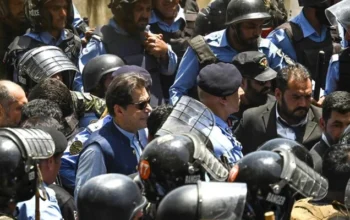
The country’s largely supported Pakistan Tahreek-e-Insaf party and its 71-year-old leader Imran Khan have been embroiled in a tangle of political and legal battles since he was ousted as prime minister in April 2022. The former premier Khan, arguably the country’s most popular politician, has been locked up since August and is being tried for leaking classified documents, allegations he says have been trumped up to stop him from contesting general elections due in February. The PTI will face former prime minister Nawaz Sharif’s party as its main opponent in the country’s political heartland of Punjab.
Most recently two top lawyers’ bodies, the Pakistan Bar Council (PBC) and Supreme Court Bar Association (SCBA), expressed distrust in the Chief Election Commissioner (CEC) and his ability to ensure that general elections, due on Feb. 8, would be free and fair. As the date for elections nears, concerns have grown against the current leadership of the ECP, which is hearing several cases against Khan and in August convicted him in a graft case, sending him to prison for three years and effectively disqualifying him for the upcoming polls.
A caretaker government under interim Prime Minister Anwaar-ul-Haq Kakar is running the country until the national election is held. Analysts have openly questioned whether Kakar’s administration, which is believed to be close to the all-powerful army, can ensure fair competition in elections. As it stands, questions surround the legitimacy of the election, whenever it is held, if Khan cannot contest.
The political uncertainty and polarization could have a negative impact on investor confidence and the business environment, as well as the security and stability of the country, which has been plagued by terrorism and violence for decades.
The country also faces external challenges and pressures, such as the ongoing tensions and conflicts with its neighbors, India, and Afghanistan, as well as the changing dynamics and interests of the major powers, such as the United States, China, and Russia, in the region.
These factors, along with weak economic fundamentals, pose significant risks and uncertainties for the economy and stock market, which could outweigh the potential rewards and opportunities.
As such, some analysts and investors believe that the market has already priced in the best-case scenario and that the downside risks are higher than the upside potential. The market is due for a correction, as the leverage costs and the margin calls could trigger a chain reaction of selling, creating a negative feedback loop and a downward spiral.
Others, however, remain optimistic and bullish, citing the attractive valuations and the strong fundamentals of the companies, which have shown resilience and adaptability in the face of challenges and crises. The positive indicators and trends, such as improving macroeconomic indicators, increasing foreign exchange reserves, declining inflation, and interest rates, rising exports and remittances, expanding tax base, and growing digitalization and financial inclusion.
They expect the market to benefit from the increased participation and inflows of domestic and foreign investors, especially institutional and long-term investors, who have a more diversified and balanced portfolio and a longer investment horizon.
They hope that the market will witness a smooth and peaceful election process, resulting in a stable and pro-reform government, which will continue to implement the IMF program and pursue the economic and social development of the country.
The divergent views and expectations of the analysts and investors reflect the complexity and uncertainty of the PSX, which is influenced by a multitude of factors and forces, both internal and external, as well as rational and emotional.
Copyright © 2021 Independent Pakistan | All rights reserved