By Staff Reporter
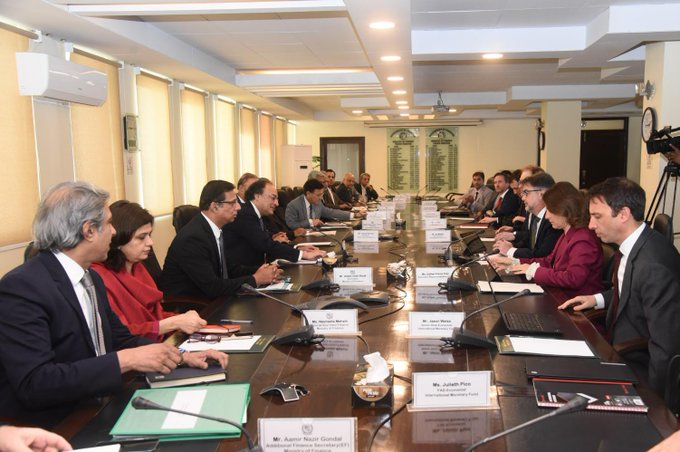
ISLAMABAD: The Finance Ministry commenced the final review of its $3 billion standby arrangement with the International Monetary Fund (IMF) on Thursday, signaling confidence in meeting the fund’s criteria and securing a subsequent tranche of $1.1 billion.
Experts also predict a favorable outcome for Islamabad, which has reportedly met nearly all the lender’s performance benchmarks.
Led by Nathan Porter, the IMF’s Assistant Director for the Central Asia and Middle East department, the visiting mission initiated discussions with key Pakistani officials, including Finance Minister Muhammad Aurangzeb and Energy Minister Musadik Malik, to assess the implementation of the lender’s recommended reforms.
The four-day review is a pivotal moment for Islamabad, which last summer narrowly avoided sovereign default through this last-minute rescue package. The discussions focused on macroeconomic indicators, fiscal consolidation efforts, structural reforms, and the governance of state-owned enterprises.
In a statement, the finance ministry said the IMF and Islamabad discussed Pakistan’s overall macro-economic indicators, efforts on fiscal consolidation, structural reforms, energy sector viability, and state-owned entity governance.
The ministry highlighted the positive outlook for the review, citing Pakistan’s compliance with all structural benchmarks and performance targets.
The authorities briefed the IMF on the recent energy tariff hikes and other fiscal measures undertaken to comply with the agreement targets. The government’s energy reform agenda, including significant increases in electricity and gas prices, was presented to the IMF team.
The levy on petrol and diesel was raised to Rs60 per liter before the IMF’s visit, and gas tariffs for domestic consumers saw a hike of up to 67 percent last month, fulfilling key prerequisites for the fund’s final review.
Media reports, quoting anonymous finance ministry officials, said the government expressed confidence in the IMF’s approval of these steps and hinted at ongoing preparations for a subsequent, more extensive program estimated at around $8 billion.
The government’s financial strategy, heavily reliant on borrowing due to high inflation and a substantial circular debt in the energy sector, is expected to complicate discussions for a new, longer-term bailout program.
As the current standby arrangement nears its April 11 expiration, Prime Minister Shehbaz Sharif has instructed his finance team to pursue a new Extended Fund Facility (EFF).
While the size of the potential medium-term program remains undisclosed, the finance minister has expressed eagerness to initiate talks for a larger, longer-term arrangement during the IMF and World Bank’s spring meetings in Washington.
Finance Minister Aurangzeb, chosen over other candidates including veteran finance minister Ishaq Dar, faces the challenge of stabilizing an economy that has historically oscillated between growth and downturn, resulting in over 20 IMF bailouts.
With an economy that contracted by 0.2 percent last year and is projected to grow by 2 percent this year, Pakistan grapples with low reserves, a balance of payment crisis, soaring inflation at 23 percent, policy interest rates at 22 percent, and unprecedented local currency depreciation.
Copyright © 2021 Independent Pakistan | All rights reserved