By Staff Reporter
Saniya Jan had every reason to believe her hard work had paid off. The 18-year-old from Baramulla district in occupied Kashmir had aced one of India’s toughest exams, the National Eligibility cum Entrance Test (NEET), securing a spot in the inaugural class at Shri Mata Vaishno Devi Medical Institute. “It was a dream come true — to be a doctor,” she told Al Jazeera, remembering her excitement. Her father, Gazanfar Ahmad, drove her 196 miles through the rugged terrain to drop her off, beaming with pride over his “brightest” daughter, a lifelong topper who had earned this through sheer grit.
But just weeks later, everything fell apart. On January 6, India’s National Medical Commission pulled the college’s approval, pointing to major problems with staff, facilities, and equipment. The next day, the school’s operating license was revoked. What followed was a scramble: students packing bags, returning home, their futures hanging in limbo.
This wasn’t just a bureaucratic hiccup. It was, as critics charge, a stark surrender to the clamour of right-wing Hindu groups outraged that 42 of the 50 students in the MBBS program — the five-year bachelor’s in medicine — were Muslims, mostly from Kashmir.
The Shri Mata Vaishno Devi Medical Institute sits in Reasi district, in the hills looking out over the Pir Panjal range, where the Himalayas divide the Jammu plains from the Kashmir valley. Run by a Hindu religious group linked to the Mata Vaishno Devi Temple and backed in part by government money, the private school started its first medical class in November. Getting into medical school in India means taking the NEET, a national test run by the government’s testing agency. More than two million students take it each year for about 120,000 spots. Most aim for public schools with low fees but tough entry scores. Those who qualify but don’t make the cut often go private.
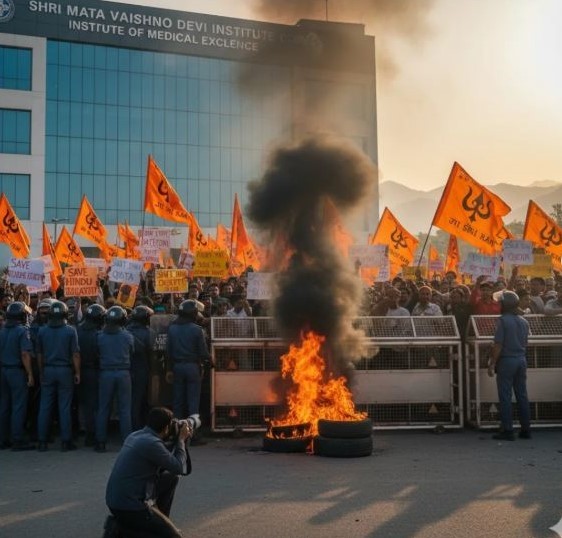
For students like Saniya, the choice made sense. It was relatively close to home — a rarity for Kashmiris, who frequently endure longer treks to study elsewhere. But proximity couldn’t shield them from the backlash. Local Hindu groups erupted in protests upon learning the class’s makeup: 42 Muslims, seven Hindus, one Sikh. Demonstrators gathered daily outside the college’s iron gates, chanting slogans and demanding that the Muslim admissions be nullified. Their argument? The institute, fueled by temple devotees’ offerings, was no place for Muslims — they had “no business being there.”
The protests dragged on for weeks. Politicians from Prime Minister Narendra Modi’s extremist Bharatiya Janata Party — which has faced criticism for anti-Muslim policies since 2014 — got involved. They petitioned Kashmir’s lieutenant governor — the federally appointed overseer of this disputed territory — to reserve spots exclusively for Hindus. Demands escalated to outright closure. And then, abruptly, the National Medical Commission stepped in, pulling the plug over alleged shortfalls in teaching staff, bed occupancy, patient flow, libraries, and operating rooms.
Students and observers aren’t buying it. Many students told Al Jazeera they saw no such problems. The place was set up well for classes. “I don’t think the college lacked resources,” said Jahan, a student who gave only her last name. She mentioned things like having four cadavers for the class, so everyone could work on them one by one — better than some other schools. Rafiq, another student using just his last name, said his cousins at government colleges in Srinagar didn’t have as much. “Even they don’t have the kind of facilities that we had here,” he said. Saniya’s father agreed after seeing the campus. “Everything seemed normal. The college was good. The faculty was supportive. It looked like no one cared about religion inside the campus.” Zafar Choudhary, a Jammu-based political analyst, cuts to the core of the skepticism. How, he asks, did the regulators approve the college initially if the infrastructure was so deficient? “Logic dictates that their infrastructure would have only improved since the classes started,” he said. “So we don’t know how these deficiencies arose all of a sudden.” Choudhary dismisses the protesters’ logic as “absurd,” given NEET’s religion-blind process. Students rank preferences; algorithms assign seats based on merit and availability. “How is it their fault?” he asked. The college’s leadership has gone silent. No public statement has emerged since the revocation.
This case shows how religious tensions can push aside fair rules — an erosion of merit in the face of communal fervour. The shutdown reeks of capitulation to identity politics. Kashmir, a Muslim-majority region roiled by decades of conflict, already hosts medical colleges where Hindus enroll under minority quotas. As student Salim Manzoor pointed out, reciprocity should cut both ways.
Yet, Hindu extremists and BJP allies framed the issue as safeguarding “religious emotions” tied to the temple trust. BJP spokesman Altaf Thakur said the closure was just about the commission’s findings. “There’s no question of the issue being about Hindus and Muslims,” he said, adding that people should respect the devotees’ views. But the facts suggest otherwise. The BJP’s track record — from policies critics label as discriminatory to alliances with hardline groups — casts a long shadow.
Local leaders have moved to help. Occupied Kashmir’s Chief Minister Omar Abdullah criticised the push to close the school. “People generally fight to have a medical college in their midst. But here, the fight was put up to have the medical college shut,” he said. He promised to place all 50 students in other schools with extra seats. “These children cleared the National Entrance Examination Test, and it is our legal responsibility to adjust them.”
Back home in Baramulla, Saniya worries about what’s next. “I appeared for a competitive exam, which is one of the hardest in India, and was able to get a seat at a medical college,” she said. “Now everything seems to have crashed. All this happened because of our identity. They turned our merit into religion.”
Copyright © 2021 Independent Pakistan | All rights reserved