By Staff Reporter
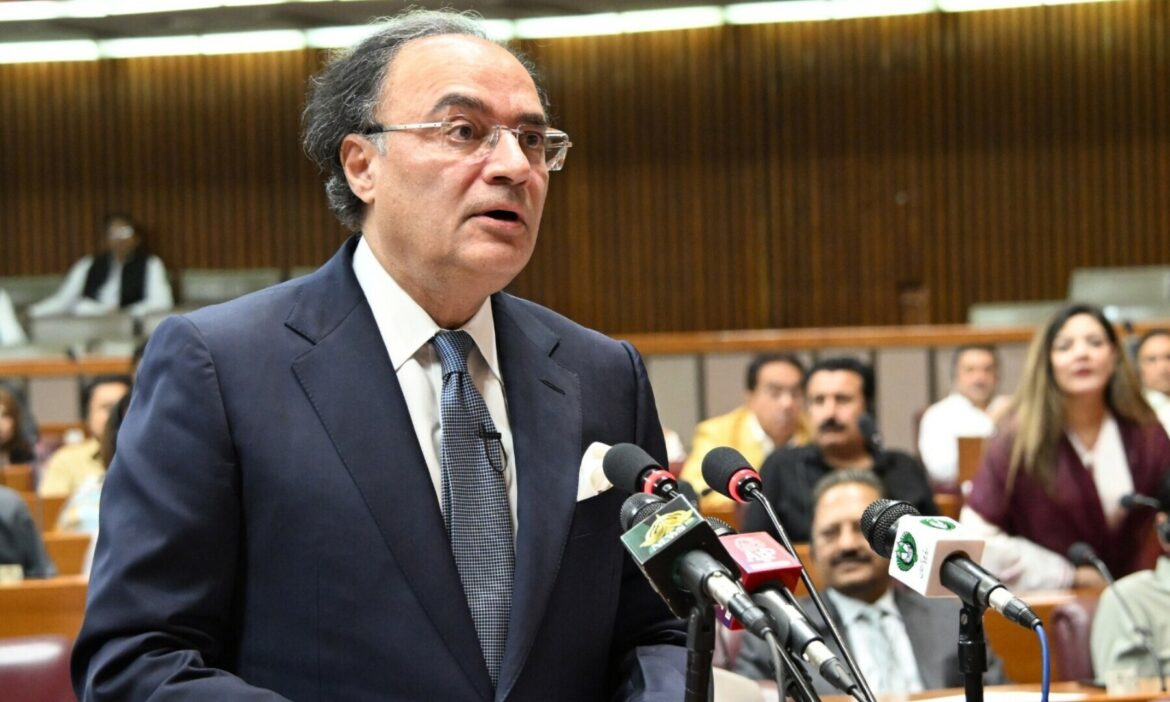
Sometime in the next few days, the finance minister will stand before the parliament and deliver a budget speech that will include, as it has every year for at least two decades, a solemn commitment to broaden the tax base. There will be new mechanisms announced, fresh enforcement pledges made, perhaps a digital initiative or two. The FBR will be modernised again. The informal economy will be brought in from the cold, again. And next year, the same speech will be delivered again.
Here is what will not be said: that Pakistan’s political class has made a conscious, sustained, and remarkably successful decision to exempt its most powerful constituents from taxation. Not through negligence. Not through administrative failure. Through choice.
The evidence for this is not hidden. It sits in a single number. Pakistan’s agricultural sector accounts for more than 20% of GDP. The conservative, research-backed estimate for what agricultural income tax should yield, under a regime comparable to Pakistan’s existing personal income tax system, is 800 billion rupees annually. Punjab — Pakistan’s largest province, its agricultural heartland, the political base of the ruling party — has set its agricultural income tax target for this fiscal year at 10 billion rupees. The other three provinces combined will collect six to eight billion. Against an 800 billion rupee potential, Pakistan is collecting, in effect, nothing.
This is not a failure of tax law. The provincial legislation, amended under IMF pressure in recent years, already enables income-based assessment. It is not a failure of data. The land registry exists. The landowners are known. One percent of Pakistan’s large farmers own 24% of its farmland. Their names are not a mystery to the state. What the state lacks is not information. It lacks the willingness to act on it, because the people who own that land are, in many cases, the same people who determine whether governments survive.
The agricultural tax exemption is the most egregious example of a broader structural pathology. Pakistan runs what functions, in practice, as a two-tier tax system: a punishing and increasingly extractive regime for the documented — salaried workers, formal businesses, manufacturers — and a comfortable near-zero liability for the undocumented, the informal, and the politically connected. The FBR compensates for its failure to reach the latter by squeezing the former harder each year, layering super taxes, surcharges, and withholding obligations onto a base that has already been saturated. Pakistan’s effective tax rates on formal-sector income now approach those of Scandinavia. The difference is that Scandinavian taxpayers receive functioning public services in return. Pakistanis receive the bill.
The government’s pre-budget announcement of a fixed-tax scheme for 3 to 3.5 million small retailers is, in this context, revealing — not as policy, but as a political gimmick. It signals activity. It produces a headline. And it carefully avoids the part of the retail sector where the real money is: the large-format retailers, the high-volume traders, the commercial establishments drawing significant turnover that have resisted documentation for years. These aren’t small shopkeepers scraping by on thin margins. They are businesses that in any functioning tax system would be filing returns and contributing meaningfully to the exchequer. A perfectly serviceable mechanism exists to reach them — advance withholding tax through electricity bills, an at-source collection tool that is already embedded in the legal architecture. It would work. It is not being used at the scale required, because those retailers, unlike salaried workers, can push back.
What makes this budget cycle marginally different from its predecessors is the IMF’s decision to redirect pressure toward the provinces. For fiscal year 2026-27, the Fund is demanding 400 billion rupees in additional provincial revenue — more than a 50% increase over current collections — recognising that the federal government has exhausted most of its politically easy options. The logic is correct. Pakistan’s provinces control the legal jurisdiction over some of the most productive untapped bases in the country: sales tax on services (covering a sector that now represents 60% of the economy), property taxation, and agricultural income. Total provincial tax revenue today is less than 1% of GDP. The potential is not modest.
But the IMF’s leverage over the provinces is indirect at best, and the provinces know it. The 7th NFC Award — the formula governing how revenue is shared between the federation and the four provinces — expired in 2015. Three subsequent rounds of negotiation have collapsed. The distribution formula still uses 1998 population data. Pakistan is, in 2026, allocating fiscal resources on the basis of a census taken when many of its current taxpayers were in primary school. Provinces that benefit from the existing formula — and three of the four would lose share under any update using the 2023 census — have every incentive to block renegotiation indefinitely. They are doing so.
The consequences of this provincial fiscal passivity are not abstract. Sindh asks the federal government to fund its bus rapid transit projects while collecting negligible property taxes in Karachi, one of the densest and most commercially active cities in Asia. India’s comparable cities collect per-capita property taxes that make Pakistani municipal revenues look like rounding errors — and do so from populations with similar income profiles. The infrastructure gap this produces is not a natural condition. It is the fiscal dividend of a political class that has concluded, in city after city, that taxing constituents is less useful to its survival than spending on them with someone else’s money.
The audit system that is supposed to backstop all of this is itself designed for underperformance. Random selection of one in 15 or one in 20 returns bears no relationship to where evasion is actually concentrated. A highly paid professional who declares implausibly low income has roughly the same chance of audit as a compliant middle-manager. Any system built around risk profiling — targeting returns where declared income diverges most sharply from plausible income, based on assets, lifestyle, and sector benchmarks — would look completely different. The FBR knows this. The resistance to building such a system comes from within the institution itself, where a portion of the informal economy’s unreported profits flows to the officials theoretically responsible for taxing it.
Pakistan’s tax crisis, in the end, is not a technical problem awaiting the right digital solution or the right IMF conditionality. It is a political settlement — between the state and its most powerful interests — in which the costs of running the country are offloaded onto those least able to negotiate their way out of paying them. Budgets are the annual renewal of that settlement. Until the settlement itself changes, the numbers on the page are largely beside the point.
Copyright © 2021 Independent Pakistan | All rights reserved