By Staff Reporter
SKARDU: The body of an American mountaineer who died in an avalanche on one of the world’s most unforgiving peaks was airlifted on Tuesday, more than three weeks after she and nine other climbers were buried in a wall of snow and ice on Broad Peak, in the Karakoram range of northern Pakistan.
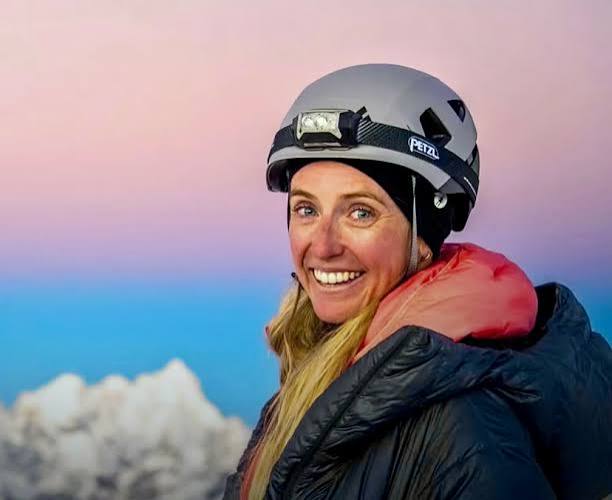
Sarah Mallory Geis was among 10 members of an expedition led by Nirmal Purja, the British-Nepali mountaineer whose exploits on the world’s highest peaks have made him one of the sport’s most recognisable figures, when the mountain gave way beneath them on July 30. Purja’s company confirmed soon after that no one survived.
For 22 days, Geis’s body remained lost on the mountain, one of the last two members of the expedition whose remains searchers had been unable to locate. It was found Friday by three local porters, who carried it down to the Broad Peak base camp. From there, the recovery effort stalled: helicopters could not fly in the punishing weather that has become increasingly common on the range’s upper reaches.
The weather broke Tuesday. Pakistan Army helicopters lifted Geis’s body from base camp and flew it to this mountain town, where it was met on the helipad by officials from the Alpine Club of Pakistan, the district administration, police, and medical personnel, according to Ayaz Shigri, the club’s general secretary. From there, the body was taken to Combined Military Hospital.
Shigri said the body would be transferred to Islamabad once legal procedures required in such cases are completed. One member of Purja’s expedition remains unaccounted for: Nawang Thindu Sherpa. Shigri said the search for him continues.
Broad Peak, the world’s 12th-highest mountain at more than 26,000 feet, is considered among the most technically demanding of the planet’s 14 peaks that rise above 8,000 meters — a list that has drawn elite climbers, and claimed a disproportionate share of their lives, for generations.
A second body, a second mountain
Roughly 100 miles away, on a peak called Spantik, a separate rescue team resumed its own grim climb Tuesday, hoping to bring down the body of a Pakistani doctor and mountaineer who died there five days earlier.
Dr. Asma Mushtaq, 34, died Aug. 20 while descending Spantik, also known as Golden Peak, after developing altitude sickness near the summit. Her body has remained since then at Camp 3, at roughly 20,500 feet, as rescuers waited out weather that had already turned them back once.
Information Minister Attaullah Tarar wrote on the social platform X that the six-person team of high-altitude porters had set out again from base camp, moving toward Camp 2.
“The rescue team has once again departed from the base camp and is now heading towards Camp 2,” Tarar wrote. “The team is moving carefully and will continue the operation as conditions permit. We pray for their safety and success.”
Shigri had told local media a day earlier that forecasters expected the weather to improve enough Tuesday for the porters to make another attempt. Pakistan Army helicopters are expected to fly Mushtaq’s body to Skardu once it reaches base camp, he said.
By all accounts, Mushtaq’s climb had gone well until it didn’t. She reached Spantik’s 23,000-foot summit in good health, according to the Alpine Club of Pakistan, part of a five-member Pakistani women’s expedition that included climbers Zoni Aslam, Zaba Shigri, Shama, and Sohana — a rare all-female summit on a mountain few Pakistani women have attempted.
It was during the descent, at about 21,000 feet, that Mushtaq’s condition turned critical. She was showing signs of a high-altitude medical emergency — the kind of oxygen-deprivation crisis, encompassing dangerous swelling in the lungs or brain, that can develop quickly when climbers ascend faster than their bodies can adjust.
Her guides, Akbar Ali and Muhammad Amin, reached her immediately, according to the alpine club.
“Despite the immediate and dedicated efforts of her mountain guides, who provided every possible assistance under extremely challenging conditions, she could not survive,” Karrar Haidri, a senior vice president of the Alpine Club of Pakistan, said in a statement mourning her death.
The recovery effort has drawn in more than just Mushtaq’s own expedition company. It is being coordinated with Gilgit-Baltistan’s tourism department, the local government, and the alpine club, with climbers from other teams on the mountain pitching in as well. A helicopter has been cleared to assist, arranged through coordination between the provincial government and the Force Command Northern Areas, the military unit that oversees the region. Tarar said Prime Minister Shehbaz Sharif is being briefed regularly.
The alpine club said it intends to investigate the circumstances of Mushtaq’s death, including the response of her expedition company, once her body has been recovered and the rescue teams are safely off the mountain.
“Any necessary action will follow the findings of that investigation,” the club said.
Mushtaq, who grew up in Lahore, had built a career far from the mountains that would claim her life. She worked in Britain as a doctor specialising in obstetrics and gynecology, and outside the hospital she became known online as a traveler and vlogger who chronicled her expeditions for a following that watched her take on peak after peak.
Copyright © 2021 Independent Pakistan | All rights reserved