By Staff Reporter
ISLAMABAD: Pakistan’s army chief departed the Iranian capital on Saturday after a round of intensive overnight talks that his government called a breakthrough in the making, even as Iran’s chief negotiator sat across from him and warned that any resumption of American military strikes would bring consequences more catastrophic than the opening salvos of a war that has already rattled the global economy and shut down one of its most vital waterways.
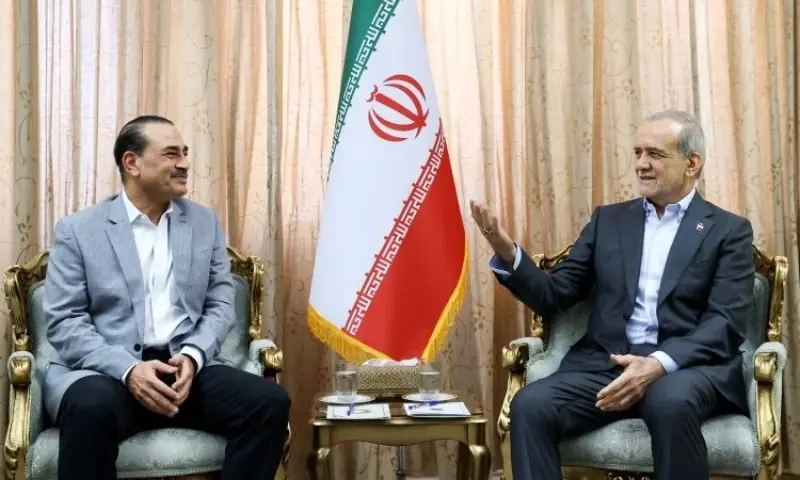
Field Marshal Syed Asim Munir — who holds the title of Chief of Defence Forces and has emerged, improbably, as perhaps the most consequential mediator in the most dangerous standoff of the Trump era — left Tehran on Saturday afternoon following a packed schedule of high-level meetings that included separate sessions with President Masoud Pezeshkian, Parliament Speaker Mohammad-Bagher Ghalibaf, Foreign Minister Abbas Araghchi and Interior Minister Eskandar Momeni.
The Inter-Services Public Relations directorate, Pakistan’s military media wing, said in a statement that “intensive negotiations over the last twenty four hours” had produced “encouraging progress towards a final understanding.” The engagements, it said, were held in a “positive and constructive environment” and “contributed meaningfully toward the mediation process.”
But the carefully calibrated optimism from Islamabad was shadowed by the language coming out of Tehran. Ghalibaf, who leads Iran’s negotiating team, used his meeting with Munir to deliver a blunt message — one that seemed as much directed at Washington as at his Pakistani guest.
“Our armed forces have rebuilt themselves during the ceasefire period in such a way that if Trump commits another act of folly and restarts the war, it will certainly be more crushing and bitter for the United States than on the first day of the war,” Ghalibaf said, according to AFP. He also told Munir that Iran could not trust “a party that has no honesty at all,” an accusation Tehran has levelled repeatedly at American negotiators and one that underscored how far the two sides remained from the kind of mutual confidence that any durable agreement would require.
The conflict that brought Munir to Tehran originated on February 28, when the United States and Israel launched coordinated strikes against Iran, triggering weeks of retaliatory missile and drone fire and a near-total disruption of shipping through the Strait of Hormuz — a narrow channel through which roughly a fifth of the world’s oil and gas supplies normally flow. A fragile ceasefire took hold on April 8, but it has remained precisely that: fragile. Both sides have continued exchanging threats, and the strait, though not entirely sealed, has remained largely closed, pushing fuel prices higher and feeding inflationary pressures that have weighed on Trump’s domestic standing.
His approval rating now sits around 37 percent, a historic low, as Americans grow increasingly frustrated with surging gas prices and a broader cost-of-living squeeze that analysts attribute in part to the maritime disruption. The Washington Post reported this week that the United States has also depleted a substantial portion of its stockpile of advanced missile-defence interceptors — a disclosure that has complicated the administration’s posture and added weight to warnings from military analysts who doubt whether a renewed aerial campaign could meaningfully shift the strategic balance.
Still, Trump has made clear that the option remains on the table. He described the state of negotiations this week as sitting on the “borderline” between a deal and renewed bombardment, and CBS News and Axios both reported that the White House was actively reviewing options for restarting the bombing campaign. On Friday, Trump met with Defence Secretary Pete Hegseth at the White House, reportedly to go over those contingencies. He also announced he would skip his son’s wedding this weekend, citing “circumstances pertaining to the government” — a phrase that set off a wave of speculation in diplomatic circles that the talks had entered a particularly sensitive phase.
Against that backdrop, Secretary of State Marco Rubio projected cautious optimism from two continents away. Speaking to reporters in New Delhi during his first visit to India — and separately on the sidelines of a NATO conference in Sweden on Friday — Rubio chose his words with evident care. “There might be some news a little later today,” he told reporters in New Delhi. “There may not be. I hope there will be.” “There’s been some progress done, some progress made,” he continued. “Even as I speak to you now, there’s some work being done. There is a chance that, whether it’s later today, tomorrow, in a couple of days, we may have something to say.”
Rubio reiterated American demands that Iran fully reopen the Strait of Hormuz and relinquish its stockpile of highly enriched uranium — terms Tehran has characterised as unreasonable. But he also took care to praise the role Pakistan has played in keeping lines of communication open, calling Islamabad Washington’s “primary interlocutor” in the talks. “The primary interlocutor on this has been Pakistan and continues to be, and they’ve done an admirable job,” Fox News quoted him as saying. Of Munir specifically, Rubio told reporters that Washington was in “constant communication” with the field marshal “at the highest levels.”
The scope of the diplomatic activity swirling around Tehran on Saturday was striking. Qatar dispatched a negotiating team to the Iranian capital in coordination with Washington. Saudi Interior Minister Abdulaziz bin Saud Al Saud spoke by phone with Pakistani Interior Minister Mohsin Naqvi, who was also in Tehran. Araghchi held telephone calls with his counterparts from Turkey, Iraq, Qatar and Oman, as well as with United Nations Secretary-General António Guterres. An Iranian diplomat in China praised Beijing for putting forward a peace initiative during the war, describing it as having been advanced “with the support of Pakistan.”
Analysts who have been tracking the diplomacy noted that the shape of what was being negotiated had shifted. Rather than a comprehensive settlement that would resolve every outstanding dispute between Washington and Tehran, what appeared to be taking form was a narrower interim framework — one that might extend the ceasefire by 60 days, set parameters for discussions on Iran’s nuclear programme and provide some immediate relief from economic pressure on Iran, according to the Financial Times, which cited people briefed on the talks. Diplomats described the process as increasingly resembling a phased stabilisation effort rather than anything approaching a final peace agreement.
Iran’s Foreign Ministry spokesperson Esmaeil Baghaei struck a tone that was sober but not despairing. He told state broadcaster IRIB that Tehran was in the “final stages” of drafting a framework. “Within a reasonable period of 30 to 60 days, the details of these points will be discussed, and a final agreement will ultimately be concluded,” he said. But he cautioned that Munir’s visit did not signal “a turning point or a decisive situation,” and acknowledged that “deep and significant” disagreements remained.
For Pakistan, the weeks since the ceasefire have represented an extraordinary — and largely unexpected — elevation of the country’s international standing. Islamabad has maintained working relationships with both Washington and Tehran while also drawing in China and Oman, and has done so at a moment when most of the region’s traditional powers have been unable or unwilling to play a similar role.
Munir has been at the centre of that effort. He first visited Tehran last month alongside Naqvi for a three-day trip in which he met Araghchi and other senior Iranian officials. Since the ceasefire, Naqvi himself has made multiple trips to the Iranian capital — travelling there over the weekend for meetings with the president, the parliament speaker and the foreign minister, and returning again on Wednesday, less than a week later, to try to keep negotiations from collapsing entirely. Prime Minister Shehbaz Sharif and Foreign Minister Ishaq Dar, meanwhile, flew to Beijing for a four-day visit in which Iran’s situation was expected to feature prominently, given China’s role as Tehran’s leading trade partner and a potential source of economic guarantees that any interim deal might require.
Al Jazeera’s Tehran correspondent, Resul Serdar Atas, described what he was witnessing as “a multifront diplomatic effort, moving on several tracks,” while cautioning that a breakthrough was not certain. “Munir’s arrival in Tehran does not mean a deal has been reached, and despite some progress, significant differences remain,” he said. “The parties are working to bridge those gaps.”
The Strait of Hormuz remained under de facto Iranian control on Saturday, though Tehran signalled limited movement. The Islamic Revolutionary Guard Corps Navy said 25 vessels — including oil tankers, container ships and other commercial craft — had passed through the strait in the previous 24 hours after obtaining Iranian permission. The gesture fell well short of the full reopening Washington has demanded, but regional diplomats noted softer messaging from the United Arab Emirates in favour of de-escalation and uninterrupted maritime trade, suggesting that economic pressure from Gulf states friendly to Washington was beginning to register in the calculations of all parties.
Iran’s intelligence assessments, as reported by analysts, suggest that Tehran retains as much as 60 percent of its pre-war missile and drone stockpile, complicating any American calculation about the military utility of renewed strikes. The Iranian leadership has remained in place throughout the conflict, and military sites believed to hold enriched uranium stocks are thought to be buried deep enough underground that destroying them would require operations of considerable complexity and scale.
Copyright © 2021 Independent Pakistan | All rights reserved