By Staff Reporter
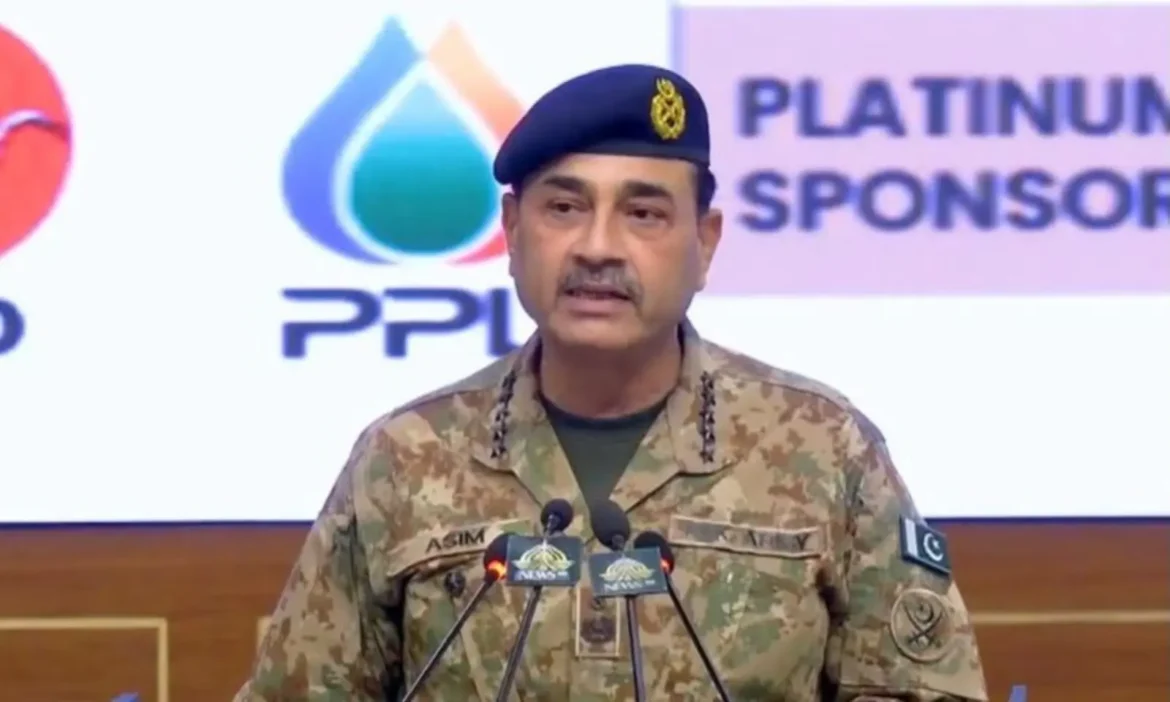
ISLAMABAD: Field Marshal Asim Munir, who commands Pakistan’s army and its combined armed forces, pledged on Friday to protect miners and investors as the government courts foreign capital for an industry beset by militant violence in Balochistan.
Munir told the Pakistan Minerals Investment Forum in Islamabad that the country aims to be a competitive destination for long-term mineral investment, according to state-run Radio Pakistan. He said mines, miners, investments, industries, projects and everyone tied to them would receive adequate protection, and that all possible measures were being taken to secure the mining sector.
He said Pakistan wants more than to export raw materials and intends to build the whole value chain, including refining and manufacturing. People living in mineral-rich areas, he said, should see tangible improvements in their lives. “Pakistan must move from potential to productivity, from promises to action, and from raw exports to value-added growth,” he said.
Prime Minister Shehbaz Sharif, speaking at the same two-day event, which opened on Thursday, said copper and gold production at Reko Diq was expected to start in 2028 after stalling for about two decades. But that timeline is in doubt. Barrick Mining Corp., which operates the project, said in April it would slow development and continue its review until mid-2027, citing security risks, project financing, scope and timeline, and warned that the capital budget and schedule could change significantly. Chief Executive Officer Mark Hill said in September the company needs some improvement in security before it commits to a full construction schedule. Local media reported this month that first production could slip to 2030, though Barrick has made no official announcement to that effect.
Barrick holds 50% of Reko Diq, with the Balochistan government owning 25% and three state-owned Pakistani companies the rest. The company had put first-phase capital costs at $5.6 billion to $6 billion.
Sharif renewed a pledge from last year’s forum to end the export of Pakistan’s minerals in raw form. “That day is not far away when this will come to a grinding halt,” he said. He wants Reko Diq and every project along the Tethyan copper belt to build refineries, smelters, and cable and conductor factories, and told investors to “mine in Pakistan, process in Pakistan, manufacture in Pakistan, and then export to the rest of the world.”
To meet investor demands, Sharif said, the government is simplifying procedures, cutting delays and making the awarding of licenses and contracts transparent. A National Minerals Data Centre and digitized geological records would let companies see what lies underground before committing “a single dime or yuan,” he said. He has told every relevant ministry and department to name a point of contact with authority to settle investor complaints, and invited companies to bring stuck files directly to him. “I will personally ensure that it moves at lightning speed,” he said.
Sharif called the safety of manpower, assets and supply routes the government’s “paramount responsibility.” He said federal and provincial governments would act together. “Your safety is our safety and your protection is our protection,” he said. He also said projects would need the cooperation of local communities and reliable power, water, roads, rail and communications, and that mining must deliver local jobs, contractors, schools, clinics and clean drinking water. He called for responsible mining to international standards, with state-of-the-art technology to protect water, land and workers’ health.
The prime minister also said Pakistan could become the world’s sixth-largest economy “earlier than 2050.” He cited a Goldman Sachs projection that put that milestone in 2075 and said: “I would like to make a small amendment here.”
The near-term outlook is more modest. The International Monetary Fund projects Pakistan’s growth at 3.5% in the current fiscal year, short of the government’s 4% target, and has raised its inflation forecast to 9.9%. The fund’s executive board is tentatively due in late November to consider approving further loan tranches.
The forum was meant to take place in April. Organizers postponed it to November, citing regional developments and uncertainty in the international travel environment. Last year’s edition drew about 5,000 delegates from more than 50 countries and produced 16 memoranda of understanding. Islamabad has invited both China and the U.S. this year, hoping to secure investment toward an estimated $6 billion to $8 billion in annual mineral export potential. Barrick Chairman John Thornton was scheduled to attend.
The security backdrop is the main obstacle to attracting that capital. In April, about 40 militants stormed a copper and gold project operated by National Resources Ltd. in Chagai district, killing ten people, including seven workers and three security personnel, a local official told AFP. In late November last year, militants attacked a compound housing foreign engineers working on the Reko Diq and Saindak projects at Nokundi. ACLED recorded 38 incidents linked to extractive activity in Balochistan between January and September this year.
Washington is a target audience. A $500 million agreement between U.S. Strategic Metals and the army-linked Frontier Works Organization, signed in September 2025, covers exports of antimony, copper, gold, tungsten and rare earths and lays groundwork for a refinery in Pakistan. Still, no U.S. company operates in Balochistan, and the government is urging Washington to lead investment there despite the security risks.
Copyright © 2021 Independent Pakistan | All rights reserved