By Staff Reporter
ISLAMABAD: The military on Saturday accused India of fabricating pretexts for renewed aggression and warned that it would strike deep inside its nuclear-armed neighbor if fresh hostilities erupt, escalating a war of words that threatens to unravel a fragile ceasefire along their disputed border.
The strongly worded statement from the military came in response to provocative comments this week from India’s defence minister and top military officials, who accused Islamabad of sponsoring terrorism and hinted at potential military action and which Pakistan described as “delusional, provocative and jingoistic.”
Indian Army Chief General Upendra Dwivedi warned that India would strike so hard that its rival would “lose a place in history and geography.” Indian Defense Minister Rajnath Singh also alleged that Pakistan had engaged in a military buildup near a sensitive border area, saying “a route to Karachi passes through Sir Creek.”
“Our soldiers have both weapons and high morale,” Singh said. “No challenge can stand before us. Whether it is terrorism or any other kind of problem, we have the capability to deal with and defeat them all.” A day before the Pakistani response, Indian media outlet NDTV reported that Army Chief Gen. Upendra Dwivedi had warned Pakistan to cease what he called state-sponsored terrorism or risk losing its “place on the map.” Dwivedi said Indian forces would “not show any restraint this time,” in what appeared to be a veiled threat of another cross-border operation.
Pakistan’s military pushed back sharply against the Indian statements, charging that the arch-rival was “stoking violence” and “perpetrating terrorism” in the region.
“We have noted with grave concern the delusional, provocative and jingoistic statements coming from the highest levels of the Indian security establishment,” the Inter-Services Public Relations (ISPR), the military’s media arm said in a statement. “These irresponsible statements indicate a renewed attempt at fabricating arbitrary pretexts for aggression — a prospect which might lead to serious consequences for peace and stability in South Asia.”
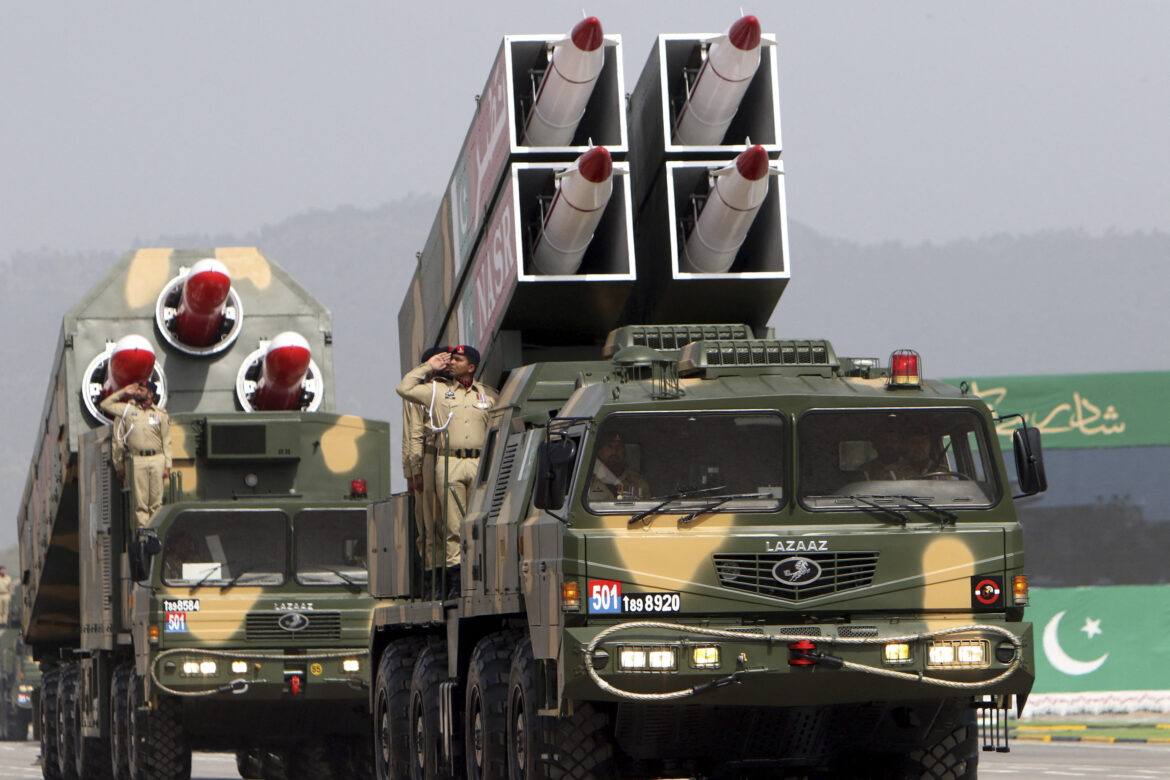
The military said Pakistan would “not hold back” if hostilities resume, signaling a potential for broader and more destructive engagement. “In the face of highly provocative statements of the Indian defence minister and its army and air chiefs, we caution that a future conflict might lead to cataclysmic devastation,” the ISPR statement said. “In case a fresh round of hostilities is triggered, Pakistan shall not hold back. We shall resolutely respond, without any qualms or restraint.”
In a pointed rebuttal to Dwivedi’s map-erasing comment, the military said “as for the talk of erasing Pakistan from the map, India must know that if the situation comes, the erasure will be mutual.” It said that in any future clash, Pakistan would “shatter the myth of geographic immunity, hitting the farthest reaches of the Indian territory” and stressed that the nation and its military possess the “capability and resolve to take the fight to every nook and corner of the enemy’s territory” against “unwarranted threats and reckless aggression.”
The ISPR highlighted its recent military enhancements, noting that “those seeking to establish a new normal must know that Pakistan has established a new normal of response, which will be swift, decisive and destructive.”
The ISPR said the world now recognised India as “the epicenter of regional instability.”
“For decades, India has benefitted from playing the victim card and painting Pakistan in negative light, while stoking violence and perpetrating terrorism in South Asia and beyond,” the military said, adding that India’s narrative has been “sufficiently debunked” and that “now the world recognises India as the true face of cross-border terrorism and the epicentre of regional instability.”
The ISPR also referenced the May conflict directly. “Earlier this year, the Indian aggression against Pakistan brought two nuclear powers to the brink of a major war. However, India seems to have forgotten the wreckage of its fighter jets and the wrath of Pakistan’s long range vectors. Suffering from collective amnesia, India now seems to be aching for the next round of confrontation.”
The latest tensions trace back to earlier this year, when India launched airstrikes on several sites in Pakistan following a militant attack in the occupied Kashmir. New Delhi blamed the assault on Islamabad, which denied involvement and called for an international probe. The strikes triggered intense exchanges of missiles, drones and artillery between the two sides before the ceasefire was announced on May 10. Pakistan said it shot down six Indian fighter jets, including French-made Rafales, during the clashes. India acknowledged some losses but disputed the number.
The two South Asian rivals have fought three full-scale wars and numerous border skirmishes since their independence from Britain in 1947, with much of the conflict centered on the Kashmir region, which both claim in full but control in parts
Copyright © 2021 Independent Pakistan | All rights reserved