By Staff Reporter
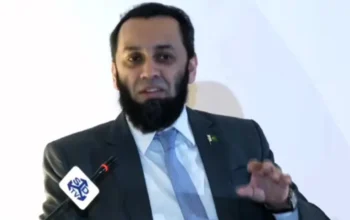
ISLAMABAD: Zeeshan Ali, a Pakistani pilot, has become the first foreign astronaut to enter China’s Tiangong space station, a milestone for Islamabad’s space ambitions and for Beijing’s drive to extend its diplomacy into orbit.
Ali and his two Chinese crewmates entered the station at 2.35pm Beijing time (0635 GMT) on Wednesday, about six hours after the Shenzhou-24 spacecraft lifted off from the Jiuquan satellite launch centre in north-west China. The capsule docked 3 hours and 38 minutes after launch, the China Manned Space Agency (CMSA) said.
‘As the first foreign crew member to board the China Space Station, I am incredibly excited. China Space Station here I come!’ Ali said in Chinese, according to the state broadcaster CCTV.
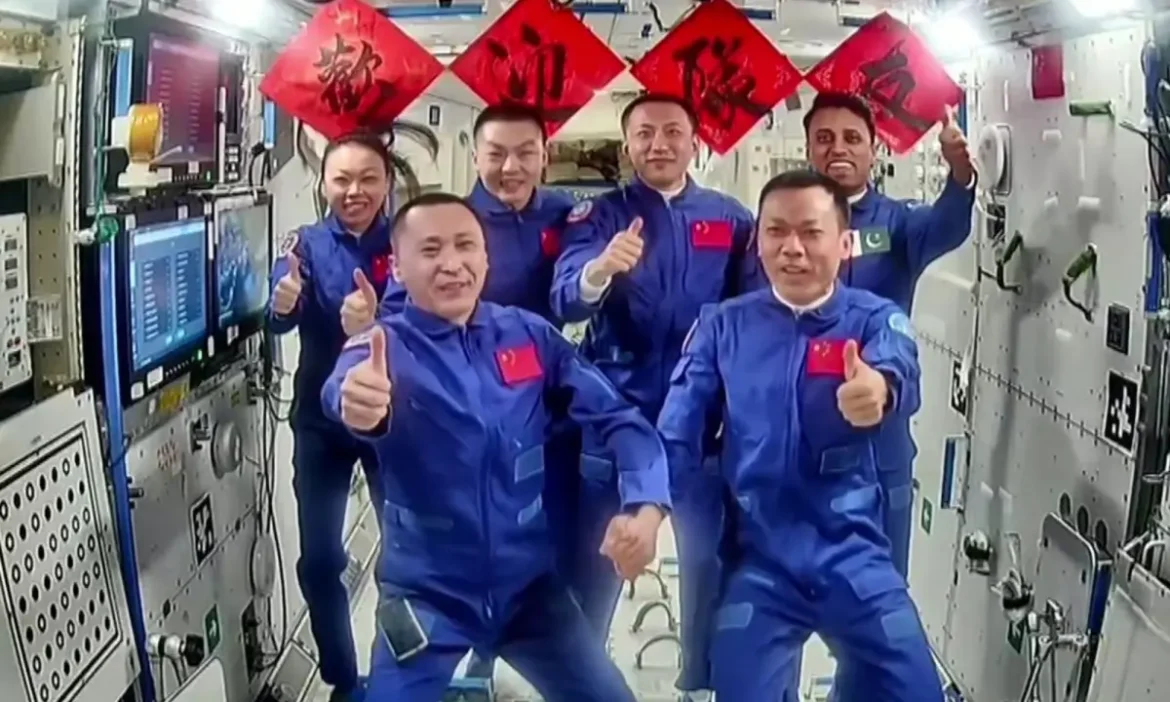
The Shenzhou-24 crew, commanded by Tang Hongbo and including the mission pilot, Wu Yi, were greeted with hugs by the three Shenzhou-23 astronauts already on board, who had prepared a cake. The two crews posed for group photographs, the ninth such in-orbit gathering in China’s space history, Xinhua reported. CGTN, the state broadcaster’s English-language channel, said on X that ‘butter chicken was on the menu’ for what it called a dinner for six, with more than 100 halal dishes selected for the Pakistani guest, among them beef nihari, lamb korma and curried chickpeas.
The flight is the first time China has agreed to select and train astronauts for another country, and the first crewed mission in which Chinese and foreign astronauts have flown together. It follows an agreement signed in February 2025 in the presence of Pakistan’s prime minister, Shehbaz Sharif. Tiangong, fully operational since late 2022, had until now hosted only Chinese crews.
Pakistan has reached orbit ahead of its regional rival: India’s first crewed mission, under its Gaganyaan programme, is not expected to launch before the second quarter of 2027.
In a letter to Pakistan’s president, Asif Ali Zardari, Xi Jinping said the two countries’ astronauts ‘joining hands in the quest for the universe represents a living testament to their deep-rooted friendship’. ‘The Chinese space station is an ark of peace, friendship and cooperation,’ the Chinese president wrote, adding that China was ready to ‘deepen international space cooperation and improve global outer space governance’.
The Long March-2F rocket left the pad at 8.18am Beijing time (5.18am in Pakistan) in a cloud of flames and smoke beneath a pink sky, CCTV footage showed. The spacecraft separated from the rocket about 10 minutes later and entered orbit. ‘The spacecraft is functioning well,’ an official at the launch centre said. ‘I declare the Shenzhou-24 launch mission a complete success.’
Ali, who is a payload specialist, is expected to stay between five and 10 days. Pakistan’s space agency, Suparco, said he would grow microalgae as a possible source of food and oxygen for future missions and test the effects of spaceflight on quinoa seeds. Pakistani payloads are due to be installed in the station’s Wentian and Mengtian laboratories. The CMSA said the crew as a whole would carry out about 90 experiments, alongside the rotation of crews and routine maintenance.
Ali and a second candidate, Khurram Daud, were chosen in April to begin training in China. Ali spent seven months in Beijing, where, in addition to flight preparation, he took intensive Chinese-language classes, learned Chinese songs, read Chinese poetry, practised calligraphy and played table tennis.
At a press briefing in Jiayuguan on Tuesday, Ali said he was ‘deeply grateful’ to the Chinese government for helping ‘us realise our dream of going into space’. He said he believed ‘what comes after this flight matters more than the flight itself’.
‘This mission is not a finish line; it is a launch pad,’ he said. ‘I hope the next chapter of China-Pakistan space cooperation will grow from one astronaut, one flight to multiple joint flights, to the Moon, Mars and beyond.’
Speaking to Pakistanis, he said: ‘I am not flying for myself. I carry the name of Pakistan on my shoulders, the hopes of 250 million Pakistanis. To every child who is watching while I am in orbit, just look up at the sky and remember that I am up there with your dreams.’
In a message to his family, he said: ‘I will travel farther from home than ever before. But I promise you one thing: whenever I look back at the Earth for the first time, I will always search for the light of our home before I look at anything else. No matter how far I fly, we will still share the same Moon, and I will still be looking back at the same Earth.’
In Islamabad, the launch was greeted as a national event. Sharif said Pakistan had begun its journey ‘beyond the stars’, describing the flight as belonging not to one astronaut but to the whole country, particularly its young people and scientists. He called it a reflection of the ‘ironclad friendship’ between the two countries, and said they were now working together ‘not only for peace and development on Earth but also in space’.
The deputy prime minister and foreign minister, Ishaq Dar, called it a ‘proud moment’ and a milestone in the countries’ ‘all-weather strategic cooperative partnership’, as they mark 75 years of diplomatic relations. Ahsan Iqbal, the planning minister, who watched the launch in China, said on X that it was ‘Pakistan’s URAAN (flight) into space, and it is only the beginning of a brighter and more glorious future’.
The military leadership, including the army chief, Field Marshal Asim Munir, also congratulated the nation in a statement issued by its press wing, the Inter-Services Public Relations. Zardari, for his part, expressed ‘profound appreciation’ to Beijing for choosing Pakistan as its first foreign partner in its crewed space programme.
The handover aboard the station will not follow the usual pattern. Tiangong can accommodate six astronauts while crews overlap, but the Shenzhou-23 commander, Zhu Yangzhu, will remain behind to support Chinese research on how the human body copes with long spells in space. That is regarded as a crucial step towards a planned crewed lunar mission and a possible journey to Mars. Zhu, who will stay for a year, will by the time he leaves hold the record for the longest single stay in orbit by a Chinese astronaut. The other two Shenzhou-23 crew members will return to Earth with Ali.
Beijing has poured billions into its space programme and aims to land astronauts on the Moon before 2030, a race in which the US is also competing through its Artemis programme.
Copyright © 2021 Independent Pakistan | All rights reserved