By Staff Reporter
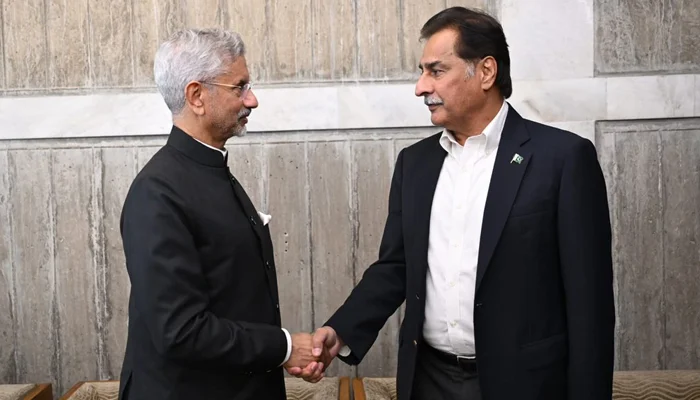
ISLAMABAD: In a brief but symbolic encounter, the speaker of the National Assembly, Ayaz Sadiq, shook hands with India’s foreign minister, Subrahmanyam Jaishankar, on Wednesday during a funeral in the Bangladeshi capital, marking the first high-level contact between officials from the two nuclear-armed neighbors since a military clash in May that brought relations to a new low.
The interaction, described in a statement from the National Assembly secretariat as an approach initiated by Jaishankar, occurred as Sadiq attended the funeral of Khaleda Zia, Bangladesh’s trailblazing first female prime minister. The encounter, which took place amid a gathering of world leaders paying respects to Zia, who died on Tuesday at age 80, came against a backdrop of a year marred by accusations, airstrikes and disputes over Kashmir and shared rivers that have deepened the longstanding enmity between Islamabad and New Delhi.
Flags across Bangladesh flew at half-mast, and thousands of security personnel lined the streets of Dhaka as Ms. Zia’s body was transported in a vehicle draped with the national flag. Leaders from around the region, including Sadiq and Jaishankar, traveled to the capital to attend the ceremonies honoring the former leader, who served as prime minister from 1991 to 1996 and again from 2001 to 2006.
“Indian External Minister Dr S Jaishankar approached the Speaker [of the] National Assembly and shaked hands,” the statement said. “During this interaction, Dr S Jaishankar introduced himself to the speaker and told the speaker that he had recognised him.” “This interaction marked the first significant high-level contact initiated by the Indian side following the Pakistan-India conflict in May 2025,”
The statement emphasised Pakistan’s stance since the conflict’s trigger by an attack in Pahalgam in the Indian-occupied portion of Kashmir, which India attributed to Pakistan-based militants. Islamabad has denied involvement and repeatedly called for an independent investigation, framing the incident as a potential “false flag” operation.
“Pakistan has consistently emphasised dialogue, restraint and cooperative measures, including proposals for peace talks and joint investigations into the alleged false flag Pahalgam incident, in order to prevent unprovoked aggression and escalation,” the statement added. The Pahalgam attack, which heightened fears of broader confrontation, prompted India to impose a series of unilateral measures against Pakistan. Among the most significant was the suspension of the Indus Waters Treaty, a 1960 agreement brokered by the World Bank that has governed the sharing of six rivers between the two countries and survived multiple wars and decades of hostility.
India also downgraded diplomatic relations, shuttered the primary border crossing and applied economic pressures, citing the attack as a severe provocation that demanded a forceful response. Pakistan, rejecting the allegations, urged a transparent probe. But tensions escalated dramatically on May 7, when India conducted airstrikes in Punjab province and the Azad Kashmir. The strikes ignited a four-day exchange of fire, with both sides targeting each other’s air bases in retaliatory actions, involving fighter jets, missiles, artillery and drones.
Casualties were reported on both sides. It was only through American diplomatic intervention that a ceasefire was secured on May 10, averting what could have become a more protracted conflict between the South Asian rivals. Pakistan claimed to have downed seven Indian fighter jets during the fighting, including French-made Rafales. India acknowledged “some losses” but rejected the figure of seven.
The rift extended beyond diplomacy and warfare into sports. During the ACC Men’s Asia Cup 2025, Indian players reportedly refused to shake hands with their Pakistani counterparts, even as the teams faced off three times, including in the final.
The water dispute has persisted as a flashpoint. In June, the Permanent Court of Arbitration in The Hague, which handles international disputes, issued a supplemental award affirming its competence in the matter and declaring that India could not unilaterally suspend the treaty.Earlier this month, Pakistan’s Foreign Office raised fresh concerns about what it called New Delhi’s “weaponisation of water,” pointing to sudden fluctuations in the flows of the Chenab and Jhelum rivers that disrupted farming in Punjab province.
Foreign Minister Ishaq Dar, addressing the issue, highlighted the court’s ruling that “reaffirmed the continued validity of the treaty and its dispute-resolution mechanisms.” He also invoked worries voiced by United Nations rapporteurs regarding India’s handling of the accord.The handshake in Dhaka, while limited to a greeting, arrives at a moment when both nations grapple with the fallout from these events.
Analysts have noted that the Indus Waters Treaty’s suspension represented a rare breach in a framework designed to insulate resource sharing from political strife, potentially setting a precedent for future escalations. Neither side has commented extensively on the encounter, but it underscores the fragile nature of diplomacy in a region where Kashmir remains a core dispute, unresolved since the partition of British India in 1947. With both countries possessing nuclear arsenals, any thaw — however tentative — could carry implications far beyond their borders.
Copyright © 2021 Independent Pakistan | All rights reserved