By Staff Reporter
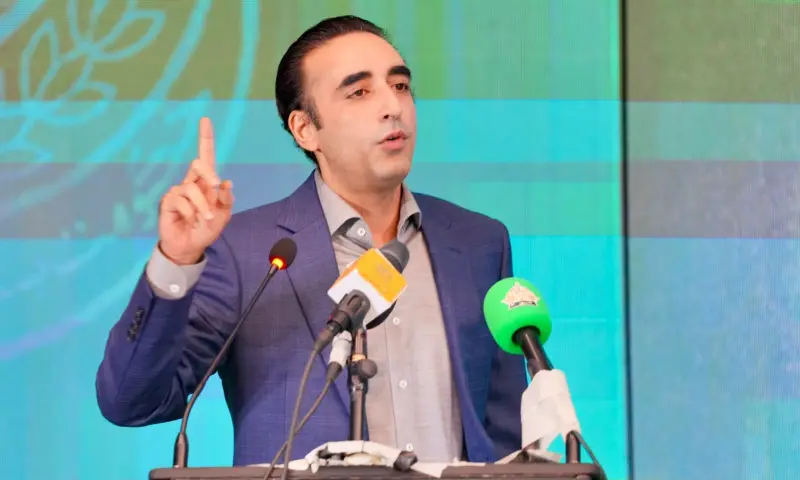
KARACHI: Bilawal Bhutto-Zardari, chairman of the Pakistan Peoples Party (PPP), said on Monday that any reset of the country’s political order must be a democratic one, a direct challenge to Interior Minister Mohsin Naqvi’s push for new provinces and a referendum to settle the question.
“To restore the trust of Pakistan’s youth, if any reset is to take place, it must be a democratic reset,” he told the launch of the Sindh Youth Card in Karachi.
“If a democratic reset happens, then the people’s stake will remain, and through that reset, we must restore the supremacy of our Parliament. We must restore confidence in our judiciary, and the election system we have, we must restore trust in it now.”
Naqvi, who began the “reset” debate in July, spent the same day rallying support in the other direction. He met Chaudhry Shujaat Hussain, the PML-Q chief, at his residence in Lahore, where new provinces and the devolution of power were discussed, then flew to Islamabad to call on Prime Minister Shehbaz Sharif. An official handout said he briefed the prime minister on law and order.
Shujaat gave the minister a hearing but not a blank cheque. He said the question of new provinces was tied to public convenience, good governance and administrative efficiency, and that strengthening existing units could also work. “The biggest stakeholders of Pakistan are its ordinary people,” he said. “If we do not take steps in the right direction today, tomorrow will not forgive us.”
How the argument arrived here
Naqvi first declared on 31 July that Pakistan’s system of governance had “collapsed” and needed a “reset”, and called for new provinces or administrative units. The military spokesman, Lt Gen Ahmed Sharif Chaudhry, supported an administrative reset if one was required for good governance.
The PPP, whose votes the coalition depends on, pushed back. The Sindh Assembly passed a resolution on 4 September rejecting any attempt to divide the province or alter its boundaries.
Last Tuesday, in a combative speech at the Karachi Press Club, Bhutto-Zardari said the system had not collapsed but had been “made to collapse”. He rejected both the division of Sindh and a referendum on it, and warned that any forced attempt to divide provinces, Sindh in particular, could lead to bloodshed. The MQM-P, which favours more provinces in Sindh, reacted angrily. Its leader Farooq Sattar asked state institutions to take notice, and the federal minister Mustafa Kamal said the remarks had hurt him.
On 12 November, Naqvi proposed a referendum as the way out, saying he would side with the public whatever it decided. He also claimed he and Bhutto-Zardari were “nearly on the same page”. The same day he made an unscheduled visit to Nawabshah to see President Asif Ali Zardari, the PPP co-chairman. Sources said provinces were discussed, but the President’s House said the talks covered national security and the regional situation.
The government says a referendum is coming
Defence Minister Khawaja Asif has since moved the matter on. Speaking on a private news channel on Sunday, he said the debate would take “some definitive shape” by the end of the year, with the process likely to advance early next year. “I can certainly say that it is not going to take two to four months,” he said, though he would not name a date.
He said the question would be settled jointly with all stakeholders, and clearly aimed at the PPP, and that it would call for a yes or no answer. He also accepted that a referendum could not stand in for the Constitution’s amendment procedure. “There is room for a referendum in the Constitution; there is no doubt about that. However, the procedure for a constitutional amendment is also laid down in it, and no one can deviate from that procedure,” he said.
“I think politics is the art of the possible, and this will definitely be made possible, God willing,” he added. Asif has previously backed as many as 12 provinces.
Parliamentary Affairs Minister Tariq Fazal Chaudhry said last week that a referendum “will happen” and that the PML-N would make “every last effort” to convince the PPP. “A referendum is neither non-constitutional nor undemocratic; the public’s opinion can be sought on any important matter,” he said.
Wider appeal
At the Youth Card ceremony, Bhutto-Zardari said little directly about provinces. He spoke instead of trust, and said it would have to be rebuilt as a “joint effort”: the opposition’s trust in the government and the government’s in the opposition, and the public’s trust in the country’s system, its parliament, judiciary and media.
He said a Pakistan with that trust could finally unite, and so face economic hardship, terrorism and climate-related disasters. “I know that a Pakistan that is united, [will] have the ability to face any crisis, any disaster, any catastrophe,” he said.
“At the same time, I fear that if we keep fighting among ourselves and remain divided further, and [spread hatred] in society instead of hope, then we will not have the capacity to face any crisis.”
The young, he said, would one day ask what leaders had done to protect them. “And at least I want when that question is asked, I can proudly, with my head held high, say that my intentions were good,” he said.
Bhutto-Zardari said he had been in Pakistani politics for twenty years and kept ties with every party. “Given the circumstances we face today, and the position we are in, if I myself am disillusioned, one can only imagine how the people of Pakistan, especially the youth, must feel,” he said. He added: “Even if I fail, history will remember that a young man stood up and tried.”
On corruption, he said the young wanted a country free of it. He said that required digital systems, such as the Youth Card or the Kissan Card, to close the avenues for graft, and “a system that functions without discrimination”.
PTI keeps its options open
The opposition Pakistan Tehreek-e-Insaf (PTI) added a twist. Barrister Ali Zafar, its parliamentary leader in the Senate, said outside the Islamabad High Court that Karachi could become a province, and that Imran Khan favoured new provinces. A referendum, though lawful, could only gauge opinion, he said, and provinces had to be created in the way “already mentioned in the Constitution”, meaning with the consent of the relevant provincial assembly.
“We will make our decision after analysing the draft of the 28th amendment,” he said. No such draft has been officially proposed, although talk of one has circulated since May. Zafar listed Karachi, interior and central Sindh, north and south Punjab and Hazara as places where provinces could be created. A PTI spokesman had earlier dismissed the referendum idea as absurd and futile.
Demands for new provinces long predate Naqvi. South Punjab, Bahawalpur and Hazara have all sought separate status, and the Punjab Assembly passed resolutions in 2012 backing South Punjab and the restoration of Bahawalpur province. Neither led to constitutional change.
Copyright © 2021 Independent Pakistan | All rights reserved