By Staff Reporter
ISLAMABAD: China and Pakistan pressed the United States and Iran on Friday to halt their renewed fighting and resume negotiations, warning that a fragile truce brokered last month over the Strait of Hormuz is unravelling into a cycle of daily strikes and counterstrikes.
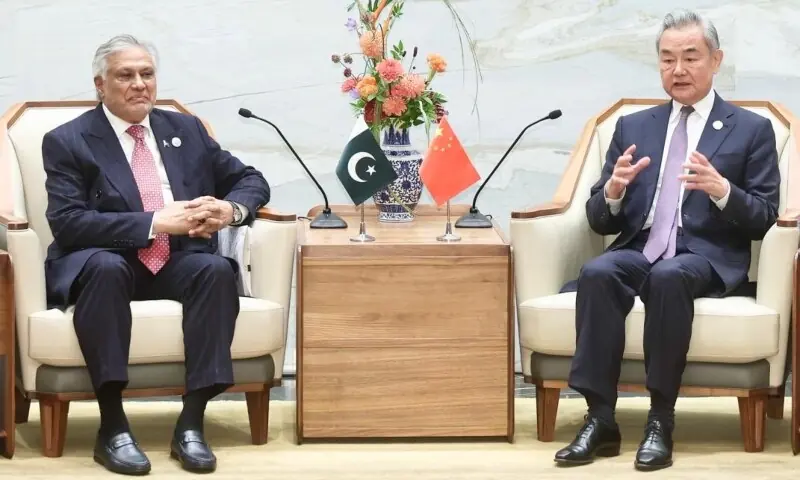
The appeal came out of a meeting in Shanghai between Chinese Foreign Minister Wang Yi and Pakistani Deputy Prime Minister and Foreign Minister Ishaq Dar, according to statements released separately on Friday by the foreign ministries in Beijing and Islamabad. The two officials “expressed concern over the deterioration of the current situation,” Beijing’s ministry said, and called on “the involved parties to immediately cease hostilities” and “return to dialogue.”
Wang described the preliminary agreement reached between Washington and Tehran as “hard-won” and cautioned against squandering it now. “Peace is before our eyes,” he said. “[We] cannot fall at the last hurdle and even more so cannot lose what we have gained.”
The diplomatic push comes as the conflict has sharply escalated over the past nine days. Iran said Friday it had launched fresh strikes on American facilities in the Gulf, marking a sixth consecutive night of American strikes on Iranian military sites. The exchanges have effectively unwound a truce reached last month, replacing it with what has become a near-daily pattern of attacks and reprisals.
At the centre of the collapse is the Islamabad memorandum of understanding, signed June 18, which had set out a 60-day negotiating window meant to reopen the Strait of Hormuz to shipping and bring a formal end to the war. Fighting resumed July 8, throwing the accord’s future into serious doubt.
Pakistan, which along with China has positioned itself as a mediator between Washington and Tehran, urged all sides Friday to show restraint and avoid steps that could further destabilise the region. It is a role Islamabad has played since March, when it joined China in issuing a five-point framework for restoring peace in the Gulf and the wider Middle East — an initiative unveiled after an earlier meeting between Dar and Wang in Beijing.
Friday’s session in Shanghai took place on the sidelines of the World Artificial Intelligence Conference, where Dar led a Pakistani delegation a day after his country signed on as a founding member of a newly established body, the World Artificial Intelligence Cooperation Organization. That broader agenda was reflected in the bulk of the two ministers’ discussion, which extended well beyond the Middle East crisis and into the substance of the Pakistan-China relationship itself.
According to Pakistan’s Foreign Office, the two sides reviewed what it called the “broad canvas” of bilateral relations and voiced satisfaction with the steady growth of the partnership, reaffirming their commitment to what both governments describe as an “all-weather strategic cooperative partnership.” Much of that conversation centered on the second phase of the China-Pakistan Economic Corridor, the infrastructure and investment program known as CPEC 2.0, with both sides agreeing to deepen cooperation in trade, investment, science and technology, the digital economy and artificial intelligence.
The ministers also traded views on regional and global developments more broadly, the Foreign Office said, and reaffirmed their intention to stay in close coordination on issues of shared interest, including in multilateral settings.
Dar’s delegation in Shanghai included Shaza Fatima Khawaja, the minister for information technology and telecommunications; Ali Mustafa Dar, adviser to the chief minister of Punjab on artificial intelligence and special initiatives; Bilal Bin Saqib, chairman of the Pakistan Virtual Assets Regulatory Authority; Dr. Syed Asad Ali Gillani, additional secretary for Asia Pacific at the Ministry of Foreign Affairs; and Aizaz Khan, Pakistan’s chargé d’affaires in Beijing.
Copyright © 2021 Independent Pakistan | All rights reserved