By Staff Reporter
MURIDKE: Police clashed with protesters from the hardline Islamist group Tehreek-i-Labbaik Pakistan on Monday, dispersing a camp outside Lahore and leaving at least four people dead, including a police officer, in a confrontation that reignited tensions and prompted fresh road closures across the region.
The violence unfolded after days of standoffs as TLP sought to march on Islamabad to demonstrate in support of Gaza and Palestine outside the United States Embassy. Authorities had blocked their path with trenches and heavy security, but the predawn operation escalated into hours of chaos, with protesters accused of hurling stones, batons embedded with nails and petrol bombs before opening fire.
A senior police official, speaking on the condition of anonymity, confirmed that the action to clear the site began at 3 am and continued for six hours. Punjab’s inspector general of police, Dr. Usman Anwar said the TLP’s leader, Saad Rizvi, had neither been arrested nor injured in the clash.
The encounter claimed the life of Shehzad Nawaz, the station house officer at Sheikhupura’s Factory Area police station, where Muridke is located. Punjab police posted on X about the officer’s “martyrdom in firing by armed groups” while he was “trying to maintain order and protecting peoples’ lives and properties.” A police spokesperson, Mubashir Hussain, said three TLP workers were also killed, along with a passerby caught in the crossfire. Forty-eight law enforcement personnel were injured, 17 from bullet wounds, and eight civilians were hurt.
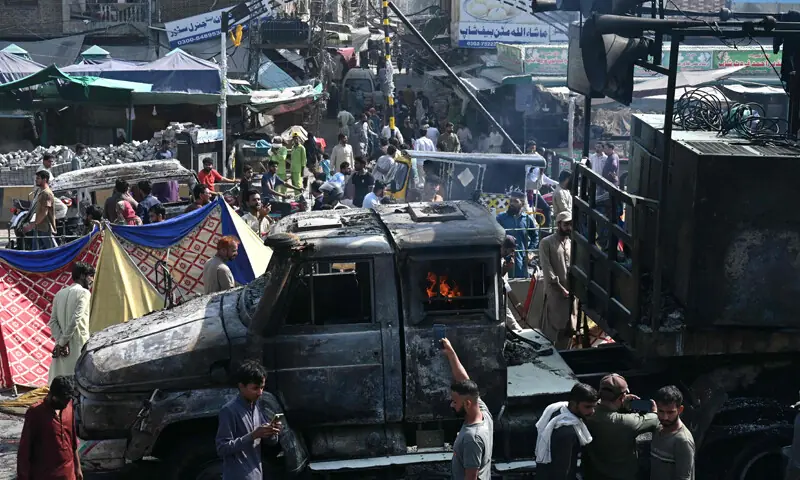
Hussain said the TLP protestors set 40 government and private vehicles on fire. Videos circulating on social media showed scenes of burnt vehicles and smoke rising amid the clashes, underscoring the intensity of the confrontation.
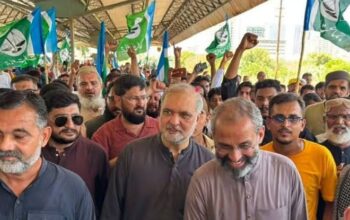
The TLP’s march had begun in Lahore on Friday, drawing thousands in a show of solidarity with Palestinians. By Sunday, authorities had deployed Pakistan Rangers (Punjab) and police from five districts to surround the camp at Muridke, signaling preparations for a crackdown. Talks between the government and the group were reported to be underway that day, but they failed to avert the violence. In the aftermath, police arrested several protesters, adding to detentions that have mounted since the protest’s start. On Saturday, Lahore’s deputy inspector general of operations, Faisal Kamran, told the media that 112 police personnel had been injured up to that point.
The unrest rippled beyond Punjab. In Karachi, TLP supporters staged demonstrations in North Karachi and New Karachi against the police action in Muridke. West-Zone Deputy Inspector General Irfan Ali Baloch said protesters blocked main roads at 4-K Chowrangi and Sindhi Hotel, disrupting traffic. When officers tried to disperse them, demonstrators allegedly pelted stones, injuring two constables. “The police resorted to tear gas shelling and arrested five of them,” Baloch told said, noting that roads were later cleared.
The Sindh Home Department urged residents to “ignore rumours about chaos” in the city. Home Minister Ziaul Hassan Lanjar, in a statement, called for “immediate action” against those spreading rumors and ordered that violators of Section 144, a ban on public gatherings, be dealt with firmly. He directed police to remain alert, with anti-riot squads on standby, and to tighten operations at sensitive areas. “Staff assigned to monitor the city should be kept on high alert and as soon as a crowd or disruptive activity is reported anywhere in the city, senior officers should be alerted immediately,” the statement quoted him as saying.
Back in Lahore, an anti-terrorism court remanded at least 100 TLP activists into police custody for 11 days on charges of vandalism and assaulting officers. The activists, presented before Judge Manzar Ali Gul, faced multiple cases, including 62 registered at Nawan Kot police station. Government officials framed the protests as a threat to public order.
At a news conference, Punjab’s information minister, Azma Bokhari, emphasized the state’s duty to safeguard lives and property. “Blocking roads and creating inconvenience for citizens, especially when peace has been restored in Gaza and people are happy there, trying to bring the country to a halt and taking the law into one’s hand is unacceptable,” she said.
A post on the Punjab government’s X account went further, accusing the TLP of “attacking the state, firing at and inflicting violence on police, destroying properties and looting and plundering,” which it described as “open treason and terrorism.” The post, accompanied by a video of masked men damaging property, asserted: “The armed mobs of the TLP are not above the law. When the state enforces its writ, these masked criminals stage a drama of playing the victims.”
In Islamabad, barriers around the Faizabad Interchange, the vital link between the capital and Rawalpindi, were briefly removed but reinstated by late morning as panic spread. Only the Islamabad Expressway remained open at the site. Mobile internet, suspended ahead of the protest on Friday and partially restored, faced disruptions in parts of Rawalpindi, with reports of slow speeds. Some schools in Islamabad closed early, citing potential “law and order” issues, and sent messages urging parents to collect children promptly.
In Lahore, authorities shut down major motorways: the M-2 connecting to Islamabad, the M-3 to Abdul Hakeem in Khanewal, and the M-11 to Sialkot. Punjab police later posted on X that injured officers were receiving medical treatment, as the region braced for possible further unrest.
Copyright © 2021 Independent Pakistan | All rights reserved