By Staff Reporter
PESHAWAR: The chief minister of Khyber Pakhtunkhwa Province pressed the federal government on Wednesday to overhaul its strategy against militants, insisting that his administration and local leaders be included in policy decisions against militancy to to avoid repeating the hardships endured by residents over the past 17 years.
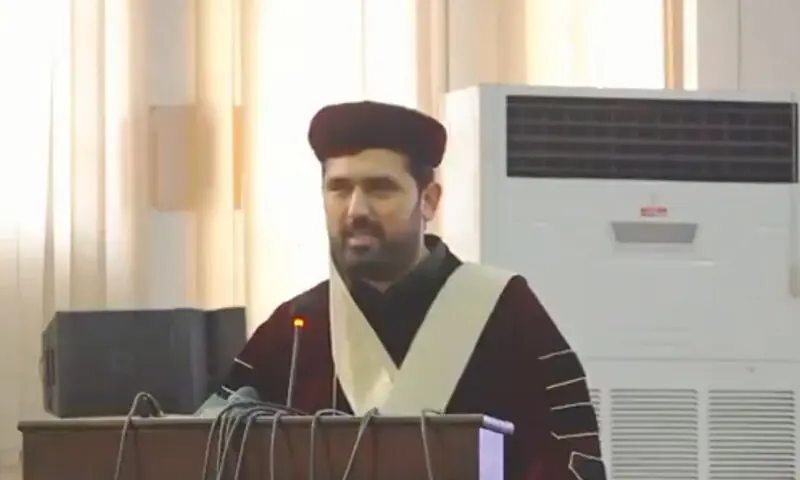
Sohail Afridi, who heads the provincial government with backing from the opposition Pakistan Tehreek-e-Insaf party, made the case during a speech at Peshawar University’s convocation. He said residents had tried to alert Islamabad to militants regrouping in the region, only to have their concerns waved away as political spin. “We would issue warnings that they (terrorists) were in the mountains and they were coming, that they had reached our markets and homes,” Afridi said. “We were told that we are spreading propaganda.”
The plea for consultation came as tensions escalated between the provincial leadership and the central government in Islamabad, with federal officials blaming the PTI-led administration in Khyber Pakhtunkhwa for failing to curb the violence. Governor Faisal Karim Kundi of the province has publicly criticized the party as being in disarray and unable to deliver on its promises.
Afridi argued that military campaigns work only if people on the ground are brought in from the start. “There needs to be a policy shift, but not behind closed doors,” he said. “It needs to be formed after consulting KP’s government, people and stakeholders. A clear policy formed in this manner will play a role in lasting and enduring peace; a decision made behind closed doors will leave our people suffering, as they have for the past 17 years.”
He pointed to mismatched goals between the province and Islamabad. “If they wanted to eradicate terrorism, then they would have sat with us and formed a policy.” He also took aim at broken pledges, recalling how families forced from their homes were told they’d get Rs400,000 in aid for homes destroyed in antiterrorism efforts, but money that never came. “We came out of our homes, so they committed that they would give Rs400,000 to people whose homes have been lost to terrorism,” he said. “Imagine hearing that after sacrificing so much. They still have not received that money.”
The economic toll on families was profound, the chief minister said, with many losing breadwinners to collateral damage in military actions or direct terrorist attacks, plunging them into hardship.
Afridi struck a similar tone the day before at a convocation for Shaheed Benazir Bhutto Women University in Peshawar. “If [you] really want to eliminate terrorism, then come and formulate the policy with us,” he said, adding that operations ought to follow broad public buy-in. He said hard-won stability had slipped away because of secretive choices, but vowed that the people of Khyber Pakhtunkhwa had sacrificed repeatedly for the country and would continue to do so.
Terrorist attacks claimed more lives than ever in Pakistan last year, according to the Annual Security Report 2025 from the Centre for Research and Security Studies, an independent think tank in Islamabad. Deaths tied to terrorism and security clashes jumped nationwide to 3,417 from 2,555 the year before, up 34 percent. Khyber Pakhtunkhwa saw the worst of it, with fatalities climbing to 2,331 from 1,620 — a 44 percent rise that drove more than 82 percent of the country’s overall increase. Local police have been in the thick of it. On Jan. 2, Inspector General Zulfiqar Hameed reported blocking hundreds of threats, especially in the south and former tribal areas, where officers held the line at great personal risk. In 2025, they took out 459 militants in firefights and nabbed over 1,300 others, including 29 with bounties, through 3,277 targeted raids. Seizures ran to heaps of grenades, explosives, guns and ammo.
The chief minister’s push for dialogue and inclusion drew sharp rebuke from the military a day before his university speech. Lt. Gen. Ahmed Sharif Chaudhry, head of the Inter-Services Public Relations, pinned the blame on PTI leaders in the province for creating conditions ripe for trouble, including a “politically conducive environment and the flourishing political-criminal-terror-nexus.” He said 71 percent of last year’s attacks hit Khyber Pakhtunkhwa.
General Chaudhry dismissed Afridi’s stance on negotiations with militants and opposition to military operations, calling it nonsense to seek promises from Afghanistan, which Pakistan blames for sheltering fighters. He ridiculed calls to avoid firm action. “If you do not want a military operation, then what should be done — sit at the feet of khawarij?” he said, using a term for renegades. “Should khawarij leader Noor Wali Mehsud be made the province’s chief minister and allegiance pledged to him?”
The general also accused the PTI of building false narratives from their seats in assemblies and questioned the army’s deployment in the province, saying it was not sent “with shovels to extract minerals.” He linked governance failures, including illegal mining and the proliferation of unlicensed weapons, directly to the persistence of terrorism, insisting that counterterrorism demanded resolute state measures rather than political equivocation.
Copyright © 2021 Independent Pakistan | All rights reserved