By Staff Reporter
ISLAMABAD: A simmering rift between ruling Pakistan Muslim League-Nawaz and its coalition partner, the Pakistan Peoples Party, burst into the open on Monday in the National Assembly, where accusations of constitutional overreach prompted a dramatic walkout and the eventual withdrawal of a contentious ordinance on special economic zones.
The confrontation unfolded on the first day of the year’s initial session of the lower house, showing tensions within the fragile alliance that has propped up Prime Minister Shehbaz Sharif’s government.
Syed Naveed Qamar, a senior Peoples Party lawmaker, took the floor on a point of order to denounce what he described as an unprecedented breach: the promulgation of an ordinance without the signature or approval of President Asif Ali Zardari. “For the first time in Pakistan’s black legislative history, an ordinance has been promulgated without the approval or the signature of the president, which is shameful and against the Constitution,” Qamar said, without naming the measure but later confirmed by party sources to involve amendments to special economic zones.
Qamar said such a maneuver had no precedent even under military rule. “This has never happened, not even in dictatorships,” he said. “How can you promulgate an ordinance and put it into effect, without getting the president’s approval on it?”
Declaring the law invalid in any forum, including courts or Parliament, Qamar announced that his party would boycott proceedings until the issue was resolved. He and other Peoples Party members then staged a walkout, leaving the chamber in protest. Law Minister Azam Nazeer Tarar rose to urge their return. “Please come back and join the proceedings. Let me explain that things are going in the right direction.”
Tarar defended the government’s actions, explaining that ordinances are issued on the prime minister’s advice, which is binding on the president under Article 48(1) of the Constitution. He acknowledged that Article 89 governs the process but insisted on deference to the presidency. The minister said nine or 10 bills and ordinances were pending assent, and that the ministry had only learned on Sunday that Zardari had approved some of them. “Just yesterday, we were informed that the president has been pleased to grant assent to those bills, acts, and ordinances,” Tarar said. “Maybe it’s part of that, or it might not be.”
Invoking Article 75, he noted that bills passed in a joint parliamentary sitting are deemed assented to after 10 days if not signed, but added, “We have not notified even those out of respect for the president.” He mentioned other pending measures, like those on universities, that the government had refrained from enforcing. “I have explained this now, but I will still talk to the relevant quarters and get back to Naveed Qamar.”
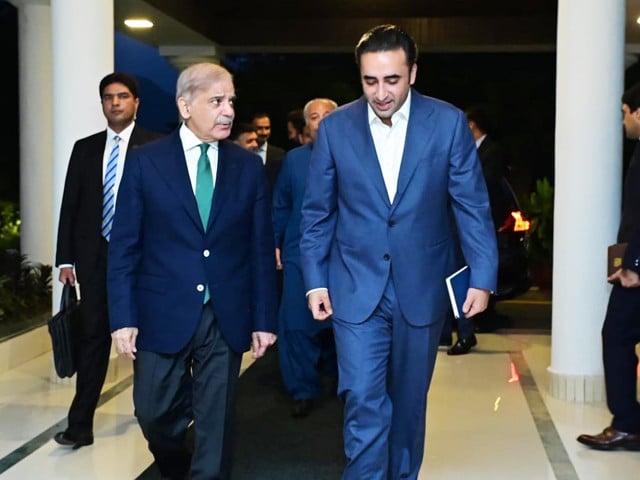
The walkout’s aftermath was swift. Peoples Party Chairman Bilawal Bhutto-Zardari, who had served as foreign minister in Sharif’s prior cabinet, convened an urgent high-level party meeting to address the ordinance concerns, according to media reports. Former Prime Minister Raja Pervez Ashraf, also from the Peoples Party, said a presidential signature is indispensable for an ordinance’s validity. “The president’s signature on an ordinance was essential, which was why it was referred to as a presidential ordinance,” he said. Without it, he argued, the measure becomes unenforceable and void. “An ordinance could not be enforced without the president’s signature and that, in the absence of such approval, it became unconstitutional and illegal.” Ashraf expressed puzzlement over the error. “I did not know how this had happened or why the mistake occurred.”
The session devolved further when Peoples Party member Hussain Tariq returned briefly to highlight a lack of quorum. After a headcount confirmed the shortfall, Speaker Ayaz Sadiq suspended proceedings, adjourning until 11 am Tuesday. By evening, the government capitulated. A statement from the Prime Minister’s Office advised President Zardari to withdraw the Special Economic Zones (Amendment) Ordinance, 2026, under Article 89(2)(b) of the Constitution, citing the summary’s proposal at paragraph 4.
In a parallel development that also showed the assembly’s fractured dynamics, Sadiq advanced the long-stalled process to appoint a new leader of the opposition, a post vacant since August 2025 after the Election Commission disqualified Omar Ayub of the Pakistan Tehreek-e-Insaf following his conviction in cases tied to the May 9 unrest. The opposition had nominated Mahmood Khan Achakzai, head of the Tehreek-i-Tahafuz-i-Ayin-i-Pakistan alliance, in October 2025, but Sadiq had deferred action, citing ongoing litigation where the assembly secretariat was a party.
On Monday, with Ayub having withdrawn his court petitions, the speaker declared the path clear. “This issue had to head towards resolution only then,” he said. “We would have done so if we had not been made a party [to the case].” Invoking Rule 39 of the assembly’s procedures, Sadiq called for nominations by 3 pm Tuesday, backed by opposition members’ signatures. The candidate with the most support would be declared leader after a count on January 14.
On the floor, Dogar affirmed that 76 opposition members had signed in support of Mr. Achakzai, per Imran Khan’s directive. “We are unanimously willing to provide verification however you want,” he said, pledging to complete formalities Tuesday and urging immediate notification. Later, Sadiq met with lawmakers from both the Pakistan Tehreek-e-Insaf and Peoples Party, briefing them on the process.
Copyright © 2021 Independent Pakistan | All rights reserved