By Staff Reporter
QUETTA: Pakistani authorities have imposed an indefinite curfew across a sub-district of Balochistan province after gunmen opened fire on a passenger bus travelling to Karachi, killing three people and wounding five, in the latest bloodshed to hit the restive southwestern region.
The curfew was declared in the Khud Kocha sub-tehsil of Mastung district from 9pm on Wednesday, hours after the attack and a separate explosion that destroyed a bridge on the same stretch of highway. The provincial Home Department said the measure would remain in place until further notice as it moved to contain a deteriorating security situation.
Babar Yousafzai, the department’s spokesperson, said residents had been barred from leaving their homes and that all non-essential movement in the area was suspended. “Strict legal action will be taken against anyone found violating the curfew orders,” he said, calling on the public to avoid unnecessary travel and to cooperate with the authorities until conditions returned to normal.
The bus had been travelling from Quetta to Karachi, operated by a private transport company, when it was ambushed in the Garo area of Khud Kocha tehsil. Police said gunmen positioned in the surrounding mountains fired indiscriminately on the vehicle as it passed below, killing three passengers instantly and injuring five others.
Rescue teams and security personnel who reached the scene took the dead and wounded to the District Headquarters Hospital in Mastung. The bodies were later released to relatives once legal formalities had been completed, while police opened an investigation and began searching for those behind the attack.
Bridge destroyed in overnight blast
The bus attack came only hours after a bridge on the same road — the Quetta-Karachi National Highway, one of the country’s principal arteries — was badly damaged in a bomb blast in the nearby Anjari area, also within Khud Kocha.
A police official said militants had planted explosives beneath the structure and detonated them in the early hours of Wednesday. “The bridge was badly damaged in the explosion, suspending all kinds of traffic on the Quetta-Karachi National Highway,” the official said, adding that no one was hurt in the blast itself.
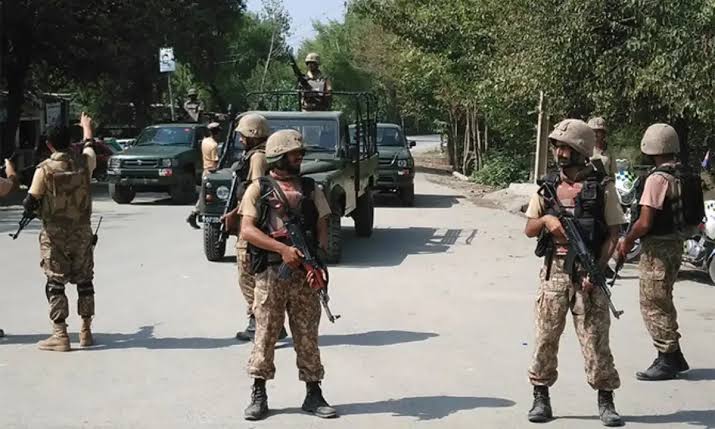
The closure brought traffic on the highway to a standstill for several hours, with long lines of buses, freight lorries and other vehicles backed up on both sides of the damaged crossing. By evening, officials had made temporary arrangements to allow smaller vehicles through, though heavier traffic remained affected. Security forces launched a search operation in the area shortly after the explosion in an effort to trace those responsible.
Wider crackdown under way
Wednesday’s violence came as the Pakistani military said its forces had killed ten militants and detained two female suicide bombers, along with a facilitator, during intelligence-led raids across Mastung and Surab districts over the preceding 48 hours, according to a statement from the military’s media wing, the Inter-Services Public Relations directorate.
The attacks are the latest blow to a province that has endured a sharp rise in militant violence in recent months. Earlier this month, security forces launched Operation Shaban in direct response to a raid on a police post at the Mangi Dam pumping station in Ziarat on 6 July, in which gunmen abducted and killed 27 police officers.
A monthly assessment published in early June by the Pakistan Institute for Conflict and Security Studies found that after two months of relative improvement, the country’s overall security situation worsened considerably in May, driven largely by a surge in attacks in Khyber Pakhtunkhwa and Balochistan. Balochistan alone recorded 71 attacks that month, up from 34 in April — a rise of 109 percent — while 52 of the 54 kidnappings reported nationwide took place in the province, according to the study.
The unrest has drawn direct comment from Pakistan’s civilian and military leadership. On 9 July, Prime Minister Shehbaz Sharif said the country’s political and military establishment had a “mutual and singular decision” to eliminate terrorism, following a string of major attacks in the province. He made the remarks at a meeting of the Provincial Apex Committee on the National Action Plan in Quetta, attended by Field Marshal Asim Munir, the army chief and chief of defence forces.
His comments followed a press briefing a day earlier by Lieutenant General Ahmed Sharif Chaudhry, the military’s chief spokesperson, who accused India and Afghanistan of orchestrating recent attacks in Balochistan. He cited three incidents in particular: an armed assault on the outskirts of Quetta on 5 July, the attack on the Ziarat police post on 6 July, and an ambush of an army convoy in Bela on 7 July.
Copyright © 2021 Independent Pakistan | All rights reserved