By Staff Reporter
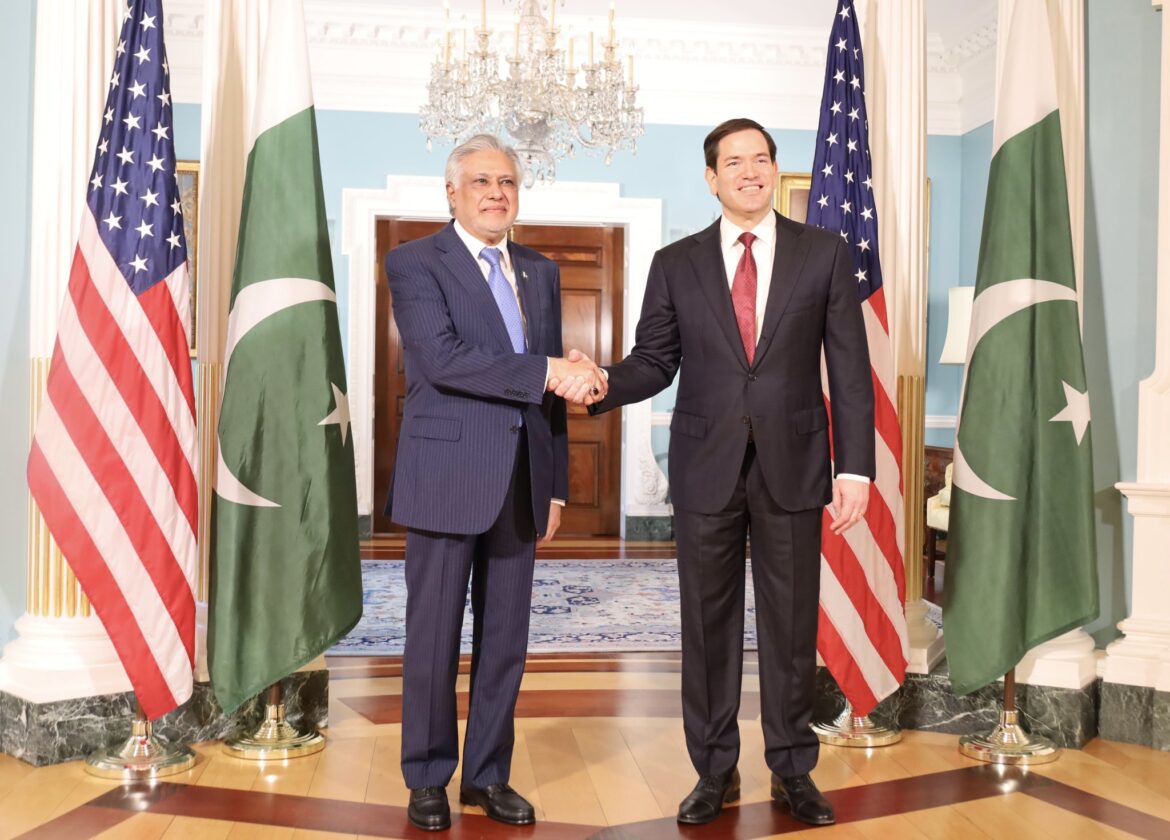
ISLAMABAD: Deputy Prime Minister and Foreign Minister Ishaq Dar will meet US Secretary of State Marco Rubio in Washington on Friday to discuss bilateral relations and Pakistan’s mediation efforts in the three-month-old conflict between the United States and Iran, the Foreign Ministry said on Thursday.
The high-level talks, originally scheduled for Thursday but postponed by a day, come as the fragile April ceasefire between Washington and Tehran showed new signs of strain. Iranian forces and US troops traded limited strikes in the Strait of Hormuz region on Thursday, hours after President Donald Trump presided over a White House cabinet meeting in which he expressed confidence that Iran was eager for a deal.
Dar and Rubio would “review bilateral relations and exchange views on regional and global developments of mutual interest,” the ministry said in a statement. The discussions would also cover “strengthening cooperation in key priority sectors” and highlight “Pakistan’s efforts to promote regional peace and stability through dialogue and diplomacy.” The visit, it added, “reflects Pakistan’s commitment to further deepening its longstanding and broad-based partnership with the United States.” Dar, who also serves as deputy prime minister, is expected to fly back to Islamabad later on Friday after concluding his Washington meetings.
Pakistan has cast itself as the principal go-between in the conflict that began Feb. 28 with coordinated US-Israeli strikes on Iran and quickly drew in retaliatory attacks on American bases across the region. The fighting killed thousands, sent global energy prices soaring, and disrupted shipping through the Strait of Hormuz, a chokepoint for roughly one-fifth of the world’s oil.
A tenuous ceasefire took effect April 8 after intense Pakistani diplomacy. Islamabad hosted the first direct US-Iran talks of the war on April 11 and 12, but the sessions ended without a permanent agreement. Since then, Pakistani officials have continued shuttling messages between the two capitals while consulting allies in Riyadh, Beijing, Doha, and elsewhere.
Thursday’s clashes showed how easily the truce could unravel. Iran’s Revolutionary Guard Corps said it struck a US air base in Kuwait in retaliation for an early-morning American attack on a ground-control station near Bandar Abbas airport, according to Tasnim news agency. US Central Command said American forces had shot down five Iranian drones and destroyed the control station that was preparing to launch a sixth. Kuwait reported intercepting a ballistic missile aimed at its territory, which hosts a large US military installation.
A US official, speaking on condition of anonymity, told Reuters the American actions were “measured, purely defensive and intended to maintain the ceasefire.” The Guard Corps warned that any repeat attack would draw a “more decisive response.” The violence came one day after Trump, addressing reporters during a cabinet meeting, dismissed an Iranian state television report that described an unofficial draft agreement to restore commercial shipping through the Strait of Hormuz to prewar levels within a month. The reported framework would have had Iran and Oman jointly manage traffic, lifted the US blockade of Iranian ports, and required the withdrawal of American forces from Iran’s immediate vicinity — though it left the broader question of US troops in the region for further talks. The White House called the report “a complete fabrication.” Tehran offered no immediate comment.
During the same meeting, Rubio told Trump and the assembled officials that the administration was watching for progress “over the next few hours or days.” He added, “Mr. President, you have other options as well, if that doesn’t work.” Trump responded that Tehran was “in a tight spot” and “just want to make a deal. I don’t think they have a choice.” An Iranian official countered that Trump was “seeking a way out of this strategic deadlock” and “alternates between issuing threats and appealing for an agreement.”
Pakistani Prime Minister Shehbaz Sharif, in an Eid al-Fitr telephone call with Iranian President Masoud Pezeshkian, expressed hope that a peace agreement “which afforded dignity and honour to the Iranian nation” could be reached soon. Such a deal, Sharif said, “would help unlock the true economic potential of Iran and benefit the entire region.”
Dar’s visit to Washington caps a week of intense Pakistani diplomacy. Earlier in New York, he addressed a UN Security Council debate convened by China on the principles of the UN Charter and the peaceful resolution of conflicts. He also met with members of the Pakistani diaspora, highlighting recent improvements in Pakistan’s economic indicators and urging them to invest back home.
For Pakistan, the stakes are both strategic and economic. Longtime ties to Iran, close relations with the Gulf Arab states, and a deepening partnership with the United States have allowed Islamabad to position itself as an indispensable interlocutor. Officials believe that a stable US-Iran accommodation would ease pressure on global energy markets and open new trade routes that could benefit Pakistan’s own economy.
Copyright © 2021 Independent Pakistan | All rights reserved