By Staff Reporter
There is a particular kind of political desperation that announces itself through grandiosity. When a leader who has staked his identity on winning finds himself standing amid the wreckage of a war he started but cannot finish — a war that killed dozens American service members, destroyed 42 aircraft, failed to topple the Iranian regime, failed to eliminate its nuclear programme, failed to permanently open the Strait of Hormuz, and succeeded mainly in radicalising the Gulf against Washington’s regional ambitions — he reaches for the largest conceivable narrative to obscure the rubble.
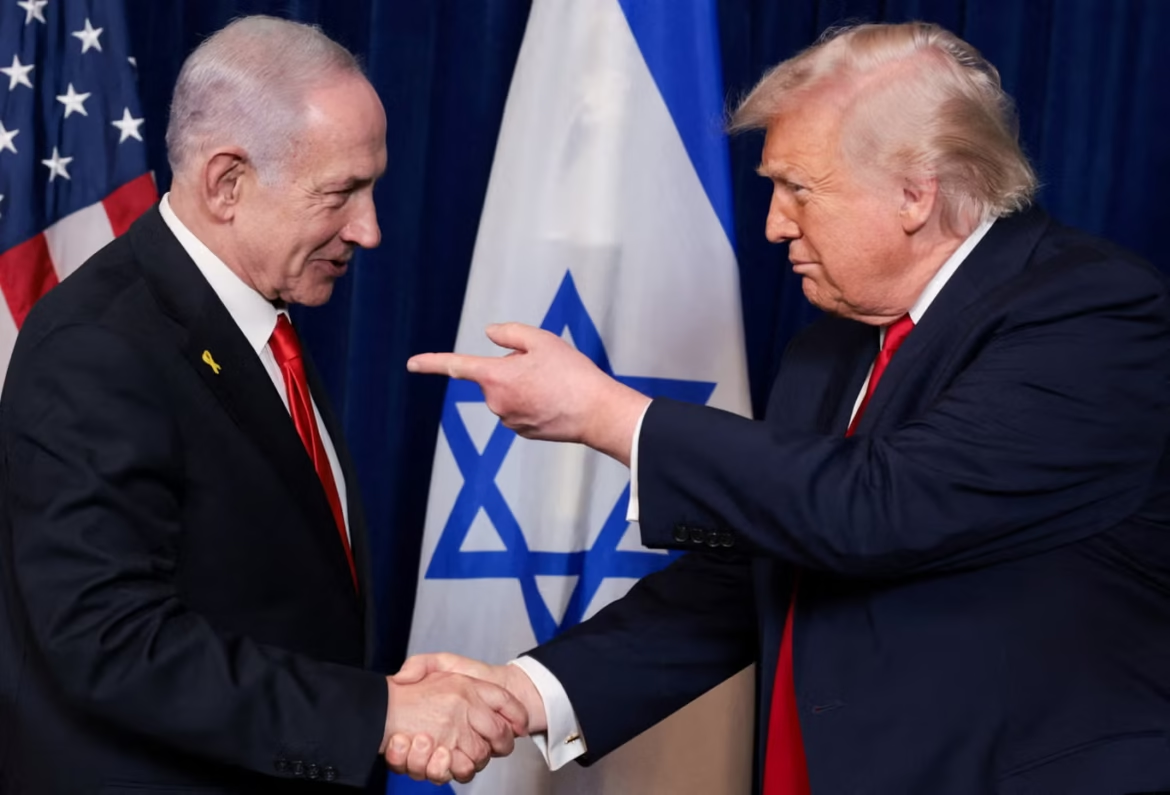
On Monday, in a Truth Social post of characteristic bombast, Trump declared it “mandatory” that Saudi Arabia, Qatar, Pakistan, Turkey, Egypt and Jordan simultaneously sign the Abraham Accords — the US-brokered normalisation framework with Israel — as a condition of any final Iran settlement. He suggested Iran itself might one day join. He spoke of reshaping the Middle East “for the first time in 5,000 years.” He called it the most important document that would ever be signed anywhere in the world.
He was told, in the most diplomatic of ways, to sit down.
According to Axios — one of the most reliable news sources on US-Israel diplomacy — when Trump raised the Abraham Accords demand on a Saturday conference call with the leaders of Saudi Arabia, Qatar, Pakistan, Turkey, Egypt, Jordan, the UAE and Bahrain, there was complete silence. “There was silence on the line,” a US official told Axios, “and Trump joked and asked if they are still there.”
That silence, pregnant and collective, may be the most diplomatically significant moment in this entire crisis. It was not the silence of consideration. It was the silence of disbelief. These are heads of state who had gathered to discuss a delicate ceasefire negotiation — a process in which Pakistan, at considerable diplomatic capital, has been the indispensable mediator. They were not expecting to be told, as an afterthought, to please also normalise relations with a government whose prime minister was under indictment in Turkey, whose military had killed tens of thousands in Gaza, and whose leader had yet to even respond to Trump’s own post about the demand.
The silence was the answer. What followed was the polite diplomatic language of the permanently unmoved.
The Strategic Failure That Dare Not Speak Its Name
To understand why Trump is now in the Abraham Accords business, you have to understand what Operation Epic Fury actually achieved — and what it didn’t. When US and Israeli forces launched joint strikes on Iran on 28 February, the stated objectives were sweeping: regime change, the destruction of Iran’s nuclear programme, the elimination of its ballistic missile capability, and the permanent subordination of the Strait of Hormuz to American will. The director of the US National Counterterrorism Center, Joe Kent — a Trump appointee — resigned in protest, writing that “Iran posed no imminent threat to our nation, and it is clear that we started this war due to pressure from Israel and its powerful American lobby.” That letter has aged with uncomfortable precision.
Three months later, Iran’s theocratic government remains. Its nuclear programme — damaged, yes, but far from dismantled — is still the subject of highly uncertain negotiations in Doha. The Strait of Hormuz, through which a fifth of the world’s oil normally flows, has been reduced to a trickle of 32 vessels a day where once 125 to 140 passed daily. A congressional report detailed the loss of 42 American aircraft over the course of the campaign. Thirteen service members were killed, their deaths acknowledged in a Memorial Day address at Arlington that Trump appeared to deliver with one eye already on the Truth Social post he was about to publish.
As one analyst put it with crisp precision, doubts are growing that Trump can translate tactical military successes into any outcome he can frame convincingly as a geopolitical win. That is the diplomatic predicament now driving everything — the Iran talks, the Abraham Accords push, the Jared Kushner and Steve Witkoff follow-up missions, and above all, the extraordinary spectacle of a US president demanding that Egypt sign an accord with a country it has had a peace treaty with since 1979, and that Turkey normalise with Israel despite Turkey having recognised Israel in 1949. The basic category errors in Trump’s post — apparently unnoticed before it was published — speak to the level of strategic coherence at work.
The Domestic Audience That Actually Matters
Here is the political logic that makes the Abraham Accords gambit legible, even as it remains diplomatically incoherent. Trump is caught between two competing pressures that are tearing his Iran policy apart. On one side, powerful hawkish voices — senators Ted Cruz, Roger Wicker, and the ghost of Mike Pompeo — warned that any deal leaving Iran with unfrozen assets, uranium enrichment capacity, and effective influence over the Strait of Hormuz would be “a disastrous mistake.” The American Israel Public Affairs Committee amplified these criticisms. AIPAC shared Wicker’s post. The pro-Israel right, which forms a significant component of Trump’s base, was threatening to brand the Iran deal as a capitulation comparable to — perhaps worse than — the 2015 Obama nuclear agreement that Trump spent years denouncing.
On the other side, the deal that reportedly sits on the table — a 60-day ceasefire extension, gradual sanctions relief, time-limited nuclear negotiations, possibly $25 billion in unfrozen Iranian assets — is precisely the kind of thing that would have led Trump to call any other president weak and feckless.
The Abraham Accords demand was Trump’s solution to this contradiction. Watch what happened to pro-Zionist American politician Lindsey Graham. On Saturday, Graham was warning that ending hostilities without achieving strategic dominance over the Strait of Hormuz would be a “nightmare” for Israel. On Monday, after Trump announced the Abraham Accords expansion push, Graham called it “simply brilliant.” The senator who had spent months calling for regime change in Iran, threatening Saudi Arabia with “consequences” if it didn’t take military action against Tehran, and attempting to undermine Pakistan’s mediating role, performed the most theatrical of pivots. “With Saudi Arabia and others like Pakistan making peace with Israel,” Graham wrote, “the region will know a level of stability never dreamed of before President Trump.”
Mark Levin, the Israelized commentator who had condemned the potential Iran deal on Saturday, was calling the normalisation push “a truly massive accomplishment!” by Monday. The pattern is unmistakable: Trump had thrown his most skeptical supporters a bone — not a real bone, not one that would actually materialise, but a performative bone, a rhetorical one, the suggestion of legacy-making triumph sufficient to soften their criticism of a deal that may, in practice, leave Iran rather better positioned than it was before Operation Epic Fury began.
Ali Vaez, the Iran project director at the International Crisis Group, diagnosed the manoeuvre with economy and precision: “Trump is trying to sell an Iran deal as an Abraham Accords sequel: good for Israel, good for the region, tough enough for Washington. But he is trading one fantasy for another — from forcing Iran to surrender to pretending a fragile deal can anchor a new Middle East order.”
The Countries That Were Never Going to Say Yes
Against this backdrop, the specific countries Trump named — and the specific conditions they have maintained for years — deserve examination, because they reveal how detached from regional reality the demand actually is.
Saudi Arabia is the case that matters most, geopolitically and symbolically. As the custodian of Mecca and Medina, the birthplace of Islam, any Saudi normalisation with Israel is not merely a foreign policy decision — it is a civilisational statement with consequences for the kingdom’s domestic legitimacy and its standing across the Muslim world. Crown Prince Mohammed bin Salman’s position has been stated, restated, and reiterated in the most unambiguous terms: Saudi Arabia will not normalise with Israel without an irreversible, time-bound pathway to Palestinian statehood. When Trump pressed MBS on this very issue at an Oval Office meeting last November, a meeting described as having “got tense,” the crown prince pushed back. Saudi sources this week were equally clear: the kingdom’s position remains unchanged, and the establishment of a Palestinian state with East Jerusalem as its capital is the non-negotiable precondition.
Netanyahu’s government has ruled out any Palestinian state. That gap is not a negotiating distance — it is a categorical impasse. Asking Saudi Arabia to overlook it is not diplomacy; it is an instruction to do something politically impossible.
For Pakistan, the situation is constitutionally and historically rooted in ways that Trump’s team appears not to have absorbed. Pakistan has never recognised Israel in its 78-year history. That position traces directly to the country’s founder, Muhammad Ali Jinnah, who rejected the UN partition of Palestine in 1947-48. Every Pakistani government since — military, democratic, hybrid — has held that line publicly, even under significant American pressure. When the original Abraham Accords were signed in 2020, then-Prime Minister Imran Khan, now imprisoned, stated plainly that Washington had been pushing him to normalise and that his conscience would not permit it. His successor Shehbaz Sharif, no ally of Khan’s in any other matter, has been equally categorical. Foreign Minister Ishaq Dar stated after the army chief’s White House visit: “We are not ready to recognise Israel until the two-state solution to the Palestine conflict is accepted. There is no change in our stated policy on the Palestine issue. Let it be clear to everyone.”
The irony runs deep. Pakistan has been Trump’s most indispensable partner in the Iran crisis — the country whose prime minister and army chief he has repeatedly praised in the most effusive terms, calling Field Marshal Asim Munir his “favourite field marshal.” It was Pakistan that brokered the April 8 ceasefire, extended it on April 21, and whose army chief undertook a high-stakes mediation visit to Tehran over the weekend, meeting the Iranian president, parliament speaker, foreign minister, and interior minister to keep the peace process alive. Pakistan’s diplomatic capital in this crisis is earned and real. To respond by demanding that Islamabad reward Israel for what former Senator Mushahid Hussain Syed rightly described as the “genocide” in Gaza is not merely unrealistic — it represents a fundamental misreading of what Pakistani mediation is and what it costs politically in a country where public sentiment on Palestine runs deep. Michael Kugelman of the Atlantic Council put the position bluntly: “Islamabad has always linked recognition of Israel to the establishment of a Palestinian state. That’s been an ironclad position. So for now, joining the Abraham Accords is a nonstarter for Pakistan.”
Qatar, meanwhile, has spent two years serving as the primary back-channel between Israel, Hamas, and the United States throughout the Gaza war. Qatar’s entire diplomatic utility in this region rests on its ability to maintain relations with parties that others will not speak to. Asking Qatar to normalise with Israel is to ask it to sacrifice the very thing that makes it indispensable. As for Turkey, Egypt, and Jordan — the inclusion of these countries in the demand represents a level of either confusion or cynicism that is difficult to characterise charitably. Turkey has maintained formal recognition of Israel since 1949. Egypt signed a peace treaty in 1979. Jordan followed in 1994. None of them need to “join” the Abraham Accords for the elementary reason that the accords exist to achieve what they achieved decades ago. Their inclusion in Trump’s list either reflects a breathtaking unfamiliarity with the region’s diplomatic history, or serves a purely presentational purpose — inflating the scale of the demand to make the eventual, inevitable refusal look like a minor footnote rather than a comprehensive rejection.
The Question of Trust
There is a deeper issue here that the frenzied diplomacy of recent days has not yet confronted squarely: the question of whether Donald Trump is a reliable guarantor of anything he proposes.
The countries that have invested the most in the Iran nuclear negotiations — Russia, China, Germany, France, the UK, and now Pakistan and the Gulf states — have watched Trump withdraw from the 2015 JCPOA, sanction those who tried to preserve it, launch a military campaign with ambiguous legal foundations, express shock when Iran retaliated, and now attempt to negotiate a settlement with conditions that shift week by week, post by post. Senator Cruz’s observation that if the deal leaves Iran able to enrich uranium and receiving billions in unfrozen assets then “that outcome would be a disastrous mistake” is not wrong on its merits — it simply describes, fairly accurately, the deal that currently appears to be on the table.
The Abraham Accords themselves, it is worth remembering, represented a departure from the 2002 Arab Peace Initiative — the framework that had tied normalisation to Palestinian statehood. The original accords were explicitly designed to bypass the Palestinian question, as Trump’s own former national security adviser Robert O’Brien acknowledged: “We couldn’t allow the Palestinians to stand as a roadblock to a broader Middle East peace.” That strategy secured diplomatic agreements with countries — UAE, Bahrain, Morocco, Sudan — for whom the Palestinian cause was never as domestically central. It purchased normalisation at the cost of making Palestinian statehood less likely, not more. The countries Trump is now demanding join — Saudi Arabia, Pakistan, Qatar, Turkey — are precisely those for whom this trade is politically untenable.
Dania Thafer, executive director of the Gulf International Forum, called the war in Iran a “strategic failure” and said Gulf states are “not interested” in normalisation at this stage, adding that they do not want to “tip the balance in favour of Israeli-led regional order.” She warned that the normalisation push could “potentially derail” the Iran agreement if Trump insists on it. That is perhaps the most significant risk in the current moment: that Trump’s demand, driven by domestic political management, actively undermines the fragile diplomatic process that countries like Pakistan have sacrificed significant political capital to construct.
Dan Shapiro, who served as US ambassador to Israel under Obama and is a genuine proponent of expanding the Abraham Accords, drew the line clearly: “Tying expansion of the Accords to a deal to end the war with Iran is needlessly complicated and unrealistic,” he wrote, noting the “current atmosphere” of unresolved wars in Gaza, Lebanon, and Iran. The pathways to regional integration, Shapiro argued, require patient work on economic opportunity, regional arrangements, and meaningful Israeli-Palestinian progress. “Trump just publicly demanding these leaders fall into line as part of a deal to end the war with Iran is not going to work.”
The Horizon That Isn’t There
None of this is to say that a broader regional settlement, or some eventual expansion of the Abraham Accords framework, is inherently undesirable. A Middle East in which Saudi Arabia and Israel have normalised relations, in the context of genuine and irreversible movement toward Palestinian statehood, would be a genuine transformation — one that serves the legitimate interests of ordinary people across the region and beyond. The problem is that Trump has, through his unconditional support for Netanyahu’s government, made that outcome significantly less likely, not more. Netanyahu has declared Palestinian statehood a non-starter. The Israeli right’s settlement expansion in the occupied West Bank continues. Gaza remains under siege, and any “reconstruction deal,” however Trump chooses to describe it, exists in the ruins of a population that has seen its urban fabric reduced to rubble.
The Abraham Accords, conceived as a model in which Arab states can normalise with Israel while the Palestinian question is quietly set aside, has encountered its structural limit: the countries that still haven’t signed are precisely those for whom setting aside Palestine is not an option. They are not holdouts who can be pressured into compliance through clever deal-linking. They are states with genuine domestic and civilisational commitments that no amount of Truth Social proclamations can dissolve.
Trump is not wrong that the Middle East needs a new order. He is wrong about what that order requires, wrong about the sequencing, wrong about the leverage he possesses, and arguably wrong about whether he — given his record, his reversals, and his reflexive deference to Netanyahu — is the right architect to build it.
The silence on that phone call was not hostility. It was the sound of experienced leaders looking at an impossible demand and choosing the only available response: to say nothing and wait for the noise to pass. Whether it does is another matter entirely.
Copyright © 2021 Independent Pakistan | All rights reserved