By Staff Reporter
MUZAFFARABAD: A man was killed, and more than a dozen people were wounded, including a police officer, on Monday as rival groups clashed during a regionwide strike in this divided Himalayan territory, where protesters demanded the abolition of elite privileges and an end to reserved legislative seats for refugees from occupied Kashmir.
The violence broke out around midday near Neelum Bridge in Muzaffarabad, the capital of Azad Jammu and Kashmir (AJK), as a “peace rally” led by Muslim Conference leader Raja Saqib Majeed collided with demonstrators from the Jammu Kashmir Joint Awami Action Committee (JKJAAC), the group that organised the shutter-down and wheel-jam strike.
The action committee had called for the indefinite lockdown over a stalled 38-point charter of demands, including the removal of perks for ruling elites and the elimination of 12 seats in the AJK Assembly reserved for Kashmiri migrants who fled from the Indian side of the territory.
Witnesses described a chaotic scene in which participants from Majeed’s rally opened fire on the JKJAAC protesters without provocation, prompting police and paramilitary forces to intervene with tear gas and gunfire. Spent bullet casings collected from the ground were later shown to reporters at the Combined Military Hospital, where the injured were rushed for treatment.
Ghulam Mustafa, a bystander who tried to help the victims, recounted the horror: One bullet struck Mohammad Sudheer, a 30-year-old crockery shop owner on Tahli Mandi Road. “By the time we reached CMH, he had lost consciousness due to excessive bleeding,” Mustafa said.
An official at the hospital confirmed that Sudheer died during treatment. Another victim, Mohammad Basharat, 50, a shopkeeper in Shokat Lines, was hit by shrapnel. He told reporters that demonstrators had tried to clear space for Majeed’s convoy but were set upon by members of his entourage who emerged from vehicles and attacked.
Raja Safeer, a 20-year-old shopkeeper among those treated in the emergency ward, voiced the crowd’s frustration over the rally’s timing. “When the action committee had already given a call for lockdown for Sept. 29, why was Majeed allowed to hold a so-called peace march on the same day?” he asked.
Authorities have suspended mobile and internet services across AJK since Sunday noon, with Dawn newspaper, quoting sources, reported that the blackout could persist until Wednesday.
Neither local officials nor Majeed could be reached for comment amid the communications curbs. Some local media reports suggested that JKJAAC protesters had fired first on the peace rally, but those accounts could not be independently verified.
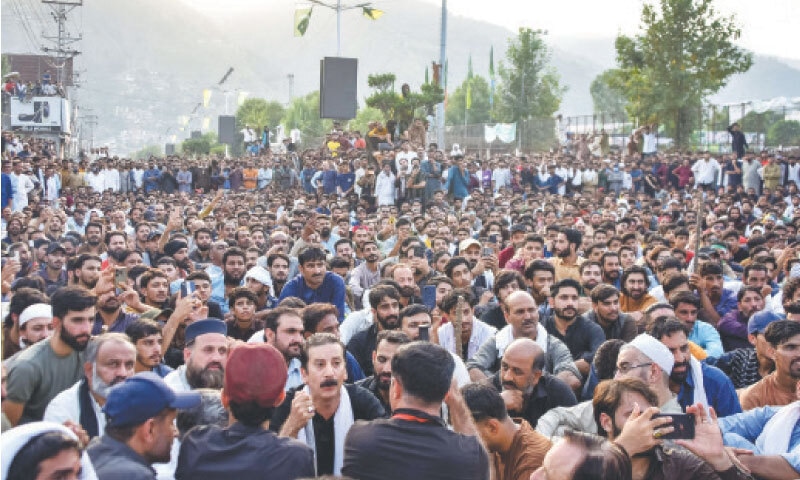
The strike paralysed daily life in AJK, with businesses shuttered, street vendors absent and roads deserted across the territory. In the evening, hundreds gathered at Muzaffarabad’s Lal Chowk, where JKJAAC leaders, including Shaukat Nawaz Mir, delivered fiery speeches.
Mir accused unnamed “elements” of trying to engineer a crisis reminiscent of the May 9, 2023, unrest in Pakistan, when protests against the military’s political role turned violent nationwide. He urged the army chief to intervene and assess the situation, then called on the crowd to reconvene at the same spot at 11 a.m. Tuesday to plot the next steps.
Similar assemblies were reported in Rawalakot and Sudhnoti, while in Bhimber, a rally was led by Ehsanul Haq, brother of AJK Prime Minister Chaudhry Anwarul Haq and an associate of Pakistan Tehreek-e-Insaf, the opposition party once led by imprisoned former prime minister Imran Khan. The deadlock has deepened tensions between the JKJAAC and the AJK government, which the Muslim Conference backs.
Minister for Kashmir Affairs, Ameer Muqam, acknowledged the impasse on Monday, confirming the death toll and injuries in the clash between the two factions. “I stand here and on behalf of the Government of Pakistan and the Prime Minister of Pakistan, I want to say this again … we believe in talks,” Muqam told reporters in Islamabad. “If there are genuine problems, they should be resolved through talks and dialogue.”
He expressed grief over the loss of life: “I say this with sorrow that in this [clash], a citizen, Muhammad Sudhir, son of Muhammad Rehman, died, and a few people were injured. This is a matter of great sadness and regret.”
Muqam held failed talks last week with JKJAAC representatives, centered on the contentious issue of dissolving the reserved assembly seats for migrants from occupied Kashmir. The charter also seeks royalty payments for hydropower projects in AJK, a resource-rich but economically strained region.
The unrest echoes a pattern of escalating protests in AJK, where the JKJAAC has mobilized crowds in recent years over public grievances, sometimes with violent repercussions. In November 2023, a similar JKJAAC-led demonstration dragged on for days before the AJK government pledged to address demands. And in May 2024, clashes between subsidy-seeking protesters and security forces left at least three demonstrators and one police officer dead, along with multiple injuries.
Kashmir’s divisions run deep, a legacy of the 1947 partition of British India that left the mountainous region split between Pakistan and India, with both nations claiming it in its entirety. The line of control has been the site of three wars and countless skirmishes. AJK, the sliver under Pakistani administration, has long chafed under what locals see as Islamabad’s overreach, including the refugee seats that dilute representation for native residents.
The AJK protests coincide with fresh turmoil across the line of control in occupied Ladakh, where demonstrations for greater political autonomy turned violent last week in the high-altitude district bordering China and Pakistan.
New Delhi has pinned the unrest on “provocative speeches” by activist Sonam Wangchuk, who ended a hunger strike demanding either full statehood for Ladakh or inclusion in the Sixth Schedule of India’s constitution — a provision for tribal self-governance over land and environment that the government has yet to deliver.
India’s 2019 decision to revoke Jammu and Kashmir’s semi-autonomous status and impose direct rule from New Delhi carved out Ladakh as a separate union territory, but unkept promises have fuelled resentment among its Buddhist and Muslim communities
Copyright © 2021 Independent Pakistan | All rights reserved