By Staff Reporter
ISLAMABAD: Prime Minister Shehbaz Sharif threw his support behind President Donald Trump’s ambitious 20-point blueprint to halt Israel’s war in Gaza on Monday, hailing the American leader’s role in rallying Muslim nations toward a potential ceasefire amid a mounting death toll that has surpassed 65,000 since October 2023.
Sharif, whose government does not recognise Israel and has long advocated for an independent Palestinian state along pre-1967 borders, issued the endorsement in a post on X. The statement came after Trump’s 20-point plan for peace, not a detailed proposal for how to end the war and implement post-war governance for Gaza, was revealed. Analysts said it is a framework, or “principles” as Trump put it, for further mediated negotiations. It’s an all-in-one deal, calling for hostages and prisoners to be freed, partial Israeli troop withdrawals and then a governance and security mechanism for Gaza.
The outline is characteristically colourful, making Trump himself the chairman of the “Board of Peace” – he would effectively be the governor of Gaza.
The framework is a shift by the Trump administration, closer to the position the Arab and European countries want – most notably these plans ditch Trump’s Gaza “Riviera” plan that he announced standing next to Netanyahu in the White House in February – which would have meant the expulsion of Palestinians that Israel’s far-right longs for.
It is also vague enough on the idea of Palestinian self-determination for the Arab nations and Netanyahu to be willing to support, though Israel’s far-right will complain. But in many parts, the plan lacks clarity – some clauses are only a single sentence long – in exactly the areas where Israel and Hamas would argue over terms.
Hamas may now be pressured by Qatar and other Arab countries to accept the principles. But then the real negotiations have to be done. In that sense, this latest development it is not an end to the war, but a basis for restoring negotiations.
“I am also convinced that durable peace between the Palestinian people and Israel would be essential in bringing political stability and economic growth to the region,” Sharif wrote in his post. He added, “It is also my firm belief that President Trump is fully prepared to assist in whatever way necessary to make this extremely important and urgent understanding to become a reality.”
Trump’s plan, details of which remain closely held, envisions a comprehensive end to the nearly two-year conflict, with Sharif singling out the U.S. president’s special envoy, Steve Witkoff, for credit. “I laud President Trump’s leadership and the vital role played by Special Envoy Steve Witkoff in bringing an end to this war,” Sharif said.
He underscored the imperative of a two-state solution, declaring, “I also strongly believe that the implementation of the two-state proposal is essential to ensure lasting peace in the region.”
The leader’s embrace of Trump’s initiative builds on a warming rapport between Islamabad and Washington, forged in part by Sharif’s public push to nominate the president for the Nobel Peace Prize. That effort stems from Trump’s claimed mediation in a tense four-day military standoff between Pakistan and India in May, which Sharif’s government credits with averting wider catastrophe.
In June, Pakistan formally recommended Trump for the 2026 Nobel, citing his “decisive diplomatic intervention and pivotal leadership” in quelling the escalation. The crisis erupted after New Delhi, without evidence, accused Islamabad of orchestrating the April 22 Pehalgam attack in occupied Kashmir. India responded with airstrikes inside Pakistan, prompting retaliation and fears of a nuclear exchange between the two rivals. Trump later boasted that U.S. involvement had forestalled a “bad nuclear war.”
Speaking to reporters during a press conference in London on Monday, Sharif reaffirmed the nomination, saying his government put Trump forward because “he helped save the region from destruction” during the Pakistan-India flare-up. “Mr Trump eased tension between Pakistan and India and has saved the region from major destruction,” Sharif told the press. He emphasised that if Trump had not intervened in the Pakistan-India escalation, ‘there would be more destruction and loss of lives.’”
The prime minister went further, noting Trump’s hand in defusing other global flashpoints, including tensions between Ethiopia and Egypt, and even in Ukraine.
Sharif’s Nobel bid stands in contrast to India’s response. Prime Minister Narendra Modi has rebuffed Trump’s attempts to take credit for the truce, underscoring the diplomatic tightrope the U.S. president navigates in South Asia.
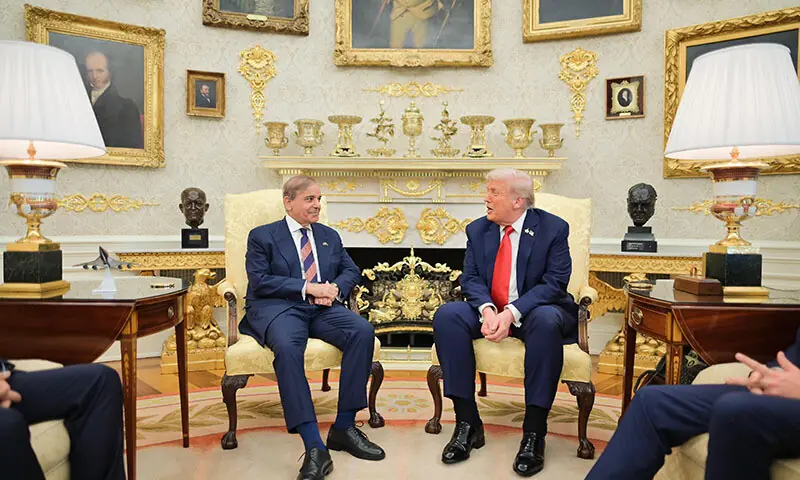
The Gaza endorsement and Nobel push cap a flurry of engagements that have thawed frosty U.S.-Pakistan ties. On Sept. 25, Sharif and Pakistan’s Army Chief, Field Marshal Asim Munir, held talks with Trump at the White House — a rare high-level sit-down aimed at rebooting cooperation on security, trade and regional stability.
The White House meeting also touched on lingering India tensions. Sharif told Trump how New Delhi had “weaponised the Indus Waters Treaty against the people of Pakistan,” a reference to India’s moves to restrict water flows under the 1960 pact amid the standoff. He recounted Pakistan’s battlefield edge with evident pride: “[I talked about] the way our forces defeated India and, by the grace of Almighty Allah, made India learn a lesson which they will remember for a lifetime.”
Sharif lavished praise on his military brass, saying, “I also said that Pakistan won the war, by the grace of God, through our brave armed forces, who fought with great courage and outstanding professional equipment, led by Field Marshal Saeed Asim Munir, who led from the front and whose resolve was unwavering, and the entire nation was behind our own forces.”
He spotlighted the air campaign. “And our air forces, led by Air Marshal Zaheer Babar and his brave fighters, made a strong defence. The world came to realise that not only is Pakistan a nuclear power, but purely meant for our defence. And now the purpose: Pakistan is also very accomplished in traditional warfare, conservative warfare.”
As Sharif burnishes ties abroad, he confronts mounting woes at home. Pakistan’s economy has steadied on the macro level, but climate change is exacting a brutal price. Massive floods this year — the first in decades to ravage both rural expanses and industrial hubs — have inflicted billions in damage, disrupted food supplies and exports, and jeopardized a tenuous rebound.
“Unfortunately, due to climate change, which caused the recent floods, there has been much destruction,” Sharif said in London. He recalled the 2022 deluge that hammered Sindh province, then pivoted to this year’s assault on Punjab. “This time Punjab became the target of this flood due to which more than 1,000 people lost their lives, hundreds of thousands of people were injured, thousands of remote areas were submerged, farms were destroyed, and installations suffered immense damage, for which, at this time, we are collecting data to see how much loss has occurred.”
Yet Sharif projected resilience. “But our spirits are high and we are facing this completely, and Inshallah we will overcome this and move forward.”
Copyright © 2021 Independent Pakistan | All rights reserved