By Staff Reporter
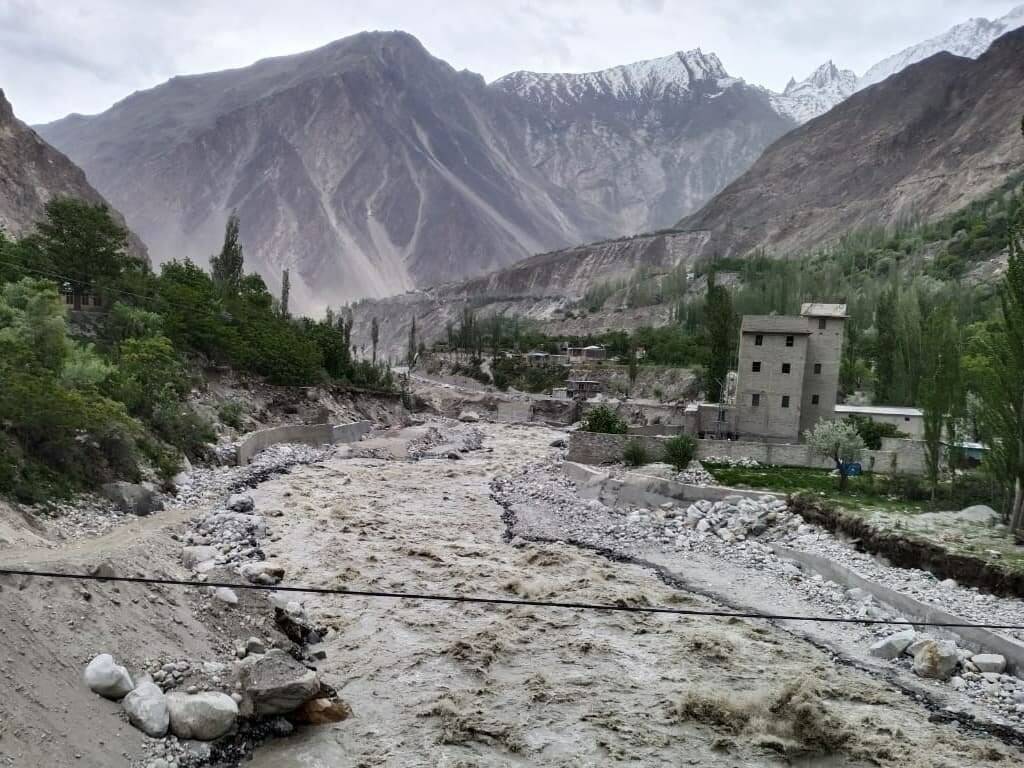
ISLAMABAD: Heavy monsoon rains unleashed catastrophic floods across Pakistan’s northern Gilgit-Baltistan region on Monday, killing at least three tourists, injuring four, and leaving 15 others missing in the Babusar area of Diamer district.
The disaster, triggered by torrential downpours, swept away eight tourist vehicles, stranded thousands, and severed communication lines, plunging the mountainous region into chaos as rescue efforts struggled to keep pace with the rising waters.
The floods are the latest in a series of punishing weather events battering Pakistan this monsoon season, which runs from June to September. From the rugged peaks of the north to the urban centers of the south, authorities are grappling with a mounting toll: at least 221 since late June, alongside warnings of urban flooding in multiple cities.
“Fifteen other tourists have gone missing, as eight tourist vehicles were washed away in the raging flood,” Faizullah Firaq, spokesperson for the Gilgit-Baltistan government, said in a statement. “Medical assistance for the injured is ongoing, with one individual in critical condition.”
Rescue teams recovered three bodies from the debris, while four injured survivors were rushed to a hospital in Chilas.
The deluge severed a key fiber optic line, disrupting communication systems and leaving countless tourists unable to reach their families. “The government has successfully rescued hundreds of stranded tourists on Babusar Highway, and many have sought shelter with local residents,” Firaq added. But the highway, a vital lifeline in the region, remains closed at multiple points, with roads and farmland sustaining severe damage.
The crisis in Gilgit-Baltistan is part of a broader onslaught of monsoon rains pummeling Pakistan. In Khyber Pakhtunkhwa’s Swat district, tragedy struck on Monday night when a house in the Gujjar Banda area of Madyan collapsed under the weight of relentless rain. “Three siblings and their mother were critically injured and moved to Civil Hospital Madyan for treatment,” said Shafiqa Gul, spokesperson for Rescue 1122 in the North region. The children perished, while their mother remains in serious condition. “The house collapsed due to heavy rain, burying three children and a woman underneath,” Gul said.
Further south, Punjab’s Provincial Disaster Management Authority (PDMA) warned of a “slightly more powerful” fourth wave of monsoon rains set to drench the province until July 25. “A flood alert has been issued for rivers and canals in Punjab,” said PDMA Director General Irfan Ali Kathia. Water flow in the Indus River hit 420,000 cusecs at the Taunsa barrage, with low-level flooding reported at Tarbela, Kala Bagh, and Chashma. Cities like Bahawalpur, Rahim Yar Khan, and Dera Ghazi Khan face heightened risks, while urban hubs such as Lahore and Faisalabad brace for potential inundation.
The Pakistan Meteorological Department (PMD) forecast rain and thunderstorms across Khyber Pakhtunkhwa’s Malakand and Hazara divisions, southern Punjab, Sindh, eastern Balochistan, and parts of Azad Jammu and Kashmir. In the north, Amir Khadam Khan, spokesperson for Rescue 1122 in Mansehra, reported that the Jalkhad road in Naran was blocked by large stones and debris. “According to initial reports, a car is stuck in the debris,” Khan said. “Fortunately, no loss of life or property has been reported so far.” The National Highways Authority deployed heavy machinery to clear the road, with a Rescue 1122 ambulance standing by.
The Gilgit-Baltistan Disaster Management Authority had sounded the alarm on June 29, cautioning of heightened risks from glacial lake outburst floods (GLOFs) and flash floods. Tourists and residents were urged to steer clear of rivers and streams, where water levels can surge to deadly heights. Monday’s tragedy underscores the peril of ignoring such warnings in a region prone to natural disasters.
In Punjab, where 71 of the 123 monsoon-related deaths occurred in the past two days alone, the PDMA has ordered a full mobilisation. “Deputy commissioners have been instructed to remain in the field, while Section 144 should be imposed along the banks of rivers and canals,” Kathia said. Police patrols along waterways have intensified, and emergency teams from Rescue 1122 and the Water and Sanitation Agency are on high alert. Kathia also called for functional drainage systems and urged residents to avoid electric pylons and crumbling structures during storms.
Copyright © 2021 Independent Pakistan | All rights reserved