By Staff Reporter
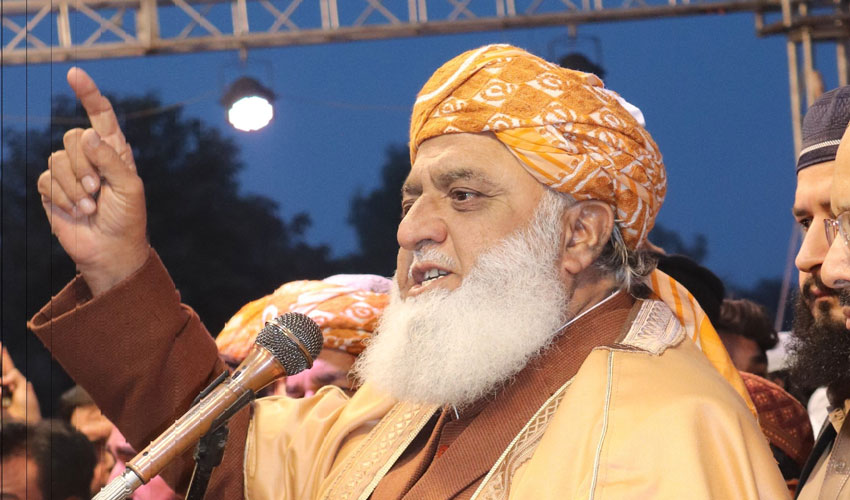
ISLAMABAD: Maulana Fazlur Rehman, the veteran leader of Pakistan’s Jamiat Ulema-e-Islam-Fazl party, said Sunday he would not apologise for remarks he made about the country’s security forces, telling a gathering of party-aligned lawyers in Islamabad that his criticism was directed at policymakers, not the institution or its soldiers.
The comments deepened a rift that has consumed Pakistani politics for days, after ruling-party officials accused Rehman of belittling the sacrifices of soldiers killed in the country’s long fight against terrorism.
Rehman made the remarks at a rally last week in Kasur, a city in Punjab province, where he addressed the deteriorating security situation in Khyber Pakhtunkhwa and Balochistan — two provinces that have absorbed the brunt of a resurgent militant threat along Pakistan’s western frontier. In that speech, he suggested that soldiers accept their duty, including the risk of death, in part because it is the job they are paid to do, and argued that the military should confine itself to its constitutional role rather than dictate policy to civilian leaders.
The remarks landed hard. Officials from the ruling Pakistan Muslim League-Nawaz, including several Cabinet ministers, said Rehman had cheapened the memory of soldiers who died in service and demanded he retract his words.
He declined.
Addressing the lawyers’ convention, Rehman insisted he holds no grievance against the armed forces as an institution, only with what he described as the small circle of officials who set policy from behind closed doors. He said he had never questioned the honour of Pakistan’s fallen soldiers and pointed to friends and political allies of his own who were killed in militant attacks over the years, describing the duty to honour such losses as a shared national obligation that transcends party politics.
Rehman framed his original comments as a reminder rather than an insult — a call for every state institution, including the military, to operate within the boundaries set by Pakistan’s Constitution. He argued that political criticism of an institution’s policies should not be conflated with hostility toward the state itself, and said Pakistan’s problems are better addressed through negotiation and coherent policymaking than through the vilification he said he has faced in the days since his Kasur speech.
He also rejected the idea that his party’s positions amount to extremism, telling the gathering that JUI-F has always operated within constitutional and legal limits and that pressing for those limits to be respected is not disloyalty.
The cleric-politician, who has led JUI-F for decades and remains one of Pakistan’s most prominent religious-party figures, used the Sunday address to revisit other longstanding grievances as well. He said a 2004-2005 agreement to register the country’s religious seminaries — schools that fall under his party’s political base — has gone unimplemented for two decades, without meaningful explanation from successive governments.
He also renewed his claim that the current governing coalition took power through a rigged general election, and said his party turned down two separate offers to join provincial governments: one in Balochistan, and another in Khyber Pakhtunkhwa, where he said he would have had to govern alongside lawmakers who defected from a rival party — an arrangement he said he found unacceptable.
Rehman devoted part of his remarks to the security situation in Khyber Pakhtunkhwa’s southern districts, where militant attacks have intensified in recent months, and called on Parliament to hold a closed-door session so lawmakers could be briefed on the scale of the threat.
Bar association distances itself
The Sunday convention drew a separate complication. The Islamabad High Court Bar Association issued a statement distancing itself from the event, saying it had no role in organizing, sponsoring, or otherwise endorsing the gathering, which had been billed in some circles as a lawyers’ convention. In a release from the bar’s secretary, Barrister Qasem Nawaz Abbasi, the association said any suggestion that it was affiliated with the JUI-F event was mistaken, and reaffirmed its commitment to judicial independence and constitutional supremacy.
Ministers respond
The uproar over Rehman’s original remarks had already drawn a wave of condemnation from senior government figures by the time he spoke on Sunday.
Defence Minister Khawaja Asif was among the most pointed critics, writing on social media that he found Rehman’s comments unfair and beneath what he would expect from a politician of his standing. Asif argued that tying a soldier’s willingness to die in defence of the country to the salary that soldier draws misunderstands — and diminishes — the ideology, sense of duty, and attachment to homeland that he said actually drive such sacrifice. He said one can disagree with how an institution operates without disparaging the devotion behind it, and characterised Rehman’s framing not as political criticism but as a lapse in basic decency.
Planning Minister Ahsan Iqbal took a more personal tone, saying he has long respected Rehman but felt his remarks diminished the significance of soldiers’ sacrifices in a way that wounded him personally, as he believes it wounded millions of other Pakistanis. Iqbal argued that framing a soldier’s willingness to die as mere compensation for a paycheck runs counter to fairness, ethics, and Islamic teaching alike, and said preserving the memory of the fallen without regard to politics is a national and moral duty. He added that while disagreement is every citizen’s right, he believes there are limits on how that disagreement should be expressed when it touches the families of the fallen.
Rana Sanaullah, the prime minister’s adviser on political affairs, offered a more indirect response, posting that the meaning of martyrdom lies beyond the comprehension of ordinary salaried people going about worldly life — a remark widely read as a rebuttal to Rehman’s framing without naming him.
The dispute has become one of the more heated exchanges between a major religious party and the governing coalition in recent weeks, with no indication as of Sunday that either side intended to back down. Rehman told the lawyers’ convention he expects an apology over what he called a propaganda campaign against him, and said his position would not change unless those criticising him changed their own conduct first.
Copyright © 2021 Independent Pakistan | All rights reserved