By Staff Reporter
ISLAMABAD: The rain arrived first in the mountains of India-occupied Kashmir, and by Sunday it had turned deadly on both sides of one of the world’s most contested borders.
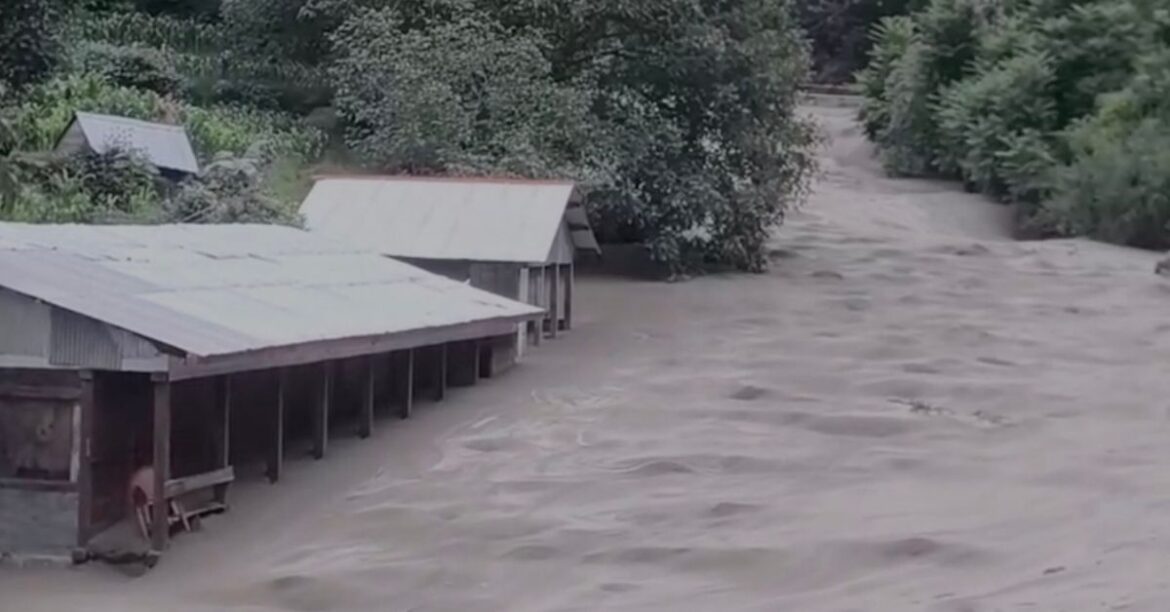
At least 11 people were killed and seven remained missing after flash floods and landslides tore through Jammu and Kashmir, according to officials cited by TRT World. In Surankote, near the Line of Control in Poonch district, a landslide buried a house and killed five people as rescue crews searched the wreckage for survivors. Four members of a separate family were unaccounted for after floodwaters swept their home away entirely. Rivers overflowed their banks in Poonch and neighbouring Rajouri district, and dozens of vehicles were submerged or carried off, forcing residents in low-lying areas to flee.
Roughly 150 miles to the southwest, in Azad Jammu and Kashmir, the same storm system claimed three more lives. A landslide triggered by the downpour crashed into a house in Hitli village, in Kotli district, before dawn Sunday, burying all six members of a family beneath the debris.
Khaleeq Masood, a local government official in Nakyal, said residents mounted a rescue effort and worked for roughly 90 minutes to free the family. It was too late for three of them: Nasreen Akhtar, 40, and her two children, 14-year-old Afza Shafiq and 12-year-old Ayan Shafiq, did not survive. Her husband, Muhammad Shafiq, and their two other children were injured and taken to Tehsil Headquarters Hospital, where doctors said their condition was no longer life-threatening.
Elsewhere in Azad Kashmir, a cloudburst sent a flash flood tearing through the Neelum Valley, damaging homes, shops, vehicles and public infrastructure. No deaths were reported there.
A surge with no warning
The storm’s most immediate consequence for Pakistan arrived not as rain but as river water — and it caught officials off guard.
The Chenab River swelled to nearly 180,000 cusecs on Sunday after the heavy rain in India-occupied Kashmir sent an unexpected volume of runoff downstream, according to a senior official with the Punjab Irrigation Department. The surge pushed the Chenab into the medium flood category and prompted Pakistan’s Flood Forecasting Division, part of the national meteorological department, to warn of low to medium flooding at Marala on the Chenab and at Jassar on the River Ravi over the next day.
“Sunday was a surprising day for us,” the official told local Dawn newspaper, “as we unexpectedly received a massive volume of water from India.” The surge, he said, pushed the Chenab’s flow to around 180,000 cusecs for nearly two to three hours. By roughly 9 p.m., he added, the river was still running about 155,000 cusecs — enough to keep it in medium flood territory.
The official said Pakistan had received no advance notice from India about the upstream conditions that produced the surge. “We were expecting rainfall there from July 21 onward, but the surge came unexpectedly,” he said, adding that authorities had gotten no information from India on either upstream river flows or the rainfall that caused them.
Pakistan and India do not currently maintain the kind of real-time data-sharing arrangement on river flows that once existed between the two countries, and the absence of advance notice on Sunday left downstream authorities reacting to a surge already in progress rather than preparing for one.
More rain, and higher rivers, expected
Pakistani forecasters said the weekend’s flooding was likely a preview rather than a peak.
The Flood Forecasting Division said an approaching westerly weather system, combined with a strong monsoon current expected to remain active from July 20 through July 24, could substantially raise flows across the country’s major rivers. The division forecast high flooding at Marala on the Chenab and upstream of Mangla on the River Jhelum, along with elevated flows in tributary streams, or nullahs, that feed both rivers.
In the Chenab basin, the nullahs at greatest risk include the Dora, Dotta, Dowara, Bhimber, Halsi, Aik and Palkhu. In the Ravi basin, forecasters flagged the Bein, Basanter, Deg and Sakki. The division also warned of high flows on the River Kabul and its tributaries, flash flooding in the hill torrents of Dera Ghazi Khan, and rising streams across Khyber Pakhtunkhwa and northern Balochistan.
Urban flooding is also possible in a string of Punjab cities over the coming days, according to the forecast, including Rawalpindi, Jhelum, Gujranwala, Sargodha, Khushab, Sialkot, Gujrat, Narowal, Lahore, Okara, Sahiwal, Bahawalnagar and Faisalabad.
The numbers behind the surge
A daily report from the Water and Power Development Authority, or Wapda, offered a fuller picture of how the surge moved through Pakistan’s river system Sunday.
At Tarbela Dam on the Indus River, inflows and outflows were recorded at 196,300 and 195,500 cusecs, respectively. On the River Kabul at Nowshera, inflows and outflows were even at 31,700 cusecs; at Khairabad Bridge, both figures stood at 216,500 cusecs. At Mangla Dam on the Jhelum, inflows measured 29,400 cusecs against outflows of 14,000. And at Head Marala on the Chenab, the report recorded inflows of 74,000 cusecs and outflows of 50,000 cusecs as of 6 a.m. Sunday — hours before the larger surge that followed.
Downstream, the major barrages told a similar story of a river system under strain. Jinnah Barrage took in 228,400 cusecs and released 220,400; Chashma Barrage recorded inflows of 227,000 cusecs against outflows of 225,000. At Taunsa Barrage, inflows reached 212,700 cusecs with 186,200 cusecs released, while Guddu Barrage logged 163,800 cusecs in and 122,900 out. Sukkur Barrage took in 111,300 cusecs and released 54,500. Kotri Barrage, farther downstream, recorded inflows of 43,200 cusecs with no outflow at all, and both Trimmu and Panjnad barrages — with inflows of 14,000 and 13,200 cusecs, respectively — released nothing.
Pakistan’s reservoirs, meanwhile, still had room to absorb more water. Tarbela Dam stood at 1,505.11 feet, within an operating range that runs from a minimum of 1,402 feet to a maximum conservation level of 1,550 feet, with live storage of 3.204 million acre-feet. Mangla Dam was at 1,174 feet, against a range of 1,050 to 1,242 feet, holding 2.777 million acre-feet in live storage. The Chashma Reservoir sat at 641.60 feet, within its 638.15-to-649-foot range, with live storage of 0.055 million acre-feet.
Wapda noted that its figures for Tarbela, Jinnah and Chashma on the Indus, for the Kabul River at Nowshera, and for the Jhelum at Mangla reflected mean flows over the previous 24 hours. The remaining river readings, the authority said, were taken at 6 a.m. Sunday — meaning they, too, predated the Chenab’s afternoon surge.
With the monsoon system expected to stay active through midweek and reservoirs already carrying substantial water, Pakistani officials are bracing for the possibility that Sunday’s surge was the leading edge of a longer flood emergency, not the extent of it.
Copyright © 2021 Independent Pakistan | All rights reserved