By Staff Reporter
ISLAMABAD: Egypt’s foreign minister met with top Pakistani officials on Sunday to bolster long-standing ties between the two Muslim-majority nations, pledging expanded cooperation on defence, counterterrorism and economic exchanges amid shared concerns over regional conflicts, including the crisis in Gaza.
The visit by the Egyptian foreign minister, Badr Abdelatty, who arrived in Islamabad on Saturday night for a two-day official trip, underscored efforts to revive institutional dialogues that have languished for years. In meetings with President Asif Ali Zardari, Foreign Minister Ishaq Dar and the army chief, Field Marshal Asim Munir, the discussions centered on military collaboration, trade initiatives and joint stances on international issues.
Abdelatty’s agenda began with a call on President Zardari at Aiwan-i-Sadr, the presidential palace, where the two leaders held a one-on-one session before broader talks. According to a statement from the President’s Secretariat, Zardari emphasised the deep-rooted bonds between the countries. “Pakistan values its longstanding ties with Egypt, which are rooted in shared faith and mutual respect, and looks forward to advancing the relationship in a more structured and forward-looking direction,” Zardari said.
He conveyed warm greetings to Egypt’s president, Abdel Fattah El Sisi, and noted that this year marks 77 years of diplomatic relations, expressing hope that both sides would “reinvigorate cooperation in trade, investment and people-to-people exchanges.” The president encouraged greater Egyptian investment in expanding sectors like energy, logistics, construction, agriculture, mining and information technology. In response, Abdelatty delivered a message from Mr. El Sisi and expressed “Egypt’s keen interest in expanding its partnership with Pakistan in various fields,” the statement said.
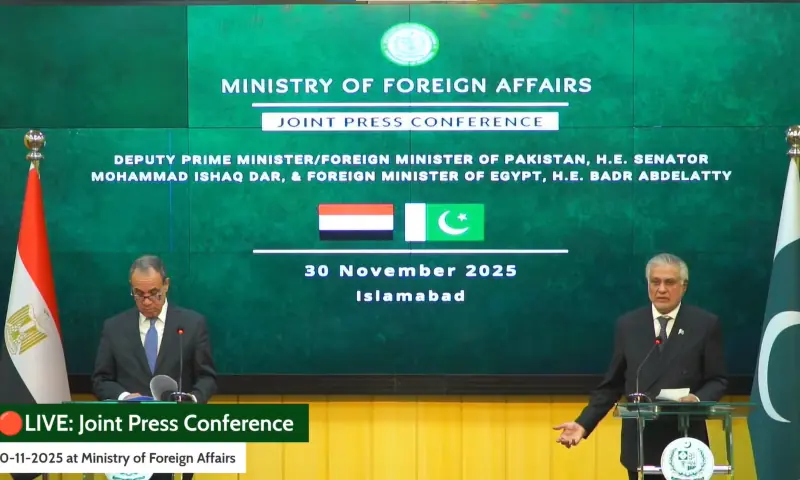
Earlier in the day, Abdelatty met separately with foreign minister Dar, followed by a joint news conference where both outlined concrete steps to enhance economic ties. Dar described their talks as a “very, very focused discussion” on elevating business-to-business activities, which he said were “surely not commensurate” with the nations’ affection, given bilateral trade of around $300 million. “With the depth and the affection the two countries have,” Dar said, Pakistan would share with Egypt “a comprehensive list of 250 Pakistani business houses representing key sectors of the economy.” These businesses, he added, “will be facilitated and supported to enhance bilateral commercial engagement.”
The list would be prepared by the Federation of Pakistan Chambers of Commerce & Industry in collaboration with other chambers, with selections made “very transparent” to include those “who really deserve and are willing to work and cooperate, and enhance the business.” After due diligence in Egypt, they would be declared a “white list,” addressing frequent complaints about delays in obtaining business visas, which Dar said would “cease at least to the extent of these top 250” businesses.
In three months, Pakistan plans to select another 250 businesses, expanding the list to 500, with Egypt agreeing to process it accordingly. Following that, a Pakistan-Egypt Business Council would be established to institutionalize private sector cooperation and promote mutually beneficial partnerships. “Once these two steps are done, Pakistan and Egyptian Business Forum will also be established,” Dar said, noting it would be co-chaired by the two foreign ministers, with its first meeting in Cairo in the second quarter of 2026 to advance trade, investment and economic collaboration.
Dar acknowledged with “little embarrassment” that the Pakistan-Egypt Joint Ministerial Commission had not met since 2010, nor had bilateral political consultations occurred. To remedy this, political consultations would be held in the first quarter of 2026, led by Pakistan’s foreign secretary and an Egyptian assistant minister, to prepare the agenda for a Joint Ministerial Commission meeting in the second quarter.“Discussions today reaffirm the strength of Pakistan-Egypt relations, and our shared commitment to further enhance bilateral cooperation across political, economic, defence, cultural and people-to-people domains,” Dar said. “We agreed to work towards a more structured framework of cooperation and to explore new avenues of partnership.”
He expressed confidence that the visit would “open new avenues of practical cooperation” and highlighted assessments of regional developments, “with particular focus on the grave situation in Gaza.” Pakistan appreciates Egypt’s “vital role in humanitarian support, mediation efforts and diplomatic engagement to uphold the ceasefire and safeguard the rights of the Palestinian people,” Dar said.
Abdelatty, at the outset of his remarks, conveyed Egypt’s condolences over recent terrorist attacks in Islamabad and Peshawar that caused “tragic loss of lives and injuries.” “We stand in full solidarity with Pakistan in the fight against violent extremism and terrorism,” he said. He described Egypt’s “very successful experience in fighting terrorism through a holistic approach focusing not only on the security dimension, but also socio-economic dimensions, as well as fighting extremist ideology through the very moderate religious institutions in Egypt, notably the Al-Azhar al-Sharif, Dar Al Ifta and the Ministry of Waqf.” “In the security domain, we have agreed to intensify our coordination to counter cross-border terrorism and extremism,” Abdelatty added. “Furthermore, we are eager to leverage this spiritual and intellectual leadership of Al-Azhar al-Sharif to strengthen our joint efforts in promoting moderate discourse and combatting extremist ideology.”
On regional matters, the ministers stressed the “importance of peaceful resolution of conflicts, respect for sovereignty, and adherence to the principles of international law and the UN charter.” Abdelatty noted the visit’s timing amid pivotal regional moments, recalling Egypt’s mediation, alongside Pakistan and others, on the Gaza ceasefire signed in Sharm El-Sheikh. “Egypt will continue uncompromising efforts to resolve the Israeli-Palestinian conflict according to international law and UN Security Council resolutions, and we are working very hard with Pakistan on that,” he said. He affirmed the two-state solution as the “only viable path towards genuine and lasting regional stability, which could only be achieved through the creation of a sovereign, viable and independent Palestinian state based on the UN pre-1967 borders with East Jerusalem as its capital.” “It is within this context we agreed to intensify our coordination and consultations on the Palestinian cause, particularly the situation in the West Bank and in the Gaza Strip.”
Later, Abdelatty met Field Marshal Munir at the General Headquarters in Rawalpindi. A Foreign Office statement said they discussed “defence and security cooperation, military exchanges, training collaborations and regional peace and stability,” with both sides reaffirming “the importance of continued high-level engagement between the armed forces of the two countries.”
Before the formal meetings with the foreign minister, Abdelatty addressed the media, calling Pakistan his “second home country” and conveying “our deep appreciation of our very cordial relation with Pakistan.” Acknowledging “common challenges” on economic, political and security levels, he said they encouraged cooperation in exchanging best practices and expertise. “That, of course, encourages us to work together and to cooperate in terms of exchange of best practices and expertise to help each other, and to confirm that stability and peace and development are the main pillars of our strategic partnership,” Abdelatty said. “We would like to elevate our relationship to the strategic level.”
Copyright © 2021 Independent Pakistan | All rights reserved