By Staff Reporter
ISLAMABAD: Pakistan’s opposition and its lawyers are taking the federal takeover of Khyber Pakhtunkhwa to the courts, challenging whether Islamabad had constitutional grounds to remove an elected provincial government and hold its chief minister in preventive custody.
Barrister Gohar Ali Khan, chairman of Imran Khan’s Pakistan Tehreek-e-Insaf (PTI), said on Monday that he would personally challenge the emergency and governor’s rule in the Peshawar High Court on Tuesday. “We will raise our voice at every forum,” he said. “Our long march and protest are ongoing.” A petition filed in the same court on Monday by Advocate Salman asks the judges to declare the measures null and void and to suspend the governor’s rule notification until a final ruling. It names President Asif Ali Zardari, Prime Minister Shehbaz Sharif and Governor Faisal Karim Kundi as respondents and calls the measures unconstitutional, illegal and mala fide, in breach of fundamental rights, provincial autonomy and the democratic mandate. The petition also says road closures imposed since Sunday have stopped people reaching the high court and district courts.
The legal fight is spreading. The Khyber Pakhtunkhwa Bar Council announced a strike of court proceedings for Tuesday and an emergency meeting on 17 October. It said the use of the federal structure for any political purpose “raises serious concerns regarding parliamentary democracy and provincial autonomy”, and vowed that lawyers would not remain “silent spectators”. The Lahore High Court Bar Association and the Lahore Bar Association demanded the immediate withdrawal of the measures and announced plans to challenge them in the Supreme Court, and a Senate resolution has been moved seeking withdrawal of the emergency. Eight members of the Pakistan Bar Council have condemned the move, but legal experts are divided over its validity and over how far the courts can review it.
At the centre of the argument is Article 234 of the constitution, which allows governor’s rule when a province’s government cannot be run in accordance with the constitution. Law Minister Azam Nazeer Tarar said on Monday that no end date has been set. “The constitution provides no time limit under 232,” he told foreign journalists in Islamabad, referring to the separate emergency provision covering war or internal disturbance. “However, for 234, as far as the provincial assembly and its powers to legislate are concerned, those would be revived after a period of six months.” That, he said, would not automatically bring back the elected government. He insisted the Centre had no wish to hold on to the province. “We are not interested to take charge of that province for indefinite,” he said.
The decision was taken on Sunday. A federal cabinet meeting chaired by Prime Minister Sharif noted the provincial government’s “deliberate disengagement from the fight against terrorism”, and President Zardari then signed off on the prime minister’s recommendation. Sharif had told the cabinet that “there can be nothing more heart-wrenching” than the way citizens, police and security officials, children and mothers were being killed in Khyber Pakhtunkhwa and Balochistan. It was the fourth time governor’s rule has been imposed in the province.
The chief minister, Sohail Afridi, his ministers, advisers, special assistants and the advocate general ceased to hold office with immediate effect. An emergency was declared in 12 districts, and the army was authorised under Article 245 to deploy troops and assets in aid of civil power. Shipping containers were placed across roads in Peshawar behind heavy police deployments. The federal government has appointed an 11-member advisory council to help Kundi, and created a separate administrative structure for the 12 districts it says have been hit hardest, with an additional chief secretary and a council to coordinate security, governance and development.
Federal ministers say the security record left them no choice. Information Minister Attaullah Tarar said recorded terrorist incidents in the province rose from 2,911 between 2021 and 2024 to about 8,600 in the 2024-26 period, an increase of 195 per cent. Nationwide, he said, incidents reached 3,774 in 2025 and 2,857 by September this year. He and Mr Tarar accused the PTI government of failing to equip police, strengthen counterterrorism units or coordinate with federal authorities, and said the Centre had sought a unified counterterrorism policy that the province’s stance on Afghanistan and militancy undermined. Federal ministers have also alleged that the PTI government had a “nexus” with terrorist groups. “There is credible evidence of leakages which establish that PTI was in touch with the TTP,” the information minister said, referring to the banned Tehreek-e-Taliban Pakistan. “We will be giving you evidence.” The PTI strongly denies the allegation and says it is politically motivated. Deputy Prime Minister Ishaq Dar insisted the move was not political and said the government could not stay idle on citizens’ security.
The opposition rejects the premise. PTI information secretary Sheikh Waqas Akram cited figures from the Centre for Research and Security Studies showing that fatalities among security personnel and civilians in the province fell 16 percent in the first nine months of 2026, while nationwide deaths rose 9 percent, partly because of worsening violence in Balochistan. He called for a transparent assessment of the figures and of the effectiveness of security policy, and said terrorism “required coordinated national action rather than political confrontation”. Data compiled by the Pakistan Institute for Conflict and Security Studies recorded 199 terrorist attacks across the country in August, 54 of them in Khyber Pakhtunkhwa, excluding the merged districts, and 89 in Balochistan.
That gap is the opposition’s sharpest political argument. Mehmood Khan Achakzai, the opposition leader in the National Assembly, said there was no writ of the state in half of Balochistan. “But you don’t impose it there, because the chief minister there is your favourite,” he told reporters outside parliament. Senate opposition leader Raja Nasir Abbas said: “If terrorism and peace were an issue … you should have imposed emergency in Balochistan first.” He added that the government had “first attacked the Constitution by coming into power through Form-47”, a reference to the form used to record election results, and was now removing a government that held a two-thirds majority.
Afridi, who led the PTI’s long march towards Islamabad, was confirmed by Minister Talal Chaudhry to be in preventive custody along with some members of his cabinet. Those with cases against them would be charged and tried, he said, and the rest released. Tarar said the interior division had been told Afridi was in “preventive detention or preventive custody”. “No arrest has taken place so far,” he said. Two police officials told AFP that 278 PTI members had been detained in the province since the emergency was declared. The PTI said police had fired on peaceful demonstrators. “The nation will remember every face that imposed governor’s rule and every one that facilitated it,” it said on X. Local media reported that the long march had fizzled out in Swabi after the proclamation, but Gohar insisted it was continuing.
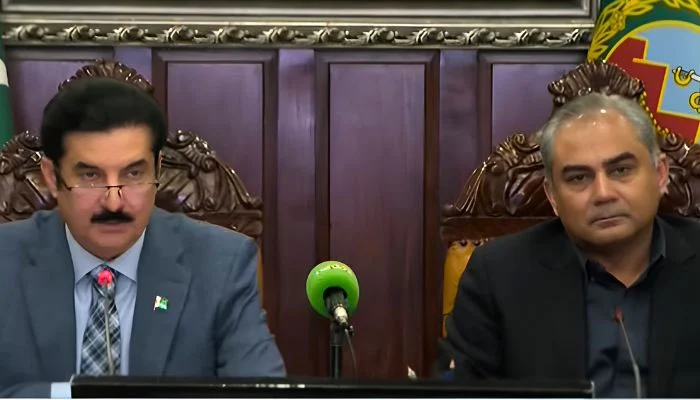
Kundi, who now runs the province and had called governor’s rule a last resort in the days before it was imposed, used a press conference in Peshawar to set out what the new administration would do. “Our first priority is the fight against terrorism,” he said, adding that the Centre had “shown confidence in us”. The administration, he said, would “not compromise on police”. He told the army, police, Frontier Constabulary and other security institutions: “Our committee, this government, is standing side by side with you and will support you fully.” Development would be the second priority, he said, with the first being to give police and the Counter-Terrorism Department whatever they asked for.
“Whatever weapons you want, whatever you need, we will get them to you,” he said. “We will not compromise on our police officers and personnel. We will equip them well.” He said Interior Minister Mohsin Naqvi had delivered 10 armoured personnel carriers to the provincial police on behalf of the Centre, and that Naqvi had assured the apex committee that forces would receive as much funding as they needed. The governor said he had spoken to the inspector general of police and the chief secretary on Sunday and ordered that Khyber Pakhtunkhwa’s officers would no longer be the lowest paid in the country. “If they are not the highest, they will at least be equal,” he said. Payments under the martyrs’ package would rise, and the children of martyrs would be given free education.
He cast the change as a break with the 13 years of PTI rule in the province. “Gone are the days when there was no coordination between the Centre and the province,” he said. “We will have coordination with the Centre; our policies will come from Islamabad … not Kabul, Jalalabad or Kandahar.” The Centre has long objected to the PTI government’s stance on dialogue with the Afghan Taliban. “There is light after darkness,” Kundi said. “The darkness has passed and our journey has begun towards the light.” He thanked residents for “rejecting the circus” of the long march, which began on 4 October, and said the public had rejected a “13-year nuisance”.
He also appealed to young doctors who have been on strike to end it, promising that their grievances would be solved, and spoke to university staff protesting over pay and jobs. He promised business leaders that he would work with them. “When there is peace here, people will come to do business and investment … and the youth will have employment,” he said. He said internet services were being restored and roads would reopen within a day or two. Of the PTI, he said his side would argue its case “with arguments, not with abusive language”.
The same message came from the province’s first apex committee meeting under governor’s rule, which he co-chaired with Naqvi. “We can sacrifice our development, but never security,” Kundi said, noting a “lack of synergy” in counterterrorism efforts and promising that this would change. He said there would be no holidays or weekends, and described the districts of Dera Ismail Khan, Tank and Waziristan as places where “people have no freedom to live, travel and do other things”. “It should be written in history that these people came and restored peace in the province,” he said. He said he would hold apex committee meetings regularly. An official handout said the committee called for “coordinated, effective and decisive” steps against terrorism, continued intelligence-based operations, and modern equipment, vehicles, weapons and personnel for police and the CTD. It also promised services at people’s doorsteps and said public suggestions would be considered in policymaking.
Naqvi said the war on terrorism had been fought for 2.5 years with “no backend support”. “It was the [provincial] government’s job to lead the war against terrorism, but they did not do it,” he said. “They kept bowing their heads only because they did not want to compromise.” He said ministers had asked the provincial government to cooperate “dozens of times”. “Today is the first time I can proudly say that the federal and the provincial governments are on the same page,” he said. He promised results from the same personnel, “the same people”, but warned: “It’s not like things will change in a day; there will be difficult times.”
Kundi held a security meeting with the new chief secretary, Dr Muhammad Fakhr Alam Irfan, Home Affairs Adviser Kifayatullah Khan and Inspector General Zulfiqar Hameed. He wrote on X that “Khyber Pakhtunkhwa has sacrificed enough”. He also met Minister for States and Frontier Regions Amir Muqam, who said with him that the people of the province had rejected “the politics of chaos and confrontation”. On Sunday, at the first meeting of the advisory council, he had said there would be “zero tolerance for corruption”.
The PTI says the move betrays a deeper agenda. Gohar called 11 October “a black day” in Pakistan’s democratic history and demanded that the measures be withdrawn. He said the party had stayed in contact with the government until the last moment and that “the federation will be strong only when the provinces are strong”. Akram said neither the PTI nor the people of the province would accept the “unconstitutional, undemocratic and unlawful” removal of an elected government. He listed earlier governor’s rule and emergency episodes under PPP and PML-N governments, including Zulfikar Ali Bhutto’s dismissal of the Balochistan government in 1973 and the 1998 nationwide emergency under Nawaz Sharif, and urged leaders to learn from 1971. He demanded the immediate reversal of the measures and “meaningful dialogue”. Gohar said parliamentary members would meet to decide how to protest in the assembly.
Achakzai called the move an “assault on Pakistan’s Constitution and democracy”. “This will not be tolerated,” he said, announcing a “democratic struggle” in districts where the emergency has not been imposed. “We will not abuse anyone; we will not fire bullets — we don’t have any — and we will not throw even a stone on anyone.” He said Afridi had only demanded access to, and medical treatment for, Imran Khan, and offered to give a written assurance that visitors would not disclose what was discussed with him. He said he would speak to the government but would not meet at the Prime Minister’s House or the speaker’s chamber. “Pakistan is bigger than that,” he said. He invited other parties to a planned all-parties conference. Maulana Fazlur Rehman, head of the Jamiat Ulema-e-Islam-Fazl, accused the government of backtracking on commitments made during talks with the PTI.
The changes reach beyond politics. The provincial law department removed 61 law officers from the advocate general’s office, including 26 additional advocates general, 31 assistant advocates general and four advocates-on-record. A notification issued on 11 October appointed 27 replacements, among them 12 additional advocates general, 13 assistant advocates general and two advocates-on-record, stationed in Peshawar, Dera Ismail Khan, Bannu, Swat, Abbottabad and Islamabad. The advocate general, Shah Faisal Uthmankhel, had already been replaced by Sanaullah, who previously served as an additional advocate general for the federal government. On Monday the KSE-100 index fell by nearly 1,965 points to close at 165,124.
The standoff had been building for weeks. Afridi first planned the march for 27 September, then moved it to 4 October, while efforts to negotiate with the federal government continued. Talks between the government and the opposition on 2 and 3 October ended without agreement, with counterterrorism policy the main sticking point, according to PTI secretary general Salman Akram Raja. The march was meant to press for the release of Imran Khan, the former prime minister, who has been in prison since August 2023 on charges ranging from corruption to inciting violence. He and his lawyers deny the charges and call them politically motivated.
Copyright © 2021 Independent Pakistan | All rights reserved