By Staff Reporter
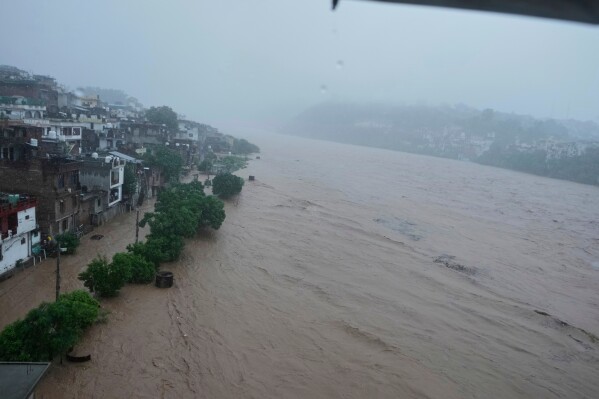
ISLAMABAD: Lahore and other parts of Punjab province braced on Wednesday for what officials called a “very high to exceptionally high” flood threat, as heavy monsoon rains and the release of water from two Indian dams swelled rivers and prompted authorities to seek army assistance in six districts.
The alert came amid relentless rains that have battered both Pakistan and India in recent weeks, pushing rivers into dangerous territory and forcing evacuations across Punjab, the country’s breadbasket and home to half of its 240 million people.
The Ravi, Chenab, and Sutlej rivers have surged, causing breaches in Narowal, Sialkot and Shakargarh. In Zafarwal, part of Hanjli Bridge collapsed under the pressure of Nullah Dek, cutting off road links to dozens of villages.
The National Disaster Management Authority (NDMA), in its latest advisory early Wednesday, described the situation as “extreme” and warned that vulnerable areas are already under threat. The Ravi, swelling rapidly at Jassar, is carrying 170,000 cusecs of water and is projected to surge to 250,000 cusecs by morning, a volume that could overwhelm embankments and inundate nearby settlements.
The Chenab at Marala, a critical flashpoint during high monsoon flows, could see a staggering 690,000 cusecs, while the Sutlej at Ganda Singh Wala is already heaving with 245,000 cusecs, with more still to come. India’s release of an additional 200,000 cusecs into the Ravi and the expected 100,000 cusecs into the Chenab has raised fears of very high flooding in the next 48 hours.
“Heavy rainfall expected in the upper regions of Ravi over the next 48 hours. The Indian dam Thein is 97 per cent full, and its spillways may be opened at any time. Due to potential discharge, a high-level flood is expected in the Ravi River. High-level flow is also expected in Pir Panjal, Bain, Basantar and Deek,” NDMA said.
A statement from the Punjab Provincial Disaster Management Authority said India had opened all gates of the Thein Dam on the Ravi River and 210,000 cusecs of water were entering Pakistan from Kot Ninan. “In the next 24 hours, the water flow at Kot Ninan will increase further. In the next 48 hours, very high level of flood will pass through Jasar Shahdara and Head Baloki.”
The PDMA initiated “large-scale evacuation operations” in vulnerable places following the swelling of the Sutlej River. “Emergency response teams were deployed, and all concerned departments were placed on high alert to safeguard public life and property.”
The data provided by the NDMA showed evacuations included 89,868 residents from Bahawalnagar, 14,140 from Kasur, 2,063 from Okara, 873 from Pakpattan, 361 from Bahawalpur and 165 from Vehari, according to the APP. It further said that around 40,000 people had moved to safer locations soon after the initial alerts.
Late Tuesday, the Provincial Disaster Management Authority said India had opened all the gates of its Thein Dam on the Ravi River. The announcement came a day after Pakistan received a second warning from India that it intended to release water from the rapidly filling Madhopur Dam. Both dams are located on the Ravi River, which flows from Indian Punjab into Pakistan.
Earlier, a spokesperson for National Disaster Management Authority said its assessment of satellite pictures of Thein Dam showed that it was 97% full and could release water at any time. India routinely releases water from its dams when they get too full, with the excess flowing into Pakistan, as the two nations share rivers. Punjab province was split between the two countries when they gained independence in 1947.
“The flood situation is grave,” said Irfan Ali Kathia, an official at the authority in Punjab. “The next 48 hours will be critical.” Rescue authorities are scrambling to prepare. The NDMA has urged families in low-lying areas to move to safer ground, warning that waiting any longer could put lives at risk.
In Shahdara and along the Motorway-2 stretch, the Ravi has been creeping up fast, forcing people to prepare for the possibility of evacuation. Officials have also been telling citizens to cut down on travel unless absolutely necessary and to stay in touch with local rescue teams. “The rivers are unforgiving right now,” one official remarked, stressing that the next few hours will show whether the protective walls hold, or whether neighborhoods on the fringe will have to be cleared out at short notice.
Rescue teams continued shifting stranded residents by boats from river-adjacent areas, while Shakargarh’s Nullah Bainsi and Nullah Basantar overflowed, submerging connecting roads and several villages.
Army called in
The provincial government has called in the army to help civil authorities as floodwaters continue to disrupt life in six districts, including Lahore, Kasur, Sialkot, Faisalabad, Narowal and Okara. Officials said district administrations in the affected areas had sought immediate military assistance to protect lives and support ongoing rescue operations.
Rescue 1122, civil defence, police and local administration are already on the ground, but the scale of the crisis has stretched their resources thin. The Punjab Home Department has formally written to the interior ministry requesting deployment of troops in the six districts.
Prime Minister Shehbaz Sharif, chairing a high-level meeting on the flood situation, was informed that over 174,000 people had been evacuated from inundated districts of Punjab following the flooding of River Sutlej.
He directed authorities to accelerate rescue operations, particularly in flood-hit districts along the river, and to ensure timely provision of food, medicines and tents. The NDMA chairman was ordered to maintain close coordination with the PDMA. Authorities are evacuating people from hundreds of villages in the vicinity of three rivers, and evacuations are continuing, helped by army troops.
The death toll caused by flooding in the country since the start of the monsoon season in late June now stands at 802, half of them in this month alone. The Gilgit-Baltistan region has suffered accelerated glacial melting, while the southern city of Karachi was partly submerged by floods last week.
Copyright © 2021 Independent Pakistan | All rights reserved