By Staff Reporter
ISLAMABAD: Pakistan’s newly created Federal Constitutional Court formally began operations on Friday with the swearing-in of its chief justice and four judges, but the ceremony was marred by a conspicuous boycott by five senior judges of the Islamabad High Court and widespread criticism that the appointments lacked transparency and violated established judicial norms, Dawn newspaper reported on Saturday.
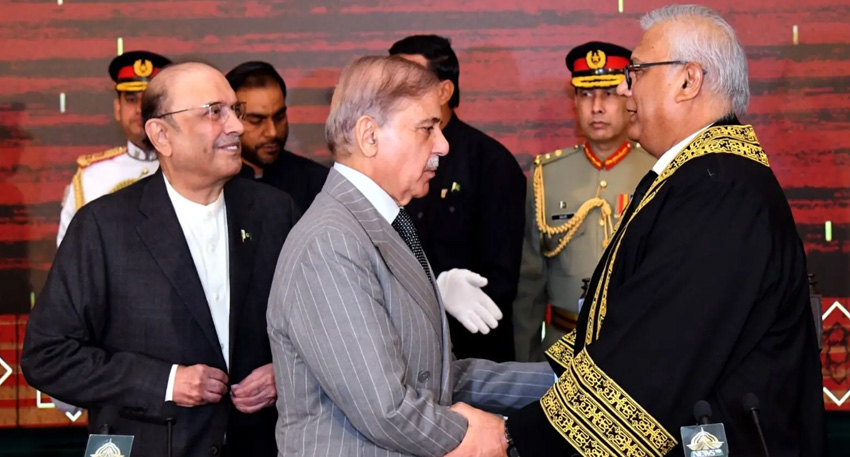
The court, Justice Aminuddin Khan, elevated from the Supreme Court’s now-defunct Constitutional Bench, took the oath as chief justice at the Presidency in the morning, administered by President Asif Ali Zardari. Hours later, in the courtyard of the Islamabad High Court, Justice Khan administered oaths to Justices Syed Hasan Azhar Rizvi, Aamer Farooq, and Ali Baqar Najafi. A fifth judge, Justice Muhammad Karim Khan Agha of the Sindh High Court, is scheduled to be sworn in on Saturday. The remaining appointees, Balochistan High Court Chief Justice Rozi Khan Barrech and Justice Arshad Hussain Shah, have not yet confirmed their availability.
Seven chairs had been placed on the dais for the Islamabad High Court ceremony, but four were removed before it began, and the event started well behind schedule. Chief Justice of Pakistan Yahya Afridi was notably absent, as were five of the eight sitting IHC judges: Justices Mohsin Akhtar Kayani, Tariq Mehmood Jahangiri, Sardar Ejaz Ishaq Khan, Babar Sattar, and Saman Rafat Imtiaz. The four IHC judges who did attend, Justices Arbab Mohammad Tahir, Mohammad Asif, Mohammad Azam Khan, and Raja Inam Ameen Minhas, sat quietly while IHC Chief Justice Sardar Sarfraz Dogar shared the podium with the new FCC judges.
The appointments, made by President Zardari under the recently enacted 27th Amendment, have ignited intense debate over the criteria used to select the judges and the sidelining of several senior jurists. Critics note that, except for Justice Khan, none of the appointees is senior to judges who served on the Supreme Court’s Constitutional Bench that the FCC has now replaced. Nor, they say, do most of the new judges have a distinguished record in constitutional law, either as advocates or on the bench.
“People have every right to know the transparent criteria on the basis of which these judges were picked to create history by becoming judges of the FCC, and on what basis other CB judges were sidelined,” a senior counsel told Dawn on condition of anonymity. The lawyer added that the resignations of two Supreme Court judges — Justices Syed Mansoor Ali Shah and Athar Minallah — immediately before the appointments had already cast a shadow over the new court. The same lawyer warned that perceptions of political loyalty rather than merit could undermine the court from its first day. “If impartiality is suspected, no court has any ground in the eyes of the public,” he said.
Former additional attorney general Tariq Mehmood Khokhar was blunter. He described Friday’s oath-taking as an event that would be remembered “not as the commencement of a new judicial chapter, but as the death rites for the nation’s existing constitutional order and judicial independence.” Khokhar called the 27th Amendment a manoeuvre by an unelected executive and legislature to circumvent and disempower the Supreme Court by creating a parallel apex constitutional forum whose judges are chosen by the government.
Muneer A. Malik, a former president of the Supreme Court Bar Association who led the 2007 lawyers’ movement that restored Chief Justice Iftikhar Muhammad Chaudhry, vowed to fight the amendment “tooth and nail.” He accused the government of “court-packing of the FCC to gain particularised judgements” and questioned whether chief justices of the high courts had even been consulted before their judges were transferred. “The entire process, Malik said, was “totally non-transparent and absolutely a joke.”
Critics have invoked the Supreme Court’s 1996 Al-Jihad Trust judgment, which held that appointments to the superior judiciary must be transparent to preserve public confidence in judicial independence.
Meanwhile, a full-court meeting of the Supreme Court, presided over by Chief Justice Afridi, took place on Friday but did not address either the judges’ resignations or the FCC appointments. Instead, according to an official statement, the justices gave final approval to the Supreme Court Rules, 2025, and granted senior advocate status to one lawyer.
The statement made no mention of the constitutional upheaval unfolding outside the court’s walls. Practical arrangements for the new court remain makeshift. Its permanent building has not been finalised. An initial plan to house it in the Federal Shariat Court building met stiff resistance from FSC judges. A fallback proposal to place it temporarily inside the Islamabad High Court is under discussion, but Justice Khan is said to prefer retaining courtrooms inside the Supreme Court building. If that request is denied, sources said, the FCC will begin hearing cases from the IHC premises as early as Monday.
For now, the court is operating with a skeleton staff. Immediately after taking oath, Chief Justice Khan appointed a retired district judge, Muhammad Hafeez Ullah Khan, as registrar for three years and Mazhar Bhatti as his secretary. Justice Khan told those present at the IHC ceremony that additional judges could be sworn in within “a day or two” and that the court might eventually expand to 13 members.
Copyright © 2021 Independent Pakistan | All rights reserved