By Staff Reporter
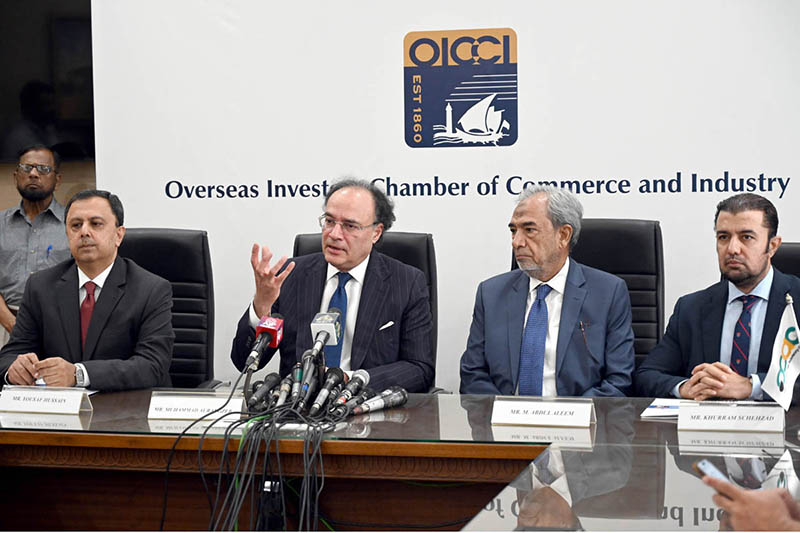
KARACHI: Finance Minister Muhammad Aurangzeb on Monday defended the Federal Bureau of Revenue’s (FBR) expanded powers to combat sales tax fraud, dismissing criticism that they overreach into income tax matters.
Speaking at a press conference in Karachi, he also pressed the banking sector to step up their role in driving economic growth by supporting privatization efforts and reviving struggling industries.
The FBR’s new authority, which includes blocking high-value transactions by non-filers, such as vehicle and property purchases, investments in securities and mutual funds, and opening certain bank accounts, along with sealing unregistered business premises and recovering taxes from firms, has drawn sharp criticism from various sectors.
“I think there is something to understand about what the existing law was at the time. The first thing to understand is that it has no relation to income tax. This whole issue is a sales tax fraud issue,” the minister said.
He noted that the original law already allowed Inland Revenue Service officers to make arrests, but the government introduced new safeguards to ensure accountability. The measures, Aurangzeb explained, followed an exhaustive legislative process, with “detailed discussions” in standing committees, the Senate finance committee, the National Assembly, and parliament, incorporating feedback from the Pakistan Bar Council’s vice chairman.
Aurangzeb urged the public to review the safeguards, highlighting that six of the 10-12 new sections specifically address sales tax fraud due to its severity. He said the arrest powers would only apply to fraud cases exceeding Rs50 million ($180,000) and require approval from a three-member FBR board.
“This is not something parliament has approved without thinking it through,” he said. “A lot of thought has gone into it.”
Turning to the financial sector, Aurangzeb outlined two critical areas where banks could bolster Pakistan’s economy: privatization and the revival of “sick units.” With 24 state-owned enterprises handed to the privatization commission, the minister stressed that “banks can play a very important role in this, and they should.”
On distressed industries, he acknowledged external pressures like high interest rates, inflation, and commodity price swings that have hampered repayment capacity. He urged banks to partner with sponsors to rehabilitate these units, calling it “a very big pillar” of the government’s industrial policy under Minister-in-Charge for Industries and Production Haroon Akhtar. “I am glad that the banking sector in Pakistan is stepping up and helping the economy to grow as we go forward,” Aurangzeb said.
Aurangzeb emphasized that macroeconomic stability is a means, not an end, pointing to significant progress in easing foreign investors’ concerns. “It was a very big issue that [foreign investors’] dividends were stuck here, their profits were unable to be repatriated, there was difficulty in opening their letters of credit,” he said, noting a “substantial improvement” over the past 12-18 months.
“It is very important for a foreign investor that when they bring their capital, they have the assurance that ‘we can take this back at any time (…) without any prohibitions’. If existing investors are not satisfied, then bringing further investment in the future is very difficult.”
In a bid to rebuild trust in the tax system, Aurangzeb invited Faysal Bank President and CEO Yousuf Hussain and Communications Minister Abdul Aleem to Islamabad to observe the FBR’s transformation efforts, which focus on simplifying processes and automating procedures.
He also sought their input on pressing issues. “It is very important to re-establish the credibility and trust of our tax authority in this country,” he said.
The minister showcased a streamlined tax form for the salaried class, reduced from 800 rows and complex codes to just eight screens, and requested feedback on its usability. “We have only started with the salaried class. We will take this to small traders, and then we will take it to SMEs,” he said, signaling a broader push to ease tax compliance.
Aurangzeb also revealed that Rs75 billion in sales tax refunds had been processed this month alone, based on data from two days prior, as part of regular efforts to stabilize the economy and promote sustainable growth.
Copyright © 2021 Independent Pakistan | All rights reserved