By Staff Reporter
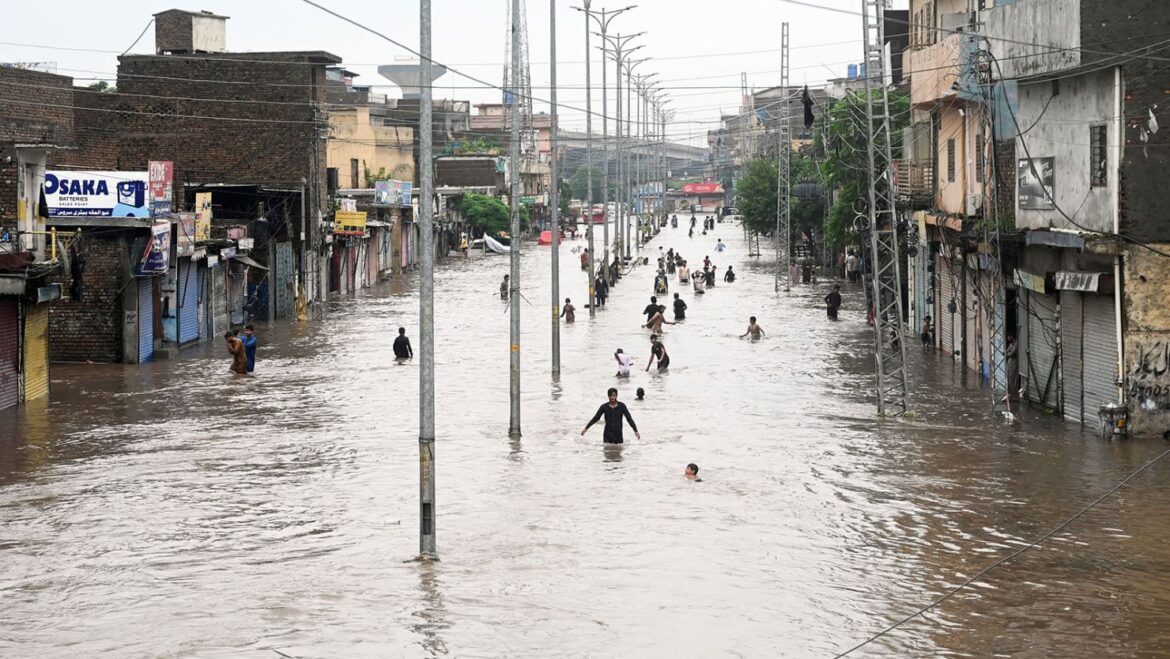
ISLAMABAD: Raging floodwaters fed by monsoon rains and releases from Indian dams swept through Pakistan’s Punjab province on Thursday, killing at least 15 people, submerging hundreds of villages and displacing or affecting more than 600,000 residents, as authorities scrambled to evacuate thousands more amid fears of a catastrophic dam breach.
The deaths, which included five members of one family in Sialkot’s Sambrial area, underscored the human cost of a disaster that has already claimed 805 lives nationwide since the monsoon season began in late June.
“According to the commissioner of Gujranwala and Gujrat division, 15 people have died in the floods, including five from one family in Sialkot’s Sambrial, four in Gujrat, three in Narowal, two in Hafizabad and one in Gujranwala,” Punjab’s provincial information department reported late Wednesday.
The toll is part of a broader crisis intensified by climate change, with this year’s fatalities nearly triple those of the same period last year, according to the United Nations Office for the Coordination of Humanitarian Affairs.
Injuring 1,107 others across the country, the deluge has hit hardest in Punjab, Pakistan’s densely populated agricultural heartland, home to roughly half of the nation’s 240 million people. At the center of the emergency are three major rivers — the Chenab, Ravi and Sutlej — that originate in India and flow into Pakistan, now swollen to “exceptionally high flood” levels by torrential rains and dam releases upstream.
An Indian government source told Reuters that New Delhi had opened all gates at key dams in occupied Kashmir after heavy downpours, issuing the third alert to Islamabad since Sunday about potential downstream surges. Pakistani officials acknowledged the warnings, bracing for up to 200,000 cusecs — cubic feet per second, with each cusec equivalent to about 28 liters — of water, though the release pattern remained uncertain.
Flow measurements highlighted the severity: Outflows at Qadirabad headworks on the Chenab reached 1,054,883 cusecs, while Khanki headworks hit 966,427 cusecs. The Sutlej recorded 261,053 cusecs at Ganda Singh Wala, and the Ravi surged to 160,000 cusecs at Shahdara near Lahore, with more water expected imminently, per the Meteorological Office’s Flood Forecasting Division.
Faced with the threat of a breach at the Qadirabad Barrage, authorities deliberately cut a protective embankment to relieve pressure, deployed the army and ordered evacuations of over 200,000 people. “Deputy commissioners have been instructed to evacuate citizens from these areas,” the Punjab Provincial Disaster Management Authority (PDMA) stated, warning that a full failure could devastate Hafizabad and Chiniot districts.
Punjab’s emergency service, Rescue 1122, has already moved 39,638 people to safety from districts spanning Sialkot, Sargodha, Chiniot, Gujranwala, Hafizabad, Mandi Bahauddin, Gujrat, Lahore, Narowal, Kasur, Okara, Pakpattan, Bahawalnagar, Vehari, Bahawalpur and Lodhran. The floods have inundated 769 villages overall, directly affecting 601,126 residents — a staggering displacement that has strained relief efforts and highlighted vulnerabilities in low-lying areas.
The Sutlej River has been particularly destructive, flooding 335 villages and impacting 380,768 people. Kasur district suffered the worst, with 72 villages submerged and 450,000 residents affected, followed by Bahawalnagar (75 villages), Vehari (23), Pakpattan (12) and Bahawalpur (15). Along the Chenab, 333 villages are underwater, including 133 in Sialkot, 100 in Chiniot and 52 in Jhang. To aid the displaced, officials have set up 263 relief camps and 161 medical camps, distributing food, shelter and healthcare.
The Pakistan Army, operating in eight districts, has led rescue operations in coordination with local authorities, but not without sacrifice: Two soldiers died and two were injured in the line of duty, said Inter-Services Public Relations Director General Lt. Gen. Ahmed Sharif Chaudhry.
In Narowal district, the Ravi’s overflow submerged the sacred Sikh shrine Gurdwara Darbar Sahib in Kartarpur, where waters rose to nearly three feet in parts of the compound, flooding the courtyard and main staircase and halting pilgrimages. Officials from the Evacuee Trust Property Board confirmed the inundation, as rescuers evacuated 200 to 300 people from the site.
In Sialkot, battered by 405 millimetres of rain this week, the international airport remained closed until 10 pm Thursday, stranding travellers and paralysing commerce. In the Bajwat region, nestled between the Chenab and Tawi rivers, nearly 70 villages were swamped, cutting off roads to Sialkot city.
“The water came so fast, we lost everything,” one resident told rescue workers amid the chaos. The destruction extended to Sohdra, where Chenab floods engulfed homes and streets in Wazirabad. Infrastructure buckled under the strain: Highways in Narowal, Shakargarh and Sialkot were submerged, including nearly a kilometer of the Sialkot-Pasrur dual carriageway.
A breach in the Naala Dek embankment wrecked the Kona Drain Bridge, while three to four kilometers of the Narowal-Shakargarh road vanished underwater. In Narowal’s Zafarwal tehsil, the town of Kanjroor — with its 20,000 inhabitants — teetered on the brink as streams overtopped embankments and swept away the Hanjli bridge.
As the waters cascade southward, the crisis threatens to engulf southern Punjab and spill into Sindh province. The National Disaster Management Authority (NDMA) advised Sindh’s PDMA to clear residents from along the Indus River and its tributaries. “The NDMA has issued this advisory in view of the exceptionally high and very high flood levels being recorded at upstream locations in Rivers Chenab, Ravi and Sutlej,” Radio Pakistan reported. “It is anticipated these floodwaters will ultimately contribute to rising flows in the River Indus.”
Sindh officials responded by naming ministers as focal points to monitor risks at the Guddu, Sukkur and Kotri barrages, while directing provincial legislators along the Indus to stay in their constituencies for at least a week. Looming over the response is the forecast from the Pakistan Meteorological Department (PMD) of more monsoon rains from August 29 to September 2 in upper and central regions, including Azad Kashmir, Murree, Galliyat, Rawalpindi, Islamabad, upper Khyber Pakhtunkhwa and northeastern Punjab.
Copyright © 2021 Independent Pakistan | All rights reserved