By Staff Reporter
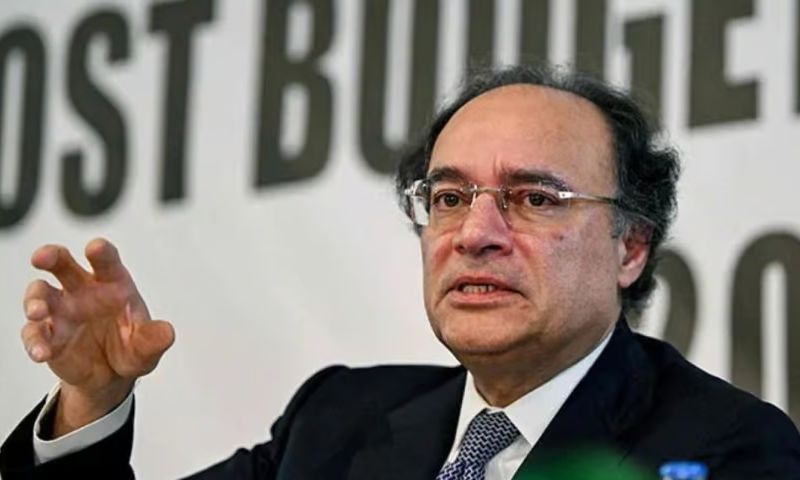
ISLAMABAD: The government is pivoting from short-term growth targets toward a strategy aimed at sustainable economic expansion, Finance Minister Muhammad Aurangzeb said Wednesday, signalling a departure from repeated boom-and-bust cycles that have destabilised the economy in the past.
“We do not want to repeat the past cycles of unsustainable growth,” Aurangzeb said at a two-day economic dialogue hosted by the Pakistan Business Council in the capital. The emphasis now is on steady, sustainable progress to solidify the economy’s foundation.
The growth path isn’t the problem, Aurangzeb said; sustaining it has been the real hurdle, with prior efforts faltering. He warned against reverting to old habits and stressed that export-driven expansion is the sole route to robust performance. Without specifying which nation, he alluded to a nearby economy targeting 8% growth yet grappling with elevated joblessness. In Pakistan, the conversation revolves around equitable and inclusive development, he said.
On sectors, Aurangzeb underscored plans to rejuvenate industry, with a forthcoming policy prioritising this push. He voiced optimism for 3.5% gross domestic product growth in the ongoing fiscal year, projecting about 4% over the next two to three years and potentially 6% to 7% in the medium term if agriculture, manufacturing and services maintain their pace.
Remittances and foreign inflows are holding firm, with consistent monthly flows via official channels and solid uptake of the Roshan Digital Account for overseas Pakistanis. He forecast remittances hitting around $41 billion this year. Easing interest rates will curb borrowing costs, the minister said, while encouraging businesses to branch out from bank loans and tap capital markets for longer-term, cheaper funding.
Aurangzeb reiterated pledges to tackle deep-rooted problems in taxes and energy. “We are going to hold the first tax advisory council meeting on Thursday,” he said. “The council will now reach out to businesses for input ahead of the next budget.”
Addressing foreign investor worries over security, he declared it non-negotiable, labelling security, macro stability and seamless profit outflows as essentials for drawing and keeping international capital. The first session of the 11th National Finance Commission is set for Dec. 4. “We will engage provinces to come up with some tangible results,” he said.
Pakistan is gearing up for its debut Panda bond sale before the Chinese New Year, Aurangzeb announced. He highlighted fresh enthusiasm from multinationals like Saudi Aramco and entities from Turkey and Abu Dhabi, which are channeling funds into energy, mining, tech, logistics and autos — a vote of confidence in the country’s trajectory.
Separately, Jameel Ahmad, governor of the State Bank of Pakistan, also asked the authorities to abandon short-term stabilisation tactics in favour of a more enduring, export-oriented economic model, warning that failure to do so risks perpetuating cycles of fleeting growth followed by harsh corrections.
Speaking at the opening session of the Pakistan Business Council’s Dialogue on the Economy on Wednesday, Ahmad highlighted how Pakistan has frequently fallen into patterns of expansion derailed by subsequent austerity measures. He emphasised that the present juncture provides a genuine chance for lasting change, provided policymakers stick to consistent strategies and the private sector demonstrates flexibility.
The remarks come as Pakistan navigates a fragile recovery from recent economic pressures, including high inflation and depleted foreign reserves. Ahmad outlined distinctions between the ongoing stabilisation and prior episodes, noting that current efforts are bolstered by synchronised, proactive monetary and fiscal policies. This contrasts with earlier approaches that often involved hasty relaxations, which eroded gains.
He pointed to the central bank’s enhanced predictive tools, which now allow decisions grounded in projections spanning eight quarters, rather than reacting to immediate data points. “Inflation has not only aligned with our forecasts but is also expected to remain within the 5–7 percent target band over the medium term,” Ahmad affirmed.
A cornerstone of the improved outlook, he said, is the bolstering of foreign reserves through deliberate means. Unlike past dependence on borrowed inflows, recent buildups stem from targeted currency acquisitions and the unwinding of forward commitments.
Public sector external debt has held steady since 2022, Ahmad added, with the external debt-to-GDP ratio dropping from 31 percent to 26 percent. Meanwhile, the SBP’s foreign exchange reserves have climbed from a perilously low $2.9 billion to about $14.5 billion — a nearly fivefold jump.
Ahmad observed a budding consensus that durable expansion will evade Pakistan unless economic strategies pivot toward long-range goals centered on public welfare, ditching the episodic, consumption-fueled surges of yesteryear. This evolution is evident in extended reforms rolled out by the government and the SBP via domestically crafted plans.
On fiscal matters, the governor noted the government’s string of primary surpluses over the last three years, a rarity in prior periods that has steered public debt toward firmer footing. He also flagged ongoing structural overhauls, such as boosting the tax-to-GDP ratio via enhanced tracking and broader taxation, alongside energy reforms to curb costs.
These are paired with the SBP’s drives to mend flaws in financial channels and widen access to banking services nationwide. Peering forward, Ahmad insisted that Pakistan’s framework must transform to avert further volatility. He argued that the nation’s typical 3-4 percent growth rates fall short for a population exceeding 250 million. “Pakistan stands at an inflection point,” he stated, pressing businesses to pursue international edge over domestic crutches like subsidies or barriers.
The governor encouraged firms to weave into worldwide supply networks, upgrade manufacturing, and capitalize on prospects from allies including the US, China, and Middle Eastern nations.
Copyright © 2021 Independent Pakistan | All rights reserved