By Staff Reporter
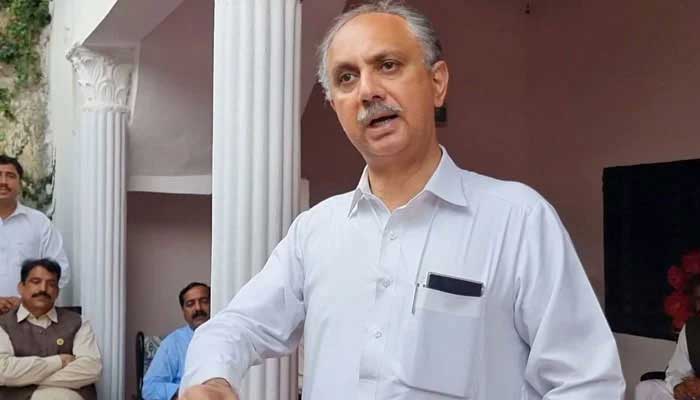
ISLAMABAD: An anti-terrorism court on Wednesday declared opposition leader and former finance minister Omar Ayub Khan a proclaimed offender after he repeatedly failed to appear in connection with charges linked to a violent protest last year, escalating legal pressure on allies of jailed former Prime Minister Imran Khan.
The ruling by Judge Tahir Abbas Sipra of came during a hearing on a case tied to an Oct. 4 demonstration organised by Khan’s Pakistan Tehreek-e-Insaf party. The judge noted that despite multiple summons, Ayub had not presented himself, prompting the court to initiate proclamation proceedings under the law.
The court also directed authorities to compile a full inventory of Ayub’s movable and immovable properties and ordered the blocking of his passport and Computerised National Identity Card, measures intended to restrict his movements and compel compliance.
The case revolves around a PTI rally held last year, during which Ayub and several senior party figures were accused under anti-terrorism laws. Prosecutors earlier this year filed a formal charge sheet, naming top PTI leaders and alleging they had incited violence and disrupted public order. The hearing was adjourned, with the court instructing officials to fulfill the procedural requirements for the proclamation.
In a separate but related development in Rawalpindi, Aleema Khan, the sister of Imran Khan, was briefly detained by female police officers inside another Anti-Terrorism Court on Wednesday, amid tense proceedings over charges linked to a Nov. 26 protest.
Aleema Khan, one of 11 defendants accused of arson and obstructing government functions during the demonstration, appeared before Judge Amjad Ali Shah. At the start, the court was told that lawyers planned to argue an application by an accused named Safai challenging the Anti-Terrorism Court’s jurisdiction. The judge observed that the 11 defendants, including Aleema Khan, had already been indicted.
Prosecutor Zaheer Shah told the court that the accused faced charges under terrorism-related laws for alleged acts of arson and encirclement during the protest. As the session unfolded, Aleema Khan tried to leave the courtroom. “Our lawyers are busy in the Supreme Court, we should be allowed to go,” she said.
Female officers intervened, escorting her back inside. Shah, the prosecutor, asserted that Aleema Khan was “in judicial custody under Section 351” and could not depart without the judge’s express approval.
Faisal Malik, a defence lawyer, vehemently objected, contending that Aleema Khan had surrendered voluntarily and that there was “no order to take her into custody.” He called the police intervention “unacceptable” and pressed the court to pursue action against the officers.
The judge, addressing the defence’s complaints, remarked, “If you had come on time, this might not have happened.” The exchange grew heated, with the prosecution accusing Aleema Khan and her legal team of impeding the trial. Shah noted that eight police witnesses had attended despite their duties and that repeated delays were hampering the process.
After the arguments, the court permitted Aleema Khan to submit her bail bonds. It also mandated that the defendants pay 10,000 rupees each to the eight witnesses as compensation for the inconvenience from adjournments.
Defence lawyers further asked the court to instruct authorities to unfreeze the bank accounts of the Shaukat Khanum Memorial Trust, a cancer hospital founded by Imran Khan, and Namal University in Mianwali. Shah, the prosecutor, responded pointedly: “We regret that Shaukat Khanum’s account had to be frozen due to the irresponsible behaviour of the accused. The court granted the defence’s request and postponed the hearing until Dec. 1.
Copyright © 2021 Independent Pakistan | All rights reserved