By Staff Reporter
There is a particular kind of presidential humiliation that arrives not with a single catastrophic event but in the accumulated weight of contradictions — the triumphant declaration that quietly curdles into farce. Donald Trump is living inside one of those moments now, and the remarkable thing is that he seems barely to have noticed.
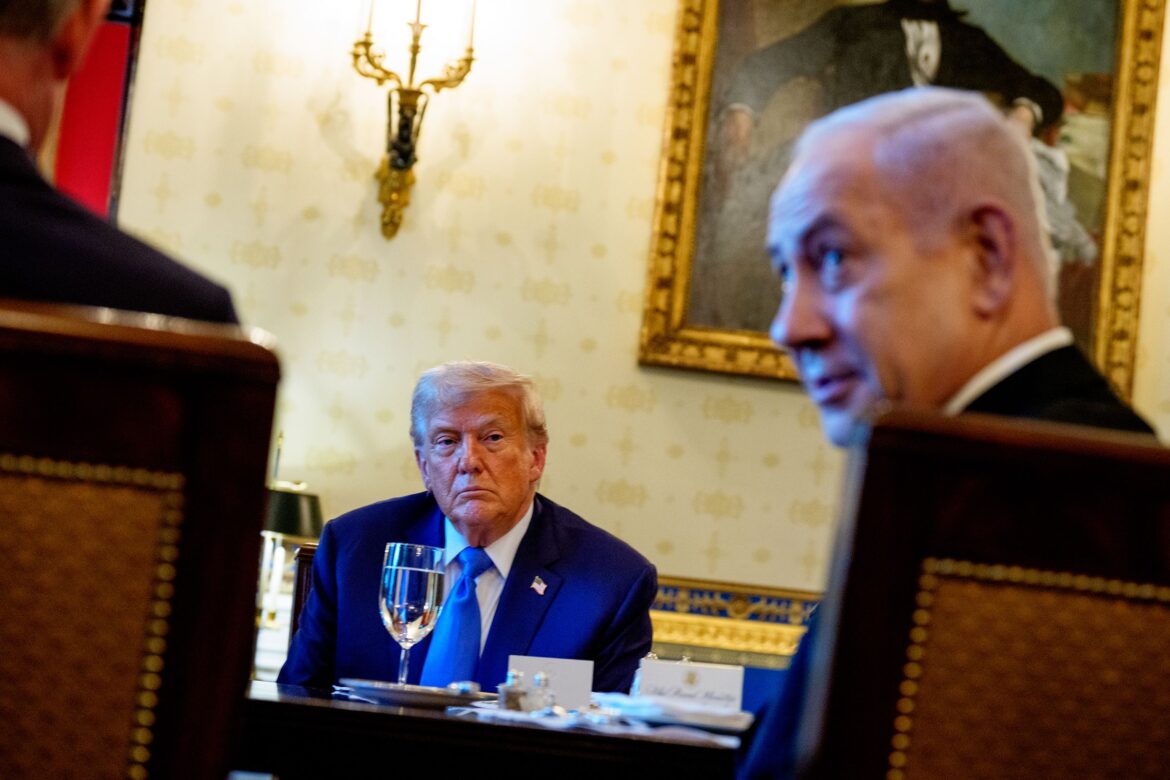
On Wednesday, the President of the United States confirmed to a podcast audience that he had called the Prime Minister of Israel “effing crazy” during a phone call earlier that week. This was not a leak, not an anonymous briefing, not a hostile intelligence assessment. Trump said it himself — cheerfully, almost — while also insisting that he likes Benjamin Netanyahu “a lot” and works “very well with him.” The two statements were offered within the same breath, and nobody in the room appeared to find this unusual. Perhaps that tells us everything about where American foreign policy now stands.
The immediate cause of the outburst was a crisis that reveals, with brutal clarity, the central structural flaw in Washington’s Iran strategy. Netanyahu had ordered strikes on Hezbollah’s stronghold in Beirut’s Dahieh district. Tehran, which had conditioned any progress in ceasefire negotiations on Israel ceasing military operations in Lebanon, promptly announced it was suspending talks with the United States. In the space of a few hours, months of painstaking indirect diplomacy lurched toward collapse — not because of anything Iran did, but because America’s closest regional ally decided to act on its own agenda. Trump, by his own account, was furious. He reportedly told Netanyahu that he owed his freedom to American support, that he was throwing away a rare diplomatic opening, and that the strikes on Beirut would not be happening. Israel stood down. The talks, reportedly, resumed. A crisis managed, then. Except that it should never have been a crisis at all.
The Netanyahu problem that every American president eventually inherits
Every occupant of the White House for the past three decades has, at some point, found themselves staring at the ceiling after a phone call with Benjamin Netanyahu, wondering how a relationship so publicly celebrated became privately so difficult. Bill Clinton clashed with him over the Oslo Accords. Barack Obama endured the extraordinary provocation of a 2015 address to Congress on Iran policy — arranged without White House knowledge — that was barely disguised as a campaign speech against a sitting American president’s signature diplomatic achievement. Joe Biden, who built his political identity on ironclad support for Israel, ended his tenure watching that relationship corrode in the acid of Gaza. Trump, in his first term, felt genuinely betrayed when Netanyahu became the first world leader to congratulate Biden on his 2020 election victory.
And yet they always come back. The relationship resets. The public warmth returns. Netanyahu has described Trump as the “greatest friend to Israel” in American history — and he may mean it, in the particular sense that Trump did break the mould. He was willing, as analyst Natan Sachs has observed, to militarily confront the Iran axis in a way that previous administrations were not. That aligned perfectly with Netanyahu’s long-held strategic ambitions. For a while, the alliance was genuinely productive, or at least productive in its own terms.
But that convergence always contained a fault line. Israel’s objective in Lebanon — the destruction of Hezbollah as a functioning military force — does not pause for American diplomatic calendars. Netanyahu’s political survival depends on a domestic audience that demands maximum pressure on Iran’s proxies, regardless of what Washington needs at any given moment. When Trump chose to launch strikes on Iran in February, he essentially signed up to a war whose shape and duration would be significantly determined by a partner with its own irreconcilable imperatives. As former diplomat Brett Bruen has put it with uncomfortable precision, Trump “decided to take the plunge” with a “mercurial leader that has an agenda which doesn’t always align with your own priorities.” The lesson is now being learned in real time, at considerable cost.
The ceasefire that dare not speak its name
Let us be precise about what “ceasefire” means in the current context, because the word is doing an enormous amount of diplomatic labour it cannot support. An Indian national was killed in an Iranian attack on Kuwait airport. Tehran struck US bases in Kuwait and Bahrain. The US struck a tanker bound for Iran’s oil hub at Kharg Island. Trump told reporters that in this part of the world, “a ceasefire is when you’re shooting in a more moderate manner.” This is not a description of peace. It is a description of a conflict that has found a temporary equilibrium somewhere below all-out war — an equilibrium that could collapse at any moment, and that nobody seems to have a reliable mechanism for converting into genuine stability.
Meanwhile, the Strait of Hormuz — through which roughly a fifth of the world’s oil supply passes — remains a source of ongoing anxiety. Oil executives and analysts are warning that crude oil stockpiles that have cushioned the impact of the war are falling at an alarming pace. The global energy crisis triggered by the closure of the strait has fed inflation, rattled central banks, and imposed real economic pain on ordinary people from Punjab to Pennsylvania. Trump’s repeated assurances that gas prices will fall “sharply” once the conflict ends are cold comfort to Americans who are paying those prices right now, at a pumping station, six months after he declared military victory.
Behind-the-scenes indirect talks do seem to have made progress, with both sides reportedly tinkering with wording for a proposed initial memorandum of understanding. But the full-scale agreement that Trump promises — one that would permanently end Iran’s nuclear ambitions and reopen the strait — remains, as one analysis has aptly put it, another Middle Eastern mirage. The noises from Tehran are noticeably less optimistic than the noises from Washington. Iran’s Foreign Minister Abbas Araghchi stated plainly that there had been no “significant progress” in recent days, even as Trump was telling reporters that negotiations were going “very well — actually, very well.”
This disconnect between what Trump says and what is actually happening is not merely a communications problem. It is a strategic liability. When a president conjures deals that do not materialise, he trains his adversaries to discount his assurances — and, crucially, to discount his threats. Tehran has watched Trump announce imminent breakthroughs so many times that there is little reason to believe the next announcement will be any different. The bluff has been called so often it no longer functions as a bluff.
Congress starts to push back — and this time, it matters
The House of Representatives vote this week to restrict Trump’s Iran war powers — passing 215 to 208, with four Republicans joining a united Democratic front — was described by its co-sponsors as “a significant bipartisan rebuke.” That is, for once, not an overstatement. This was the fourth such attempt. The previous three failed. The fact that this one succeeded, however symbolically, reflects a measurable shift in the political weather.
The Republicans who crossed over — Thomas Massie of Kentucky, Brian Fitzpatrick, Tom Barrett of Michigan, and Warren Davidson — were not acting from political naivety. Barrett spoke plainly about voting his conscience even at the risk of presidential retribution. Massie, who has been stripped of committee assignments and targeted in primaries for his persistent opposition to Trump, voted against the war resolution anyway. These are not gestures of convenience. They are signs that a small but significant cohort of Republicans has concluded that the political cost of continued unconditional loyalty now outweighs the cost of dissent.
Representative Gregory Meeks, the leading Democrat on the House Foreign Affairs Committee, framed the result as evidence that Trump had failed on every metric: he had not achieved the war’s stated aims, he had pushed up fuel prices at home, and he had made a diplomatic solution to Iran’s nuclear programme harder, not easier. That is a damaging charge sheet, and the fact that four Republicans implicitly endorsed it by their votes suggests it is landing beyond the Democratic base.
The resolution still needs the Senate, which has so far failed to bring a similar measure to a full-floor vote despite 50 apparent supporters. And the White House has signalled it may consider the underlying legal mechanism unconstitutional in any case, meaning Trump could attempt to ignore the resolution even if it passed. But the political signal has been sent. More Republicans are listening to constituents who did not vote for an open-ended war in the Middle East. The window for treating this conflict as politically costless is closing.
What Iran actually wants — and why the sequencing matters
Marco Rubio, in two days of Congressional testimony that were as revealing as they were uncomfortable, offered a clearer picture of where the negotiations actually stand than Trump’s Oval Office optimism usually allows. The US position is essentially this: Iran must first open the strait, remove mines, and cease firing on ships — all with no sanctions relief as an upfront payment. Iran must then commit to negotiations on ending uranium enrichment and disposing of its existing stockpile. Only at that point would Washington consider unfreezing Iranian assets. “There’s not going to be some sort of advanced signing bonus or good-faith front,” Rubio said.
This is a maximist negotiating position in the abstract. In practice, it crashes immediately against the leverage Iran accumulated by shutting the Strait in the first place. Tehran has forced Washington to rein in Netanyahu over Lebanon. It has kept the world’s oil markets on edge for months. It has watched the US burn through weapons stockpiles at a rate that will reportedly take three years to replenish. Democratic Senator Cory Booker said what many are thinking: “We are the strongest nation on the planet Earth, and we’re in a stalemate with Iran.” Rubio contested the framing, but the difficulty of the rebuttal was plain enough.
The deeper problem is one of time. The 2015 Obama nuclear deal — which Trump tore up in his first term and which he now insists any new agreement must comprehensively supersede — took nearly two years of intensive negotiation and years of preparatory groundwork. Rubio himself acknowledged in Senate testimony that working out the technical details of a new nuclear framework would require “a team of experts to meet over a 30-, 60-, 90-day period.” That is not the language of a president who has been promising a deal “over the weekend” for the better part of two months.
The contradiction that Secretary Rubio cannot fully escape — and to his credit, he does not always try — is that the administration must simultaneously explain why it cannot end a war it has already declared won, and why it is negotiating to constrain a nuclear programme it claims to have already “obliterated.” Democratic Congresswoman Sara Jacobs posed the question with piercing simplicity: “If the war is over, who won?” The answer, as experienced in Kuwait airports, at oil tankers in the Persian Gulf, and at petrol stations across the American Midwest, is that nobody has won anything yet.
The real trap — and who set it
There is a school of thought in Washington, articulated by analysts close to the hawkish end of the Iran debate, that Tehran is deliberately running out the clock — calculating that the longer the holding pattern lasts, the more constrained Trump becomes. Every week that passes without a deal is a week in which Gulf allies grow more anxious, Republican moderates grow more restless, American consumers grow more frustrated, and the credibility of further military action erodes. Iran, for all the damage inflicted on its navy, its nuclear facilities, and its senior leadership, understands that it does not need to win. It needs to survive long enough for Trump’s domestic political coalition to fracture. That analysis is not comforting. But it is not obviously wrong.
Trump came to this conflict with several genuine assets: military superiority, allied support, and a domestic mandate for firmness. He still has the first. The second is fraying, as evidenced by the Netanyahu phone call and the ongoing anxiety among Gulf states about being caught in Iranian retaliation. The third is eroding, visible in falling approval ratings, the House vote, and the rising number of Republicans willing to say publicly what they are all apparently saying privately.
He is also constrained by his own rhetoric. He rejected the Obama deal as weak. He has insisted any new agreement must be far more comprehensive. He has promised a historic, definitive resolution. Each of those commitments narrows the available exit ramp. A deal that resembles what was on the table in 2015 — the very deal he tore up — would be politically devastating. A deal that falls short of his stated ambitions would be worse. And no deal, as November approaches with energy prices high and the conflict unresolved, is a scenario that should worry Republicans in every contested district in the country.
The hope, if it exists
There is a version of this that ends reasonably well. Iran’s economy is under severe pressure. Its leadership has been degraded. The Islamic Revolutionary Guard Corps is fighting on multiple fronts simultaneously. At some point, the cost-benefit calculation in Tehran may shift. Pakistani and Qatari mediators remain engaged. Pakistan’s Prime Minister Shehbaz Sharif has remained a key mediator in talks between Washington and Tehran, and both sides are talking through intermediaries rather than fighting with full intensity. Extended diplomacy has its own logic. When enemies are talking, they are not — quite — at war.
But that hope requires a kind of patience and strategic discipline that Trump has not, so far, displayed. It requires accepting that the “boring” long-form negotiations he publicly disdains are not a failure of will but the only available mechanism for a durable outcome. It requires managing Netanyahu — firmly, consistently, and without public drama that gives Tehran grounds to walk away from the table. It requires honest communication with the American public about what is actually achievable and on what timeline, rather than a rolling series of promises about deals that are perpetually days away.
And it requires a recognition, which nothing in Trump’s public posture suggests he has made, that the United States is not in the position of strength that its military capacity would imply. Iran has played a weaker hand with considerable skill. The question is whether Washington will acknowledge that reality before the costs — economic, political, and human — become genuinely irreversible.
In the meantime, the “effing crazy” remark hangs in the air over Middle Eastern diplomacy like smoke from a strike that has yet to be claimed. Netanyahu smiled it off. Trump said he likes Bibi a lot. The ceasefire, such as it is, held through another night. And somewhere in the halls of the Iranian foreign ministry, officials are doing the arithmetic on how many more weeks of this their adversary can politically afford. The answer, increasingly, is: not as many as he thinks.
Copyright © 2021 Independent Pakistan | All rights reserved