By Staff Reporter
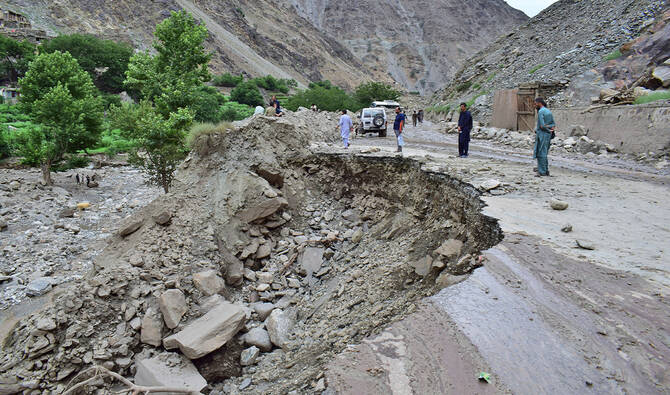
HUNZA: A glacial lake outburst flood (Glof) from the Shishper Glacier tore through Hassanabad Nullah in Pakistan’s Gilgit-Baltistan region on Sunday, sweeping away part of the vital Karakoram Highway and wreaking havoc on homes, farmland, and infrastructure, officials said.
The deluge, described as the most severe in the area since 2018, was fuelled by accelerated glacier melt amid unprecedented high temperatures and repeated heatwaves this year.
“The volume of today’s flood was the highest in the Nullah since 2018,” Zubair Ahmed Khan, assistant director of the Gilgit-Baltistan Disaster Management Authority (GBDMA) for Hunza and Nagar, told local media.
The torrent severed the main road link for much of Hunza’s population, forcing authorities to divert traffic via the Sas Valley Road from Murtazabad. It ripped through agricultural land, uprooted trees, and damaged public and private property, compounding the region’s woes after a similar Glof last month destroyed four homes and vast tracts of farmland.
In Hassanabad, residents were left grappling with the aftermath. “The flood eroded land near multiple homes and put more than 50 houses near Hassanabad Nullah at risk,” Saleem Bercha, a local resident, told Dawn newspaper. “Several homes have developed cracks. Ten houses were dismantled recently to try to save them from the water.”
Authorities said the disaster struck after the Shishper Glacier’s water discharge was blocked for around an hour before bursting through, obliterating protective walls and damaging irrigation and drinking-water channels supplying Aliabad and nearby villages.
Elsewhere in Gilgit-Baltistan, flash floods triggered by heavy glacier melt surged through Supultar Nullah in Nagar Khas, blocking the Hoper Valley road and isolating a popular tourist destination. The flood destroyed a bridge, severed the Hisper Valley road in Tokorkot village, and damaged irrigation systems, leaving several homes under threat.
In Hunza’s Shimshal Valley, rising river levels damaged the only access road and protective walls safeguarding it, further isolating communities. Across the region, restoration efforts for irrigation and water supply systems, wrecked by recent cloudbursts, flash floods, and Glofs, remain stalled, leaving communities facing acute shortages of drinking and irrigation water.
In Danyor, residents reported that the destruction of main water channels had left thousands without water. “Crops and trees have dried up,” a resident told local media. Volunteers are now working to repair the damage in affected areas, where communities rely almost entirely on glacier-fed water for survival.
Experts attribute the rising frequency of Glofs and extreme flooding to climate change-driven glacier melt, with this year’s unprecedented temperatures accelerating the crisis.
Copyright © 2021 Independent Pakistan | All rights reserved