By Staff Reporter
ISLAMABAD: Pakistan’s military spokesman has said the country is acting as an “honest broker” between the United States and Iran, even as Islamabad moves towards the military defence of Saudi Arabia against escalating attacks by Yemen’s Houthi movement.
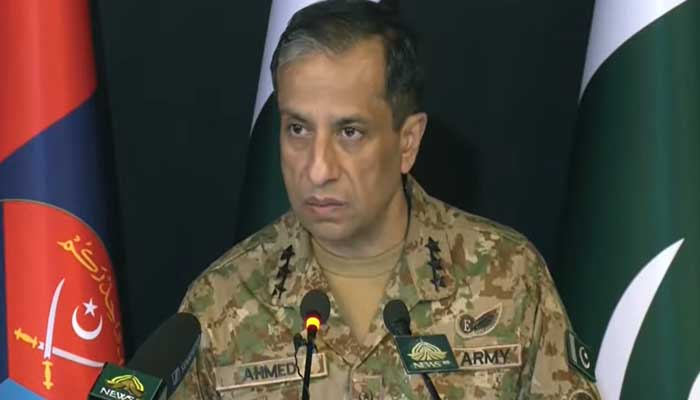
Lieutenant General Ahmed Sharif Chaudhry, director general of Inter-Services Public Relations (ISPR), told CNN that Pakistan remained committed to a “negotiated and peaceful” end to the conflict and wanted to stop it spreading. “We want that the conflict should not expand horizontally or vertically,” he said. He added that Pakistan was doing “whatever is possible, whatever is necessary so that the gap narrows”.
He was interviewed by the network’s correspondent Ivan Watson, who posted a clip on X on Wednesday. A longer excerpt was published by state-run Pakistan Television on Friday.
Watson asked whether Pakistan could “still play a neutral role” when Iran had targeted Saudi Arabia and the Iran-aligned Houthis were now attacking the kingdom. Pakistan is bound to Riyadh by the Makkah defence pact.
Lt Gen Chaudhry did not use the word neutral. “Pakistan has been exhibiting that we are a very honest broker … everything stems from honesty,” he said. “We have been very clear on where Pakistan stands with all our partners.”
He pointed to Pakistan’s public record since the war began. Islamabad had openly condemned the Israeli and American attacks on Iran, he said, and had also condemned Iran’s retaliatory strikes on Gulf states.
“We don’t mince our words; we have a stake in regional peace and stability,” he said. “We tell all that nobody benefits from expanding this war.”
Troops “for decades”
Asked whether Pakistani troops were already in Saudi Arabia under the Makkah alliance, the general said they had been there “for decades” and across multiple domains. The alliance, he said, had not emerged “in a vacuum” but from long-standing diplomatic, political, military and people-to-people ties between Pakistan, Saudi Arabia and Turkey.
In the longer excerpt he declined to say how forces would be used. The accord and its implementation, he said, would be “purely defensive”, and decisions on which units went where and how they were employed were for the operational commander.
“Because it’s a military conflict … no participating country starts disclosing how and where I am going to employ my forces,” he said. “So how and when they will be employed, you will see [for] yourself.”
He said all states had a right to self-defence under the UN charter and that the best course was to “ward off” a threat through collective deterrence before it became a conflict. Pakistan, Saudi Arabia and Turkey had “potent” military and diplomatic capabilities, he said, adding that anyone “having some funny ideas” against a member would “think twice, thrice or multiple times”.
The Makkah Joint Defence Agreement was signed on 7 August. It commits the three countries to treat an armed attack on one as an attack on all.
At an emergency meeting in Riyadh on Monday, the three agreed to move “immediately” to practical implementation of their collective defence commitments. They also agreed to the rapid deployment of agreed forces and capabilities in the kingdom, according to a joint statement released by Pakistan’s Foreign Office. The deployment is to proceed under approved arrangements and each country’s national laws.
The meeting followed a sharp rise in Houthi attacks on Saudi Arabia. Yemen’s civil war has become the fiercest front of the wider regional conflict that began on 28 February with the US-Israeli assault on Iran.
On Thursday the Houthis fired ballistic missiles at Riyadh’s King Khalid International Airport and at facilities elsewhere in the kingdom. Debris from intercepted missiles damaged a kindergarten and a medical complex in the capital, Saudi civil defence said. Saudi authorities later said three Saudi nationals had been killed in attacks on the Riyadh airport.
Lufthansa and Air India suspended flights to Riyadh, and nearly half of departures from the airport were cancelled on Thursday, according to the aviation analysts Cirium. The Houthis say they are targeting the kingdom over its support for Yemeni government forces. Riyadh says it is backing an offensive to retake Houthi-held territory.
Pakistani and Turkish officials have given differing accounts of how far the pact reaches.
Turkey’s foreign minister, Hakan Fidan, has ruled out sending troops to attack the Houthis, calling the agreement “defensive”. Pakistan’s defence minister, Khawaja Asif, said nothing in the accord barred members from becoming “directly involved” if one came under threat. He also said that while Pakistan and Turkey had a presence in the theatre, only Saudi troops were in combat.
Pakistan’s information ministry has rejected a New York Times report that Pakistan Air Force jets were being used against the Houthis, calling it “fake and fabricated”. It earlier described as “speculative” a Reuters report that 30,000 to 40,000 Pakistani troops had been deployed to Saudi Arabia.
On Friday, a Foreign Office spokesman said Pakistan already had a “substantial number” of forces and resources in Riyadh. It was now for the alliance to assess the threat and act under its own mandate, he said. Prime Minister Shehbaz Sharif condemned the Houthi attacks and reaffirmed Pakistan’s commitment to Saudi Arabia’s sovereignty and territorial integrity.
Pakistan helped broker a ceasefire in April between Washington and Tehran and hosted the first round of talks in Islamabad. A second round failed to materialise, and a preliminary deal reached in June later collapsed over control of the Strait of Hormuz, according to Al-Monitor. The outlet reports that indirect talks are now being mediated by Qatar.
Donald Trump said on Thursday the US would not attack Iran before the midterm elections on 3 November, citing “productive” discussions. Oil prices jumped more than 5 per cent on Thursday before easing, with Brent crude settling near $104 a barrel, according to Dawn.
Copyright © 2021 Independent Pakistan | All rights reserved