By Staff Reporter
ISLAMABAD: The federal minister overseeing Pakistan’s health system said on Thursday that he would submit himself to the same accountability he has promised for anyone found responsible for a fire that killed 14 newborns at a major Islamabad hospital, as grieving families, opposition politicians, and international officials pressed for answers about how the tragedy unfolded.
“Accountability should start with me,” Federal Minister for National Health Services Mustafa Kamal said in an interview on a local television channel, adding that no one under his authority would be shielded if investigators determined they were responsible for negligence.
The fire broke out on Wednesday morning in the gynecology ward’s nursery at the Pakistan Institute of Medical Sciences, one of the country’s largest public hospitals, engulfing a room housing 15 infants. Only one baby survived. Hospital officials said two doctors, two nurses, and other staff on duty were unable to reach the rest of the newborns before flames overtook the room.
By Thursday, the hospital’s third floor had been sealed off, and the scene, according to accounts from the facility, had turned sombre, with doctors, staff, and mourning relatives moving through restricted corridors near where the fire occurred. Authorities returned the bodies of all 14 infants to their families overnight.
The disaster has set off a reckoning over fire preparedness at Pakistani hospitals and ignited a political confrontation over who bears responsibility, even as the precise cause of the blaze remains unresolved.
CONFLICTING ACCOUNTS OF THE CAUSE
Hospital and district officials initially attributed the fire to a malfunctioning air-conditioning unit. But in a preliminary report, hospital administrators instead pointed to a nebuliser that they said sparked the blaze, which then spread within roughly a minute because of high oxygen concentrations in the nursery. A fact-finding committee empanelled by the Islamabad district magistrate has not endorsed either explanation and is conducting its own independent inquiry, city officials said.
Kamal, addressing the timeline Wednesday, said preliminary video evidence showed flames appearing around 6:38 a.m., with the room fully engulfed by 6:39 a.m., a pace he said appeared to have been accelerated by oxygen equipment in use in the nursery. He repeatedly cautioned that the information remained preliminary and that establishing the cause would fall to the inquiry committee.
Mohammad Aamir Chauhan, a fire and life-safety professional who visited the hospital after the blaze, said he believed the fire intensified rapidly once it reached oxygen lines feeding the nursery, though his account, like others offered outside the hospital, has not been confirmed by investigators.
Prime Minister Shehbaz Sharif has appointed a separate investigating committee, led by retired federal secretary Shahid Khan, to take statements from hospital staff, witnesses, and victims’ families. That panel is expected to deliver urgent recommendations to Sharif within 48 hours and a full report within five days.
Sharif has already moved against the health bureaucracy, suspending Federal Health Secretary Aslam Ghauri, the ministry’s most senior civil servant, in the fire’s aftermath.
A LOCKED GATE, AND A COMPETING NARRATIVE
Much of the public anger has centred on hospital security measures that families say hampered both the response to the fire and their own efforts to reach loved ones.
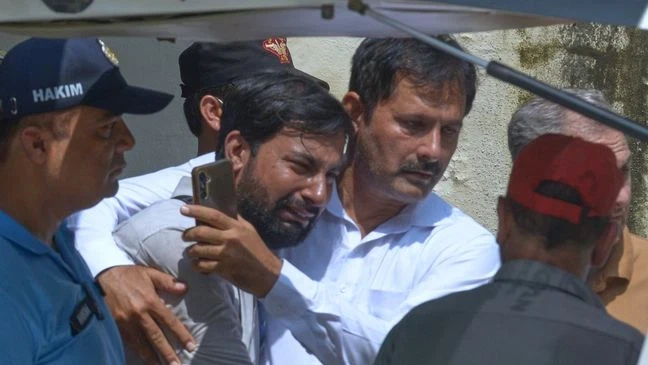
Kamran Riaz, whose niece was among the newborns killed, said his family learned of the fire by phone and rushed to the hospital, only to find themselves kept outside amid a heavy deployment of police and security personnel.
“You can see that there is a lot of security and police here,” Riaz said. “Then we were not allowed to go inside.”
Riaz said he wanted a full accounting of the safety arrangements in a nursery that held 50 to 60 children at the time of the fire. “So much fire has spread there. What were the security arrangements?” he said. “This is the question that should be asked from the team and the people present there. What did they do?”
He said he did not trust an internal government inquiry to deliver honest answers. “We demand that there should be a proper investigation and there should not be any members of the government involved,” he said. “There should be an unbiased and proper investigation.”
Another father, who had been visiting the ward for eight days and did not give his name to reporters, offered a starker account, alleging the ward lacked adequate escape routes.
“That building had no fire security, no proper exits,” he said. “All doors were closed, only one door was for us to visit our children. They kept the other doors locked because they feared we would come to see our children too often.” His account could not be independently verified.
Chauhan, the fire-safety professional, said staff had made an effort to save the infants. “They tried to save the children,” he said. “But they did not get a chance.”
Kamal offered a different account of one gate that has drawn scrutiny, saying it had been open to foot traffic four or five years ago but was secured after three newborns were abducted from the hospital roughly three years ago. Since then, he said, the gate had been staffed by security personnel and used as a controlled entry point. He said preliminary information indicated the gate had not impeded the evacuation, during which he said 400 to 450 people were moved out of the affected area, including four babies evacuated from a room adjacent to where the fire began.
AN AGING BUILDING, A SWELLING CITY
Pressed on why the ward lacked sprinklers, Kamal said the building, constructed in 1984, was not technically suited to accommodate them. He said the hospital was built when Islamabad’s population stood at roughly 350,000; the city is now home to an estimated 3.6 million people, and PIMS also draws patients from Khyber Pakhtunkhwa, Azad Jammu and Kashmir, and Gilgit-Baltistan.
He said the hospital once handled patient volumes tied to roughly 300 outpatient departments three decades ago; it now sees about 9,500 visitors daily, a figure that swells to roughly 50,000 when patients’ companions are included. Of the hospital’s 36 fire extinguishers, Kamal said, 22 were deployed during Wednesday’s fire, containing the blaze and preventing it from spreading to adjacent rooms.
Asked about the hospital’s history of safety lapses, including the deaths of four heatstroke patients in June 2023 amid air-conditioning failures and a July fire at the facility’s nursing hostel, Kamal said he could not speak to incidents that predated his tenure. He characterized the hostel fire as a minor incident involving a damaged sofa, saying a report had been filed and precautionary measures put in place.
He said he had remained in touch with Sharif throughout Wednesday, joining a briefing by video link while travelling from Karachi and going directly to the hospital after landing in Islamabad. He said the prime minister was “deeply disturbed” by the deaths, had summoned officials from relevant institutions for a preliminary report, and had raised the need to review fire-safety drills and training at Islamabad’s two federal hospitals.
Kamal was confronted by protesters while speaking to reporters outside the hospital earlier in the week and was forced to leave the premises.
OPPOSITION DEMANDS RESIGNATION
Pakistan Peoples Party Senator Sherry Rehman called on Kamal to resign, telling reporters the emergency department’s door had been locked, forcing people to break windows to get inside. “According to my information, doctors were not present,” Rehman said, calling the deaths of the newborns “extremely tragic.” She said her party had not come to the hospital to politicize the tragedy but felt obligated to press for answers. “The minister responsible should resign,” she said.
Fellow PPP leader Nayer Hussain Bokhari said responsibility extended beyond any single official, arguing the entire Health Ministry should answer for the fire and that removing one secretary would not be sufficient.
PUNJAB ORDERS PROVINCE-WIDE AUDIT
The fallout extended beyond Islamabad on Thursday, as Punjab Chief Minister Maryam Nawaz Sharif ordered a fresh, province-wide audit of public health facilities to be completed within 24 hours.
A letter from the chief minister’s office directed deputy commissioners to verify the availability and working condition of fire extinguishers at public hospitals and to assess, in consultation with Rescue 1122 emergency services, whether emergency exits were accessible and adequate. The directive also called on Rescue 1122 to evaluate hydrant points near health facilities and identify where new ones are needed, with one week allotted for necessary repairs and installations.
The order further mandates a full review of air-conditioning systems, electrical wiring, and medical equipment at hospitals, with compliance reports due by Aug. 29, and requires monthly emergency drills at health facilities going forward.
Maryam Nawaz also directed health officials and the Infrastructure Development Authority Punjab to prepare a feasibility study on installing fire alarms, smoke detectors, and sprinkler systems in intensive care units, nurseries, and emergency departments at hospitals across the province.
A PATTERN OF WARNINGS
The tragedy has renewed scrutiny of fire readiness across Islamabad, where a citywide survey completed earlier this year identified widespread gaps. The Capital Development Authority’s review of roughly 6,500 public and private buildings, including 300 government facilities, found that most lacked approved fire-safety plans or the certificates required to confirm compliance.
Islamabad has maintained fire-prevention and life-safety regulations since 2010. In January, after ordering inspections across the capital, the CDA reiterated that public and private buildings must maintain functioning emergency exits and warned owners who had not submitted required safety certificates that they could face enforcement action.
The capital has weathered a string of serious fires in recent years. A 2022 blaze at Islamabad’s Centaurus Mall triggered a mass evacuation and took roughly two hours to bring under control, drawing responders from the Pakistan Navy and Air Force alongside civilian fire crews; no deaths were reported. The city’s H-9 Sunday Bazaar has been especially fire-prone, with at least five major fires since 2017, including one in June that damaged more than 380 stalls and another in July 2024 that destroyed hundreds more.
For Chauhan, the losses at PIMS illustrated the gap between safety regulations on paper and readiness in practice. “We need to ensure safety,” he said. “We need to remove the mistakes that have been made. We need to conduct an inquiry.” He added: “We need to design and implement the fire safety system. We need to maintain it regularly.”
INTERNATIONAL REACTION, AND A SECOND RECENT TRAGEDY
UNICEF, the United Nations children’s agency, said it was saddened by the deaths and called for an urgent strengthening of fire-prevention standards at health facilities worldwide.
The Islamabad administration said six fire engines and four ambulances responded to Wednesday’s blaze, and State Minister for Interior Talal Chaudhry said rescue teams reached the scene within six minutes.
The fire ranks among the deadliest recent tragedies involving children in Pakistan. In June, 14 schoolchildren were killed in Lahore when the roof of a tutoring center under construction collapsed.
Copyright © 2021 Independent Pakistan | All rights reserved