By Staff Reporter
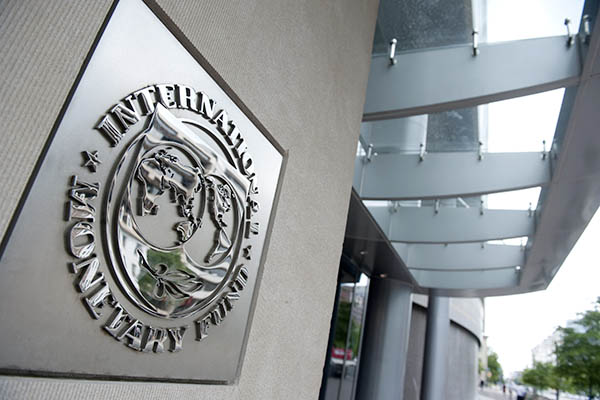
KARACHI: The International Monetary Fund lowered its economic growth projection for Pakistan to 3.5% for fiscal 2027 from a previous forecast of 4.1%, citing risks from the Middle East conflict, while raising its inflation outlook for the South Asian nation to 8.4% — the highest among major international forecasters.
In its World Economic Outlook report released on Tuesday on the sidelines of the IMF and World Bank spring meetings in Washington, the fund retained Pakistan’s growth forecast for the current fiscal year at 3.6%, in line with projections from the Asian Development Bank and Fitch Ratings. It also kept the current-year current-account deficit forecast at 0.4% of gross domestic product.
For fiscal 2027, the IMF more than doubled its current-account deficit projection to 0.9% of GDP, or roughly $5 billion. Inflation for the current fiscal year was revised up to 7.2% from 6.3%, while the fund sees it climbing to 8.4% next year from an earlier 7%. Pakistan, which sources about 90% of its energy imports from the Middle East, is among the countries most exposed to the fallout from the conflict that erupted at the end of February. The nation has played a prominent role in diplomatic efforts, hosting talks between the US and Iran aimed at brokering a peace deal.
Global growth risks recession
The war has forced the IMF to cut its global growth forecast for 2026 to 3.1% from 3.3% in January — and from an expected upgrade to 3.4% had hostilities not broken out. The fund left its 2027 projection unchanged at 3.2%. Global inflation is now seen at 4.4% this year, 0.6 percentage point higher than previously forecast. “Once again, the global economy is threatened with being thrown off course — this time by the outbreak of war in the Middle East at the end of February 2026,” the report said.
In a worst-case scenario in which oil, gas and food prices spike and stay elevated, global growth could drop below 2% in 2026 — “a close call for a global recession which has happened only four times since 1980,” the IMF said, with the most recent during the Covid-19 pandemic. The fund based its adverse and severe scenarios on oil prices ranging from $100 to $120 a barrel. In the most extreme conditions, it sees oil averaging $110 this year and $125 in 2027, with inflation climbing as high as 6% next year and forcing central banks to raise interest rates.
The conflict has already roiled energy markets. The Strait of Hormuz — a vital shipping route — has been effectively closed, and US President Donald Trump ordered a naval blockade of Iran’s ports. Oil prices surged after the outbreak, briefly approaching $120 a barrel, before easing to $98.85 on Tuesday.
IMF Chief Economist Pierre-Olivier Gourinchas said a prolonged conflict would lead to spiraling inflation, higher unemployment and food insecurity in some countries. Even if fighting stopped immediately, the disruption to oil supply would rival the 1970s oil crisis triggered by the Arab embargo during the Yom Kippur War, he told the BBC. Yet the global economy is now less dependent on oil and more efficient, providing some resilience, he added.
The fund cautioned that its baseline projections assume the conflict is short-lived and energy flows normalize by mid-year. If disruptions persist, growth could slow to 2.5% or even 2%.
Uneven pain across regions
The war’s impact is hitting the Middle East and Central Asia hardest, with the region’s 2026 growth forecast slashed by about half to 1.9%. Oil exporters face sharp slowdowns or outright contractions this year, though most are expected to rebound in 2027 assuming production normalises.
Iran’s economy is projected to shrink 6.1% in 2026 before rebounding 3.2% the following year. Qatar, whose Ras Laffan LNG facility was struck by Iranian missiles and drones, faces an 8.6% contraction this year followed by an 8.6% expansion in 2027. Iraq’s growth is expected to slow sharply by 6.8% this year before surging 11.3% in 2027. Saudi Arabia, the region’s largest economy, is still seen expanding 3.1% this year — 1.4 percentage points below January’s forecast — and 4.5% in 2027, aided by its East-West pipeline that can move up to 7 million barrels of oil a day to the Red Sea.
Among advanced economies, the UK is the hardest hit by the energy shock, with 2026 growth cut to 0.8% from 1.3%. The euro area was revised down 0.2 point to 1.1%. US growth is projected at 2.3%, still an acceleration though slightly lower than before; the world’s largest economy is seen benefiting marginally from higher energy prices even as gasoline costs rise for consumers. China’s expansion is now forecast at 4.4% this year, a touch below January’s 4.5%, with 4% unchanged for 2027.
Russia, by contrast, is one of the few beneficiaries. The fund raised its 2026 and 2027 growth forecasts to 1.1% each from 0.8% and 1%, respectively. That follows Trump’s decision in March to lift restrictions on Russian oil exports and temporarily ease sanctions on 140 million barrels of Iranian crude.
The IMF noted that resilience will vary by a country’s dependence on the Strait of Hormuz, damage to infrastructure and access to alternative export routes. It warned that forecasts for next year’s recovery among Middle East oil exporters “may need to be revised if the duration of the conflict extends and the degree of damage suffered gets reassessed.”
Copyright © 2021 Independent Pakistan | All rights reserved