By Staff Reporter
ISLAMABAD: Misinformation exploded across social media and seeped into mainstream reporting in the hours after a father-and-son duo inspired by Islamic State ideology carried out Australia’s deadliest mass shooting in nearly three decades, killing 15 people and wounding dozens at a Hanukkah celebration near Sydney’s Bondi Beach, complicating investigations and stoking ethnic tensions.
As details of the Dec. 14 attack emerged slowly from authorities, unverified claims proliferated online, falsely pinning the perpetrators’ origins on Pakistan and endangering innocent individuals. Social media platforms buzzed with speculation, with accounts from India, Afghanistan and some Israeli sources circulating photos of an unrelated Pakistani-Australian man named Naveed Akram — a different person running a business in New South Wales — and labeling him as one of the shooters.
This innocent man, who shares only a common South Asian name with the actual attacker, released videos pleading for the misinformation to stop, citing death threats and fear for his safety. Mainstream Indian and Afghan outlets amplified the errors. Some Indian media ran headlines claiming “Pakistani-origin” attackers, while the Jerusalem Post briefly linked them to Lahore before issuing corrections.
International reports added to the confusion, especially by Al-Jazeera, with early accounts citing unnamed US intelligence sources suggesting Pakistani ties — claims that were quickly debunked. Right-wing influencers and coordinated online campaigns, predominantly from India, seized on the name ‘Akram’ to fuel anti-Pakistan narratives amid longstanding regional tensions. False assertions included purported celebrations in Sydney’s Muslim communities, later debunked as footage from unrelated Christmas events, and doctored images purporting to show links to Pakistan.
Analysts pointed to this rapid disinformation as mirroring patterns seen in other high-profile incidents, where ethnic and religious biases drive premature conclusions, endangering diaspora communities and hindering official probes. The episode also underscored the perils of the digital age, where unverified narratives can outpace facts, amplifying Islamophobia and straining international relations.
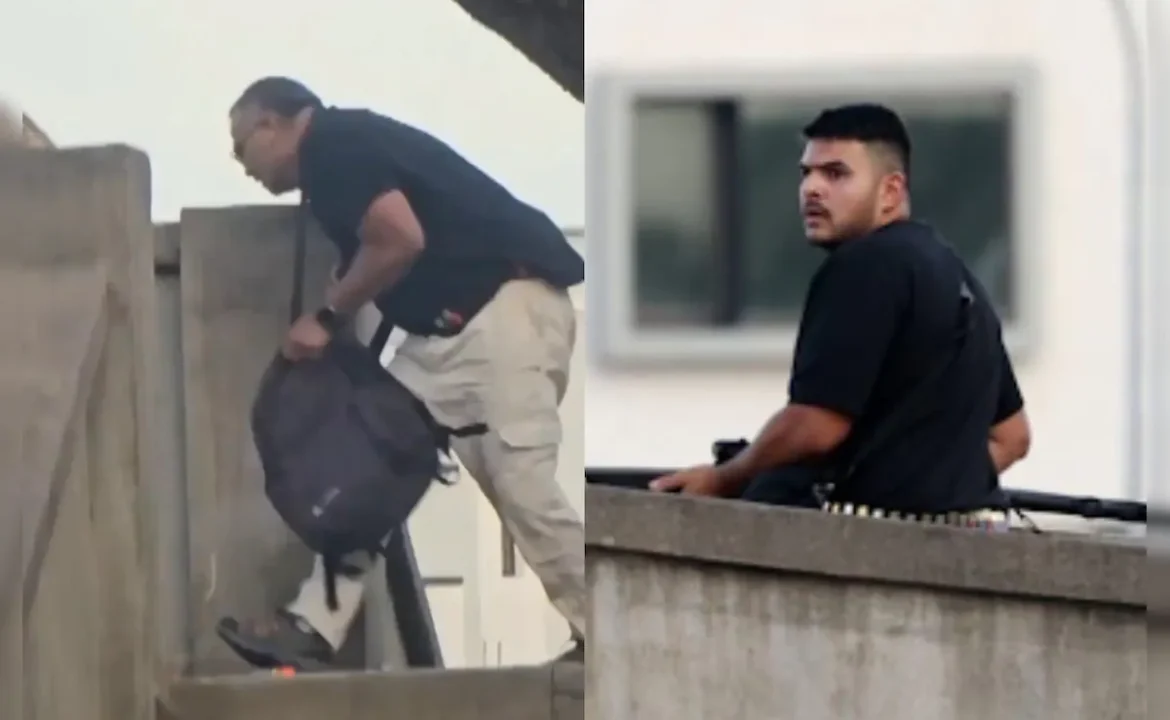
Australian authorities, meanwhile, are probing whether the attackers — identified as 50-year-old Sajid Akram and his 24-year-old son Naveed Akram — received terrorist training during a recent trip to the Philippines. The pair opened fire on a crowd of more than 1,000 at the “Chanukah by the Sea” event organised by Chabad of Bondi, in a roughly 10-minute killing spree that police have declared a terrorist incident.
Officers shot and killed Sajid at the scene, while Naveed was hospitalized in critical condition after being wounded. The death toll stands at 16, including Sajid, surpassing the scale of any mass shooting in Australia since the 1996 Port Arthur massacre that led to sweeping gun reforms. “Early indications point to a terrorist attack inspired by Islamic State, allegedly committed by a father and son,” Australian Federal Police Commissioner Krissy Barrett said at a news conference. “These are the alleged actions of those who have aligned themselves with a terrorist organisation, not a religion.” Police said the vehicle registered to Naveed contained improvised explosive devices and two homemade flags associated with ISIS, the militant group designated as a terrorist organization by Australia and many other countries.
Sajid, a native of the southern Indian city of Hyderabad, migrated to Australia in 1998 on a student visa after completing a commerce degree, according to a statement from Telangana state police on Tuesday. He retained Indian citizenship and an Indian passport, with limited family contact in recent years due to personal disputes. Naveed was born in Australia. Hyderabad is the capital of Telangana state.
“The family members have expressed no knowledge of his radical mindset or activities, nor of the circumstances that led to his radicalisation,” Telangana state police said in the statement. It added that Sajid visited India on six occasions, mainly for family-related reasons, since migrating, and there was no “adverse record” on him before he left. Telangana police stressed that the factors leading to the radicalisation of the two gunmen “appear to have no connection with India or any local influence in Telangana.”
The father and son spent nearly the entire month of November in the Philippines, arriving on Nov. 1 from Sydney with the southern province of Davao listed as their final destination, Manila’s immigration department confirmed. Sajid entered as an Indian national, while Naveed used an Australian passport. “Sajid Akram, 50, Indian national, and Naveed Akram, 24, Australian national, arrived in the Philippines together last November 1, 2025 from Sydney, Australia,” immigration spokeswoman Dana Sandoval told AFP, adding they departed on Nov. 28.
Australian police said the purpose of the trip is under investigation, and it’s not conclusive whether they were linked to any terrorist group or received training there. Philippines police are also investigating. Islamic State-linked networks operate in the Philippines, though reduced to weakened cells in the southern Mindanao island in recent years, far from their influence during the 2017 Marawi siege.
Australian Prime Minister Anthony Albanese attributed the attack to “Islamic State ideology.” “It would appear that this was motivated by Islamic State ideology,” Albanese told national broadcaster ABC. “With the rise of ISIS more than a decade ago now, the world has been grappling with extremism and this hateful ideology,” he said in a separate interview.
Albanese said Naveed, reportedly an unemployed bricklayer, came to the attention of Australia’s intelligence agency in 2019 but wasn’t deemed an imminent threat. “They interviewed him, they interviewed his family members, they interviewed people around him,” Albanese said. “He was not seen at that time to be a person of interest.” Gun laws are under fresh scrutiny in Australia, with police revealing Sajid was a licensed owner with six registered weapons, obtaining his license in 2023 — not 2015 as initially stated.
Ahmed al Ahmed, a 43-year-old Muslim father-of-two who charged at one of the gunmen and seized his rifle, remains in hospital with gunshot wounds. Hailed as a hero globally, including by US President Donald Trump, a GoFundMe for Ahmed has raised more than A$1.9 million ($1.26 million).
Copyright © 2021 Independent Pakistan | All rights reserved