By Staff Reporter
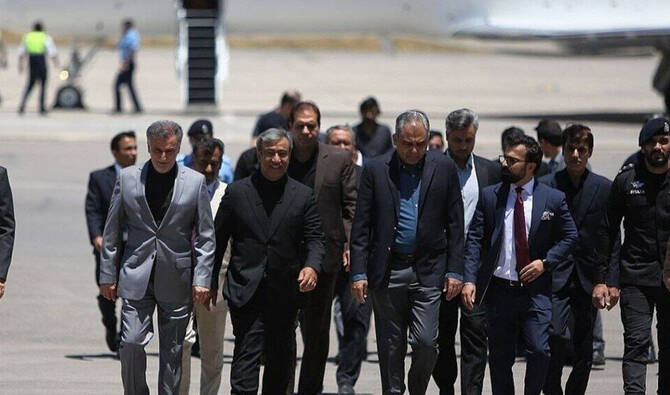
ISLAMABAD: Interior Minister Mohsin Naqvi flew to Iran on Saturday for a fresh round of high-stakes diplomacy, arriving in Mashhad as the fragile US-Iran peace deal he helped broker entered its most sensitive and consequential phase yet.
Naqvi’s visit — his latest in a series of shuttles between Islamabad and Tehran since the outbreak of US-Iran hostilities in late February — came at a moment of acute diplomatic anxiety. Swiss talks between American envoy Steve Witkoff and Iranian Foreign Minister Abbas Araghchi had been called off after Israel launched strikes on southern Lebanon, killing 32 people and violating a ceasefire reached only hours earlier. The violence cast a long shadow over the next phase of negotiations, even as both Washington and Tehran insisted their commitment to the broader framework remained intact.
Iran’s state-run Islamic Republic News Agency reported that Naqvi had arrived in Mashhad to visit the Imam Reza Shrine before travelling on to Tehran, where he was expected to hold separate meetings with Foreign Minister Araghchi and Interior Minister Eskandar Momeni. The agency said the visit was intended to “follow up on the progress of the negotiations between Iran and the United States.”
Iranian Foreign Ministry spokesman Esmaeil Baghaei told ISNA that Naqvi’s trip reflected Pakistan’s continuing effort to “bridge remaining differences” between Tehran and Washington and to sustain the momentum generated by the recently concluded understanding — the so-called Islamabad MoU, signed on 18 June.
A Pakistani official confirmed Naqvi’s departure to local media, though they declined to elaborate on the agenda, speaking only on condition of anonymity.
The agreement, whose signing was announced by Prime Minister Shehbaz Sharif, calls for the reopening of the Strait of Hormuz, the easing of restrictions on Iranian oil exports, and the launch of a 60-day process to negotiate a broader settlement of the long-running dispute over Iran’s nuclear programme. Sharif signed the document alongside US President Donald Trump, who put his signature to it at the Palace of Versailles — the same setting where the treaty ending the First World War was concluded — with French President Emmanuel Macron standing at his shoulder. Iranian President Masoud Pezeshkian signed separately in Tehran.
The deal marked a remarkable culmination of months of behind-the-scenes Pakistani diplomacy that began almost as soon as the US-Iran crisis erupted. Islamabad hosted rare direct talks between the two sides in April and worked to facilitate backchannel communications, coordinating its efforts with Saudi Arabia, Qatar, Turkey, Egypt and China in the process.
Diplomatic sources cited by ISNA described the upcoming technical negotiations as particularly delicate, with both sides required to address overlapping and politically charged questions around the nuclear programme, the lifting of sanctions, and the mechanisms by which both parties would verify each other’s compliance. Any final, legally binding agreement remains some way off, officials cautioned, and the risk of the process unravelling — whether through a fresh military incident or a breakdown in trust — is considered real.
Islamabad’s Saturday push was designed in part to guard against precisely that outcome, according to the ISNA report, with Naqvi’s presence intended to help prevent setbacks and maintain the delicate equilibrium achieved through months of painstaking engagement.
Pakistan’s role did not go unacknowledged in Washington. In a wide-ranging interview with Axios, President Trump offered an unambiguous assessment of Islamabad’s contribution, singling out both Prime Minister Sharif and Chief of Army Staff Field Marshal Asim Munir — whom Trump has previously called “my favourite” and a “great fighter” — for particular praise.
“In Pakistan, you have the field marshal, who is great. Munir, he’s great. And you have the prime minister, and they just get along great,” Trump told Axios. “He totally respects the prime minister. It’s a beautiful thing to see.” On the deal itself, he said: “They really helped us with this. They knew the Iranians, they knew the people and they were good.”
Copyright © 2021 Independent Pakistan | All rights reserved