By Staff Reporter
ISLAMABAD: Iran on Monday moved to quash speculation that China had stepped in as a mediator with the United States, insisting that Pakistan remains the principal channel for indirect contacts between Tehran and Washington, even as President Donald Trump accused the Islamic Republic of “duplicity” for denying that talks were taking place.
The clarification, delivered by Iranian foreign ministry spokesperson Esmail Baqaei at a televised briefing, capped a chaotic 24 hours in which Trump declared that negotiations with Iran would begin “this afternoon,” only for Tehran to insist no such meeting existed — triggering an angry outburst from the US president, who warned that a naval blockade of Iran would continue “until there is a Deal, or Total Surrender.”
The confusion underscored the fragility of a diplomatic process that has lurched between breakthrough and collapse since fighting between the two countries resumed last month, more than five months after Trump and Israel launched their war on Iran on 28 February.
Pakistan, not China, says Tehran
Addressing reports that Beijing had quietly assumed a mediating role over the Strait of Hormuz, Baqaei was unambiguous. “The mediator in the discussions related to Iran and the US is Pakistan, and Qatar also helps in cases where necessary,” he said.
He acknowledged that Iran maintained “very friendly relations” with China and worked closely with Beijing across a range of areas, and said China shared Tehran’s concerns about the deteriorating security situation in the region. But he stopped short of describing this as a mediating role. “China is also helping, like a number of other countries, but to say that we have added a new mediator to the existing mediators is not, in the strict sense of the word, the case,” he said.
The remarks came a day after Iranian foreign minister Seyed Abbas Araghchi held a second round of telephone talks in under 24 hours with Pakistan’s chief of defence forces, Field Marshal Syed Asim Munir, and Saudi foreign minister Prince Faisal bin Farhan, according to the state news agency IRNA. Pakistan’s deputy prime minister and foreign minister, Ishaq Dar, then spoke to Araghchi again on Monday, inviting him to visit Islamabad “at his earliest convenience,” Pakistan’s foreign office said. The two men discussed regional and international developments, it added, including the situation in Occupied East Jerusalem.
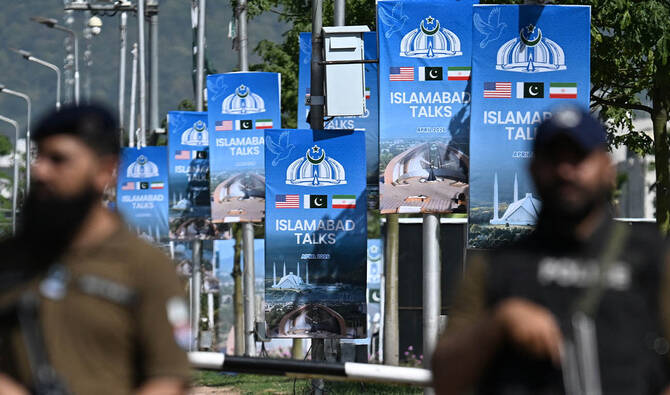
Islamabad’s role in the process has grown steadily since April, when it hosted the first direct US-Iran talks — the highest-level engagement between the two countries in years. Those discussions produced the Islamabad Memorandum of Understanding, signed in June, which set out a framework for negotiations covering Iran’s nuclear programme, regional security and freedom of navigation through Hormuz. A further round followed in Bürgenstock, Switzerland, also in June, with Pakistan and Qatar again serving as mediators; the two sides agreed there to set up a high-level committee, launch technical working groups, establish a direct communications channel to guard against incidents in the strait, and adopt a 60-day roadmap toward a wider settlement.
That roadmap came under severe strain when fighting flared again last month, and Pakistani government sources told the Anadolu news agency on Monday that no date or venue had yet been fixed for a resumption of direct talks. “There is no meeting [between US and Iranian negotiators] scheduled in Islamabad, at least in the next 24 hours,” one senior Pakistani official said, adding that Islamabad and Doha remained the likely venues once a date was agreed. Pakistan’s interior minister, Mohsin Naqvi, is expected to travel to Tehran within days to discuss reviving the process, the sources said, and any resumption is expected to begin with indirect contacts aimed at restoring the position that existed before 9 July, rather than tackling the nuclear file immediately.
Trump announces talks, Tehran denies them
The friction began at the weekend, when Trump told reporters aboard Air Force One that he had called off a planned military strike on Iran and that negotiations would resume on Monday afternoon, covering both the Strait of Hormuz and what he called Iran’s “denuclearisation.” He gave no details of venue or participants.
Trump said he had acted at the request of Iran and of Saudi Arabia, the United Arab Emirates and Qatar. “We were asked by the three primary groups. We were also asked by Iran very strongly,” he said. “They said we’d like to make a deal.” He described the operation he had shelved as one that would have been “the biggest attack since World War II” and said it would have taken Iran “many, many years” to rebuild. Asked whether the strikes would have targeted Iran’s energy infrastructure, he declined to say. Iranian media disputed his account, denying that Tehran had asked him to hold back.
By Monday, Baqaei was flatly contradicting the US president’s framing. “Iran is not currently holding talks with the United States and is now in discussions with Oman over a temporary safe route through the Strait of Hormuz,” he told the televised briefing, adding that there was no plan to send or receive any delegation “these days.”
Trump responded within hours on Truth Social, accusing Iran of being “duplicitous” for “openly and proudly” denying it was negotiating. “Whether Iran wants to admit it or not, we are, in fact, talking of a solution to a problem that they have caused, for decades,” he wrote. He insisted Iran had asked for talks — “some would say ‘beg'” — but was now offering “their usual blather” about control of Hormuz, which he said was “already completely controlled by the United States Navy and our ‘Blockade’ or, as some say, ‘The United States Wall of Steel!’ Nothing gets through to Iran, unless we want it to, and nothing will get through unless a Deal, or Total Surrender, is accomplished.”
Iranian lawmaker Hassan Ghashghavi, spokesman for parliament’s national security commission, offered a more measured account on Sunday, saying mediators were working to revive the June memorandum, which he stressed was never intended as a final peace settlement but as a stepping stone toward one. “They know that the main issue and, in fact, the key to the matter right now is the issue of the Strait of Hormuz, so yes, there is an exchange of views,” he said. Iranian president Masoud Pezeshkian struck a similarly cautious note on X, writing: “We must strive to compel the enemy to remain committed to what it has signed.”
A new route through Hormuz — but not a reopening
At the centre of the dispute is the Strait of Hormuz, through which around a fifth of the world’s oil and liquefied natural gas passed before the war. Iran largely closed the waterway once fighting began, insisting on retaining control and charging tolls — a demand Washington has rejected — and refusing to let vessels use any route other than one hugging the Iranian coastline. That impasse was a central trigger for the return to hostilities last month.
Baqaei said Monday that Tehran was close to an understanding with Oman, which sits on the strait’s opposite shore, over a new shipping corridor. “We are now going to reach an understanding on a route acceptable to both sides — neither the northern route nor the southern route — but one that respects the sovereign rights of both sides and safeguards our national interests and security,” he said, describing a single path with separate entry and exit lanes. He was emphatic, however, that this fell well short of reopening the strait, and repeated the point in Monday’s briefing: an Oman agreement would not be sufficient to reopen the waterway, he said, given that the situation would remain unchanged for as long as US “aggression” continued. “Under no circumstances will the Strait of Hormuz return to the situation before the war,” he said in a separate televised interview.
IRNA reported that Araghchi had described the Oman negotiations as being in their “final stages.” Baqaei stressed that the talks concerned only the new route and had “no link to the Strait of Hormuz being opened or closed. That is a separate discussion.” The proposal follows Iran’s rejection last month of an earlier Omani plan, backed by Gulf states, to jointly manage the strait — a scheme that people familiar with the matter told Reuters would have involved voluntary fees for vessels using the waterway.
A separate de-escalation formula, drafted by Pakistan and Qatar in consultation with regional partners, reportedly proposes that Iran reopen the strait fully while the US lifts its blockade of Iranian ports, with no transit fee charged until a final agreement is reached — though Pakistani sources cautioned this remains a proposal rather than an agreed outcome.
Markets react, tensions persist at sea
Oil markets responded swiftly to Trump’s weekend announcement. West Texas Intermediate crude fell 4.7 per cent to $80.72 a barrel at the opening of Asian trade on Monday, extending a decline of more than 4 per cent recorded earlier. Maritime tracking firm Kpler said traffic through Hormuz had fallen sharply in the run-up to the announcement.
The waterway remained a scene of continued incident despite the diplomatic overtures. Iran’s Revolutionary Guard aerospace force said it shot down a US MQ-9 Reaper drone over the strait on Monday, according to the Fars news agency. The UK Maritime Trade Operations centre reported an explosion early Monday near a tanker roughly 20 nautical miles northeast of the Omani town of Khasab, after the vessel’s master reported hearing a blast in close proximity; the ship and crew were said to be safe, and UKMTO urged vessels transiting the area to exercise caution and report suspicious activity. Separately, Greek shipping company GasLog said its LNG carrier GasLog Shanghai had been involved in an unspecified “incident” while exiting the strait on 31 July, but that the vessel was stable and everyone aboard safe and accounted for; the company said it had activated its emergency response plan and notified the relevant authorities. Ship-tracking data showed the vessel had since reappeared off Oman’s Musandam Peninsula.
Further south, Fars reported that at least six oil tankers had diverted from the Bab al-Mandab Strait toward the Cape of Good Hope to avoid attacks by Yemeni forces, a rerouting that, citing a Windward report, it said added $2 million to $2.5 million to transit costs.
Iraq’s state oil marketer, SOMO, has meanwhile offered steep discounts on August-loading Basrah crude to persuade buyers to lift cargoes from within the strait, according to a document reviewed by Reuters, with discounts of $25 to $27 a barrel on Basrah Medium and $27.80 to $29.80 on Basrah Heavy compared with relevant benchmarks, depending on the loading window. SOMO did not immediately respond to a request for comment.
CENTCOM seeks ‘unconventional’ options
Away from the diplomatic track, CNN reported Monday that a senior officer in the intelligence branch of US Central Command had emailed a broad group of military analysts last week seeking fresh ideas for pressuring Tehran. “We are looking for new creative and unconventional ways to pressure and punish Iran,” the officer wrote, according to a source familiar with the message. A second source said the crowdsourcing-style approach — unusual for a request conveyed by email, according to military officials — reflected an acknowledgement within CENTCOM that its strategy needed re-evaluation, and came as the limited options available to Trump for forcing a deal on his terms were increasingly seen as unpalatable.
CENTCOM spokesperson Captain Timothy Hawkins defended the approach in a statement: “US Central Command has a long history of thinking and working in innovative ways. Admiral Cooper, in particular, reaches out to members of our great team, regardless of rank, to achieve the highest levels of operational performance possible.”
More than five months after Trump and Israel launched their campaign against Iran — initially aimed at destroying its nuclear industry and missile programme, and at fostering a popular uprising against the government — none of those objectives has been realised. Iran retains the ability to fire missiles and drones at US and allied targets across the region, continues to hold its stockpiles of enriched uranium, and has used its disruption of shipping through Hormuz as significant leverage in the standoff, even as the resulting rise in energy prices has fed inflation and increased political pressure on Trump to find a negotiated exit.
Copyright © 2021 Independent Pakistan | All rights reserved