By Staff Reporter
ISLAMABAD: Iraq’s air force chief has signaled a desire to buy Pakistan’s JF-17 Thunder fighter jets, according to a military statement released on Saturday, as the two countries look to expand their defence relationship.
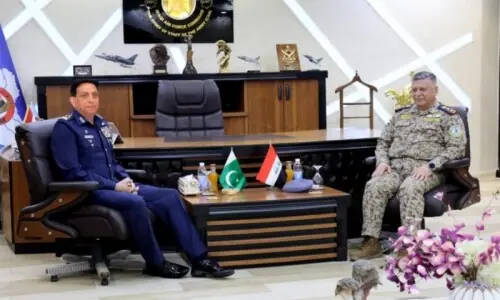
The comments came during a visit by Pakistan’s air force head, Air Chief Marshal Zaheer Ahmed Baber Sidhu, who met with his Iraqi counterpart, Lt. Gen. Staff Pilot Mohanad Ghalib Mohammed Radi Al-Asadi, at air force headquarters in Iraq. Sidhu arrived to a ceremonial guard, a gesture that reflected the goodwill between the two sides, the statement from Pakistan’s Inter-Services Public Relations said.
The talks centered on ways to build up ties through shared training programs, skill-building efforts and better coordination in operations. Sidhu spoke of the long-standing religious, cultural and historical connections between Pakistan and Iraq, and assured ongoing help from his force in bolstering Iraq’s training and growth. The two agreed to move forward with combined drills and other steps to make their air forces work together more smoothly.
“The Iraqi air chief praised PAF’s professionalism and technological advancement, expressed interest in benefiting from PAF’s world-class training and expressed keen interest in JF-17 Thunder fighter jets, Super Mushshak trainer aircraft,” the statement said. “He also appreciated Pakistan’s role in regional stability.”
The JF-17, built in partnership with China, is pitched by Pakistan as a budget-friendly fighter that can handle multiple roles, complete with support for upkeep and pilot preparation beyond typical Western options.
Iraq’s outreach follows a similar conversation this week between Sidhu and Bangladesh’s air force chief, Air Chief Marshal Hasan Mahmood Khan, in Islamabad, where they delved into possible buys of the JF-17. Other developments include talks between Pakistan and Saudi Arabia to turn about $2 billion in Saudi loans into a package that includes JF-17 jets. This builds on a defence agreement from last year that views an assault on one country as a threat to the other. Bloomberg has reported that Turkey is nearing an agreement to enter that pact, potentially reshaping security arrangements in the Middle East and extending their reach.
Pakistan’s defense exports have gained momentum since a clash with India in May of last year, when Pakistani officials said they brought down six Indian planes, among them French Rafales. India admitted to casualties but kept details sparse. The incident put a spotlight on how Chinese gear stacks up against Western models, drawing inquiries from other countries about Pakistan’s approach to air combat across various fronts.
Recent reports from Reuters indicate Pakistan is wrapping up a $1.5 billion sale of arms and aircraft to Sudan’s military, which is fighting rival paramilitaries. Last month, another Reuters story detailed a $4 billion deal with the Libyan National Army — one of Pakistan’s biggest exports yet — covering 16 JF-17 jets and 12 Super Mushshak trainers. The ISPR statement called the Iraq trip a sign of both air forces’ intent to tighten their partnership and work more closely.
Copyright © 2021 Independent Pakistan | All rights reserved