By Staff Reporter
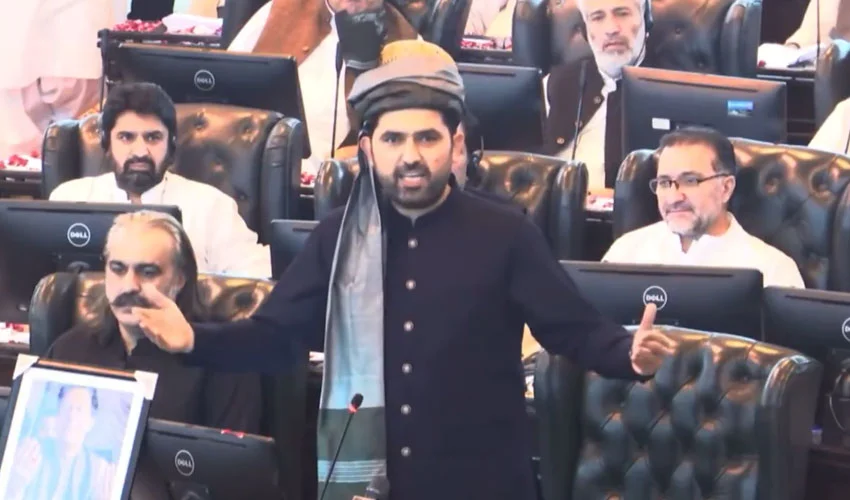
ISLAMABAD: An Islamabad court issued a non-bailable arrest warrant for Khyber Pakhtunkhwa Chief Minister Sohail Afridi on Wednesday after he failed to appear in a case accusing him of making misleading statements against state institutions.
Senior Civil Judge Abbas Shah presided over the hearing noted that Afridi had ignored repeated summons without justification. The judge ordered authorities to arrest the chief minister and produce him in court.
The case, registered with the National Cyber Crime Investigation Authority (NCCIA) under the Prevention of Electronic Crimes Act (PECA), based on comments Afridi made in November alleging that security forces in Khyber Pakhtunkhwa would bring dogs into mosques and tie them down, violating the sanctity of the sites. The hearing was adjourned until Feb. 10. This marks the second time the court has issued such a warrant against Afridi in the case. At a previous hearing on Jan. 4, Judge Shah had similarly ordered his arrest, saying the chief minister’s persistent absences was a deliberate effort to evade proceedings despite multiple opportunities to respond to the allegations.
The case against Afridi was triggered by his remarks during a media interaction outside Adiala jail on Nov. 6, 2025, which drew widespread condemnation. A first information report (FIR) was filed on Nov. 9 on behalf of the state, invoking Sections 11, 20 and 26-A of PECA. The FIR alleged that Afridi and others had “knowingly and deliberately, with mala fide intentions and ulterior motives, uttered false, misleading, derogatory and intimidating words against state institutions,” which were recorded, disseminated and propagated through social media platforms, including the Pakistan Tehreek-e-Insaf (PTI) party’s YouTube channel.
It specifically referenced a video on the channel where Afridi made statements “containing offensive, profane, false, misleading and unfounded allegations, with the intent to malign, defame and cause harm to the reputation and integrity of the state institutions of Pakistan.” The document further claimed the content was part of an “organised attempt to undermine public trust on state institutions, including racial hatred, create unrest in the country and destabilise national security.”
Afridi was also accused in the FIR of “preparing, publishing, sharing and circulating fake and misleading contents publicly on social media with the intention to incite violence, create racial hatred, panic, fear, disorder and unrest among the general public along with promoting anti-state sentiments, which is detrimental to the security, integrity and stability of Pakistan.”
The NCCIA’s involvement followed an inquiry on Nov. 8 that concluded the statements were false and intended to harm institutional reputations. Beyond the cybercrime proceedings, Afridi faces separate charges in an anti-terrorism court related to his alleged role in a Nov. 26 protest in Islamabad. He is also under scrutiny by the Election Commission of Pakistan (ECP) for an alleged violation of the code of conduct during a recent by-election for a National Assembly seat in Khyber Pakhtunkhwa.
On Tuesday, the Peshawar High Court (PHC) restrained the ECP from taking any final action against Afridi in that matter. A two-member bench, comprising Justice Syed Arshad Ali and Justice Faheem Wali, heard a writ petition filed by the chief minister. His counsel, Bashir Khan Wazir, argued that the ECP had issued a notice over a speech Afridi delivered during a public gathering, accusing him of threatening government officials.
The lawyer contended that the speech occurred outside the by-election constituency in Haripur and was part of a province-wide tour to announce development projects. During the hearing, Justice Arshad Ali inquired whether the ECP’s decision had been received, and the counsel confirmed it had, presenting it via a supplementary application. The court then summoned the ECP’s record and briefly adjourned the session.
Copyright © 2021 Independent Pakistan | All rights reserved