By Staff Reporter
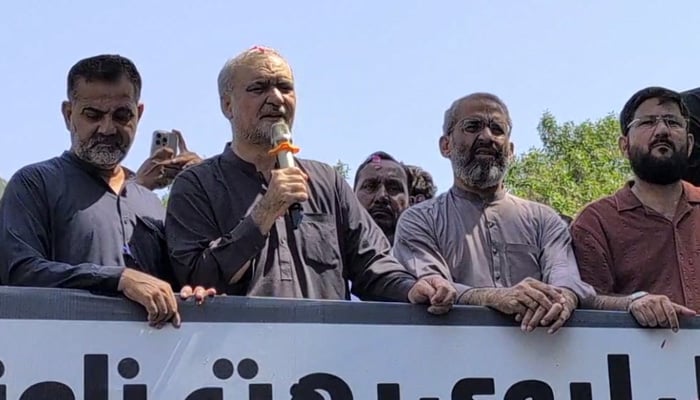
KARACHI: Hafiz Naeemur Rehman, the leader of Jamaat-i-Islami, boarded a train at Cantonment Station on Sunday bound for Islamabad, opening a march that he warned could grow from a protest over fuel taxes into an effort to bring down the government.
“When we reach Islamabad, it’s not guaranteed that the situation would remain under control,” Rehman told supporters before departure, adding that any attempt to suppress the movement would push events beyond anyone’s control.
The march is the latest and most serious escalation in a five-week campaign against the petroleum levy, the tax on fuel that Pakistan introduced under its loan program with the International Monetary Fund. Rehman called the Islamabad march the party’s “final call,” and said the government had one option left: provide relief.
The confrontation arrives at an awkward moment for Prime Minister Shehbaz Sharif’s government, which has also braced for a separate demonstration by Imran Khan’s Pakistan Tehreek-e-Insaf party on Sept. 27, demanding the jailed former prime minister’s release. Both parties have refused the government’s requests to postpone, and Rehman has said his party is in contact with the PTI, whose supporters have backed the Jamaat-i-Islami march.
Fuel prices and the levy
Petrol and diesel prices have jumped since the summer because of energy supply disruptions in the Strait of Hormuz, linked to the ongoing conflict between the United States and Iran. Planning Minister Ahsan Iqbal has said prices fell when relations between Washington and Tehran improved and had to rise again when tensions escalated.
Taxes on petrol stood at 114 rupees per liter and on diesel at 100 rupees, including an 80-rupee levy on petrol and a 77.28-rupee levy on diesel, plus a 5-rupee climate support charge on both fuels. Rehman puts the combined burden of customs duty, the climate levy and the petroleum levy at 106 to 107 rupees a liter, and said the government was collecting more from the levy than its budget target. In a separate statement this week, he said the levy raised 1.567 trillion rupees a year while the government had announced only 25 billion rupees in relief.
Rehman said abolishing the levy would bring petrol down to roughly 200 rupees a liter and let the economy move forward. He asserted that Pakistan had raised fuel prices more sharply than any other state in the region.
A relief plan and talks that went nowhere
Government and party officials began talks on Sept. 7 after the party’s strikes and sit-ins, and the party says it has sat through five rounds with no settlement. At the outset, Iqbal said the government would “be happy to take any steps” in light of workable proposals, but the government’s negotiators pointed to the benchmarks set by the IMF as limits on how far it could adjust unilaterally.
Rehman rejected the government’s special fuel relief scheme, saying it could not substitute for scrapping the levy. He criticized its eligibility rules, which he said would leave many motorcycle owners outside the program, and said those who qualified would receive 500 rupees a week. He also complained there was no relief on diesel, which he said drives the country’s economic activity.
On Saturday, a government delegation that included Iqbal, Rana Sanaullah, and Salman Rafique traveled to the party’s Mansoorah headquarters in Lahore. Officials asked the party to postpone the march because of security threats, according to accounts of the meeting. Liaquat Baloch, a senior Jamaat-i-Islami leader, said the march would remain necessary until the levy was withdrawn.
The route
Sunday’s train is scheduled to stop at Hyderabad, Tando Adam, Nawabshah, and Mehrabpur before Rehman addresses a rally in Rohri, in Sukkur district, Sunday evening. Rehman said a road caravan also left for the capital, and that convoys from Khyber Pakhtunkhwa, Balochistan, and Sindh would join. The rail leg ends in Multan on Monday. A road caravan will then travel to Lahore on Sept. 22, with the last stretch to Islamabad beginning Sept. 23. Marchers are expected in the capital on Sept. 23 and 24, and the party has said D-Chowk, the traditional protest ground near the Red Zone, is its intended destination.
Rehman said supporters would begin arriving from all directions as early as Sunday, but said the party would not block roads. “We are coming to get relief, not to lay hands on anyone,” he said Friday, adding that the party had asked the government for permission for the protest.
Islamabad braces
Authorities have not waited. According to local media about 600 shipping containers had been brought into Islamabad and officials aimed to deploy up to 1,000 at key locations. Access to the Red Zone through D-Chowk has been sealed. Police leave has been canceled, hospitals were placed on emergency footing, and Rangers and army personnel have been deployed, with four separate protest calls set to converge on the twin cities between Sept. 20 and 27.
The precautions reflect the memory of the PTI’s November 2024 march on D-Chowk, which ended in violence and thousands of arrests. Government lawyers have argued in court that officials can take precautionary measures such as imposing Section 144, which bans public gatherings, and placing containers, but “cannot fire upon our citizens.”
Rehman’s argument
Rehman cast the march as a fight for ordinary Pakistanis, not the party. “We are not going to Islamabad for ourselves or for the party,” he said, but for the country’s 250 million people. He accused the government of making the nation “pay for its bad governance” and said it “wants to rob the common people in times of crisis.”
He also criticized the government’s part in agreements with independent power producers, saying its representatives were present when the arrangements were made. Rehman asked why the government had not terminated the contracts, saying agreements could be canceled in wartime.
Rehman noted the party had not chosen to protest in extreme heat. “We have no desire to protest in extreme heat,” he said, adding that the government had left people with no alternative.
Copyright © 2021 Independent Pakistan | All rights reserved