By Staff Reporter
ISLAMABAD: Pakistan’s finance minister warned that a wave of planned protests could cost the economy about 120 billion rupees a day, as the government tries to head off marches on the capital by two opposition groups and a farmers’ alliance.
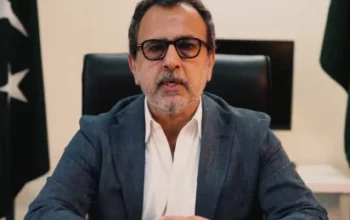
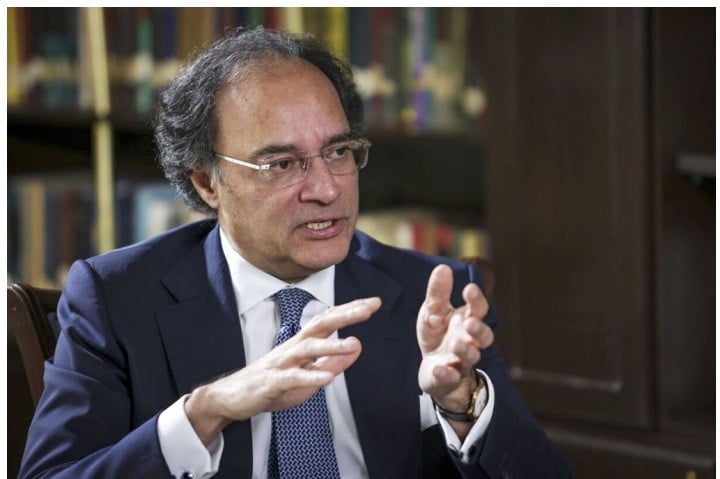
Muhammad Aurangzeb called the disruption “self-inflicted pain” in a recorded televised message on Sunday, saying the estimate came from the economic wing of the Planning Commission and was “based on very good research.” He said the country was trying to protect hard-won macroeconomic stability as it moves toward growth.
The warning comes a week before Imran Khan’s Pakistan Tehreek-e-Insaf party stages a nationwide protest on Sept. 27 to demand the jailed founder’s release and what it calls the supremacy of the Constitution. The party plans to march toward Islamabad and has turned down a government request to postpone. Jamaat-e-Islami set off from Karachi on Sunday on its own march to press for the abolition of a petroleum levy, and the Kissan Ittehad farmers’ alliance has announced a march for Sept. 25.
Cost Estimate
Aurangzeb put the largest share of the daily loss, about Rs86 billion, on the services sector, including financial services, communications, retail, transport, wholesale and hospitality. Industry would lose about Rs25 billion, covering construction, finished goods, raw materials and supply chains, and agriculture about Rs9 billion. He estimated a further Rs17 billion in lost government revenue.
The minister also pointed to the cost to the exchequer of logistics, transport, fuel and security deployments used to respond to earlier protests. He said the burden would ultimately fall on laborers, small traders and daily-wage earners.
Aurangzeb said recovery from disruption can be slow. A strike in December 2025 took 1.5 months to recover from, he said, and he cited a similar episode in August.
He warned that goods exports, which run at an average of about $90 million a day, could fall by as much as 50% in a worst-case scenario. Information technology exports, which reached $811 million in July and August, are particularly exposed to any disruption of internet connectivity. Aurangzeb said such disruptions had cut IT exports by as much as 80% in the past.
Fragile Gains
The protests come as Pakistan is seeking to consolidate an economic recovery after years of crisis. The State Bank of Pakistan’s reserves reached a record $21.4 billion in the week ended Sept. 11, boosted by about $3 billion raised in the country’s largest single Eurobond sale. Total liquid reserves, including commercial banks’ holdings, stood at $26.8 billion.
The economy grew 3.7% in the fiscal year ended June 30, and the government says it will exceed 4% this year. The fiscal deficit narrowed to 2.6% of gross domestic product in fiscal 2026, the lowest in 22 years. Aurangzeb said tax revenue has risen about 40% over two years. The current account deficit narrowed to $543 million in July-August from $853 million a year earlier, supported by remittances of about $7.3 billion.
Aurangzeb cited foreign direct investment of $311 million for August. State Bank data compiled by Topline Securities show net FDI of $316 million for the month and $495 million for July-August. He described economic stability as “basic hygiene” that comes first, followed by domestic investor confidence and then foreign investment.
Aurangzeb also cited 11 initial public offerings last year against five in the first two months of the current one, as a sign of investor confidence.
The government has set a goods export target of $32.9 billion for the year, and Aurangzeb said it expects about 6% growth. The government is also contending with the fallout of the Middle East conflict, which he said has disrupted supply chains and raised freight and insurance costs. He also cited a fresh wave of terrorism, including last week’s attack on a police compound in Kohat that killed at least 31 people, and said the army and civil armed forces were confronting the militants.
“This is very hard-earned macroeconomic stability, and now we are moving towards growth,” Aurangzeb said. “There were very difficult decisions, and our economy, after a long time, is now back on track.” He urged the parties to “sit together” and resolve their differences through dialogue.
Government Response
Information Minister Attaullah Tarar said later Sunday that “no violent group will be allowed to reach Islamabad,” and that the administration, police and interior minister were “absolutely clear” on the matter. He pointed to a Sept. 14 Islamabad High Court order that held no political party or leader has the right to occupy public roads, highways, interchanges, toll plazas or buildings in the capital, or obstruct citizens’ free movement.
Interior Minister Mohsin Naqvi said on Friday that the government would stop anyone from marching on the capital “in every possible way.” Authorities in Islamabad and neighboring Rawalpindi have already begun preparations, including seeking the detention of activists, arranging shipping containers, requesting additional personnel and procuring anti-riot gear. Hundreds of containers have been placed at entry points to the capital.
Jamaat-e-Islami chief Hafiz Naeemur Rehman said at Karachi’s Cantonment Station that the march could turn into a campaign to oust the government if the petroleum levy isn’t withdrawn. The government levies Rs114 a liter in taxes and duties on petrol and Rs100 on diesel, and five rounds of talks with the party have failed to end its protests. The party has staged sit-ins in dozens of cities since Aug. 16, and its convoy is due in Islamabad on Sept. 23-24.
Copyright © 2021 Independent Pakistan | All rights reserved