By Staff Reporter
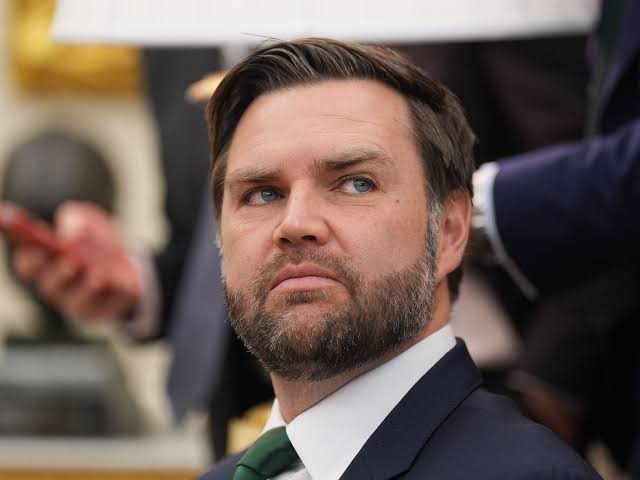
JD Vance spent three hours in conversation with Joe Rogan this week and used it to say something that should be leading every American newspaper rather than trailing behind headlines about Jeffrey Epstein: that people within the Israeli government have been running a funded operation to sabotage the peace process he personally led, and to turn American public opinion against him for pursuing it. Asked what he thought of the people behind it, the vice president of the United States did not equivocate. “Go to hell,” he said. “I’m going to do what I have to do for the American people. I represent Americans first.”
That sentence, from that office, describing that target, is the story. Not a colourful aside in a three-hour podcast. Not one more round in a familiar argument about the Middle East. A senior US official has said, in public and on the record, that an allied government funded a campaign to undermine his diplomacy while Americans were dying in the war it concerned — and Washington’s response so far has been closer to a shrug than a reckoning.
What Vance actually said
Vance was direct about what he knows and how he knows it. “I know beyond a shadow of a doubt that there have been people within the Israeli government who are trying to, like, actually shift us away from that policy because they want to continue the military campaign,” he told Rogan. He named the mechanism without hedging: leaks to journalists, coordinated social media attacks, an operation he called “very discreet, extremely well-funded” and built specifically to derail the negotiation he was running on the president’s instructions.
He was responding to reporting by Time magazine, published two days before the interview, which found that Brad Parscale — Donald Trump’s former campaign manager, now running the digital operation Clock Tower X — was retained last September, according to Foreign Agents Registration Act filings, to run an influence campaign on behalf of Israel. A hundred pieces of content a month, targeted overwhelmingly at younger Americans on TikTok, YouTube, Instagram and podcasts. An Israeli Foreign Ministry official told Time plainly what the campaign was actually for: “preventing young conservatives from turning against Israel.” Payment for participating influencers, in comparable operations Time cited, ran to a base fee plus per-view bonuses worth up to several thousand dollars a post.
Vance said people paid through this apparatus turned around and attacked him personally — accusing him of taking orders from Qatar, from Tucker Carlson, from anyone but the president he serves, while he was trying to close the deal Trump had authorised him to negotiate. “People are attacking me viciously for quite literally trying to accomplish the negotiation objective that the president set for the country,” he said. This is what a sitting vice president is describing: a foreign government’s funded operation, working to turn his own political base against him, while he tried to end a war.
Why “go to hell” is the right response, not an overreaction
There will be an instinct, in some quarters, to soften this into something more familiar and less alarming — foreign governments lobby Washington all the time, the argument goes, so what is Vance really objecting to? Vance preempted that framing himself, and it is worth taking his distinction seriously rather than collapsing it. Ordinary lobbying does not bother him, he said plainly: “Israel does it, other countries do it.” What he is describing is different in kind, not degree — a foreign-funded operation that, in his account, moved from persuasion into manufacturing the appearance of grassroots American opposition to a policy his own president had already set, and into personal attacks on the official trying to carry it out. “What does bother me is when those operations, those influence campaigns, actually affect American political judgment,” he said. That is not a man confused about the difference between an ally making its case and an ally working to sabotage his diplomacy. It is a man who has drawn that line clearly and is telling people they crossed it.
Parscale disputes the sharpest version of the charge. “I have never funded, organized, or participated in any effort to undermine President Trump — ever — including his MOU or ceasefire proposal,” he told Time, insisting the Israel-linked, FARA-registered funds never went directly to influencers. Weigh that denial against what his own operation was built to do. A hundred pieces of monthly content, aimed at the exact demographic — young, online, increasingly sceptical of Israel — whose drift was the stated reason the campaign existed in the first place, running at the precise moment Vance was trying to close a deal Israel’s government did not want closed. A denial that no invoice says “attack Vance’s negotiation” is not much of a defence when the entire machine was built to shape opinion on exactly the question his negotiation sat inside. Vance did not have to prove a paper trail to conclude, correctly, that a foreign-funded operation engineered to keep young Americans onside for Israel was always going to end up doing what it appears to have done to him personally.
Former Israeli diplomat Alon Pinkas, now a columnist, called Vance’s remarks “unprecedented” — noting that no sitting US vice president has ever accused Israel of openly running a campaign to undermine American policy. “There have been disagreements in the past, there has been friction,” Pinkas said. “But for a sitting vice president to come out so vociferously, clearly, and crudely against an Israeli influence campaign against the US is truly unprecedented. It is quite shocking.” That assessment comes from inside Israel’s own foreign policy establishment, not from a Washington critic looking for ammunition. When Pinkas calls it shocking, the appropriate response in Washington is not to move on by the weekend.
The Epstein remarks that shouldn’t have overshadowed this
The same interview produced a second set of claims that dominated the American press coverage instead: Vance asserting that Jeffrey Epstein “clearly had connections to the highest levels” of both American and Israeli intelligence, and suggesting — apparently in reference to Epstein’s documented relationship with former Israeli prime minister Ehud Barak — that Epstein was connected to “elements of the Israeli deep state that were left of centre,” which he said he found “fascinating.”
These claims deserve considerably more scrutiny than Vance gave them himself. On the available reporting they are unproven — Vance offered no evidence and no source, and did not specify what “connections” means in intelligence terms, which is exactly the kind of vagueness that lets speculation calcify into accepted fact when repeated by senior officials on large platforms. That the vice president volunteered this, unprompted by any question requiring it, in the same conversation where he was making a far more serious and substantiated charge, is itself worth noting. Whichever the reason, the effect was to hand the American press a more sensational headline than the one that actually mattered, and the foreign-funded operation working against a live peace process ended up as the secondary story instead of the lead.
Why Vance went on Rogan, and why that matters
Al Jazeera’s Washington correspondent Patty Culhane offered the most plausible reading of Vance’s choice of venue: Rogan reaches exactly the young, largely male, right-leaning audience that Parscale’s campaign was built to hold onto for Israel, and that Vance will need if he runs for president himself. “That explains why Vance went on the Joe Rogan podcast,” Culhane said. “[Rogan is] one of the most popular podcasters in the country and is very much a key voice in influencing the young men that make up the MAGA base.” Read that way, Vance was not simply describing an influence operation. He was contesting the same audience it was built to hold, on the same platform where that fight is actually happening.
That reframes the episode entirely. This is not a diplomatic disagreement being aired unusually loudly. It is a foreign-funded campaign to shape the opinion of young American conservatives, and the vice president of the United States going directly to that same audience to say so, by name, in terms sharp enough that a former Israeli diplomat called them unprecedented. Support for Israel among younger Americans on the right has been sliding for some time, through the war in Gaza, the campaign against Hezbollah, and now Iran. A funded operation built to arrest that slide, if Vance’s account holds, has instead produced a public accusation from the second-highest office in the US government. That is not a sign the operation succeeded.
What happens now
The Israeli Prime Minister’s Office has said nothing since Vance’s remarks aired. That silence will not last, and how it eventually breaks — an outright denial, a quiet walking-back, or nothing at all — will say a great deal about whether Jerusalem takes the charge seriously or is simply waiting for the news cycle to move on to Epstein instead.
It should not be allowed to. A sitting vice president, in the middle of a live war, has said on the record that a foreign government funded an operation to turn Americans against his own diplomacy and against him personally, and told the people behind it to go to hell. Washington has treated remarks like that, from officials at this level, as effectively unsayable for decades. Vance said it anyway. The question now is whether anyone in Washington, or anywhere else, is prepared to follow up on it — or whether a genuinely serious allegation gets buried under the more sensational story sitting next to it in the same interview.
Copyright © 2021 Independent Pakistan | All rights reserved